History of Crimean Winemaking
In the history of Crimean winemaking and viticulture, there is a period little known to the general public when the coordination center of its development was located in Kherson.
In the history of Crimean winemaking and viticulture, there is a period little known to the general public when the coordination center of its development was located in Kherson.
We are talking about the years 1957-1960, when industrial enterprises of the Kherson, Mykolaiv, and Crimean Oblasts were united into a single Kherson Economic Administrative Region (HEAR). Similar regions were created throughout the Soviet Union; they were headed by councils of national economy (sovnarkhozes), which performed the functions of the liquidated line ministries.
At the same time, the budget rights of the republics were expanded, meaning the lion's share of Ukrainian money remained in the Ukrainian SSR. The Crimean Oblast, whose economy was in a catastrophic state, began to receive huge injections from the republican budget, including for the rise of its winemaking industry. The state and collective farms of the "Massandra" winemaking combine, the Crimean Winemaking Trust, and the Simferopol Distillery were then under the jurisdiction of the Kherson Economic Council.
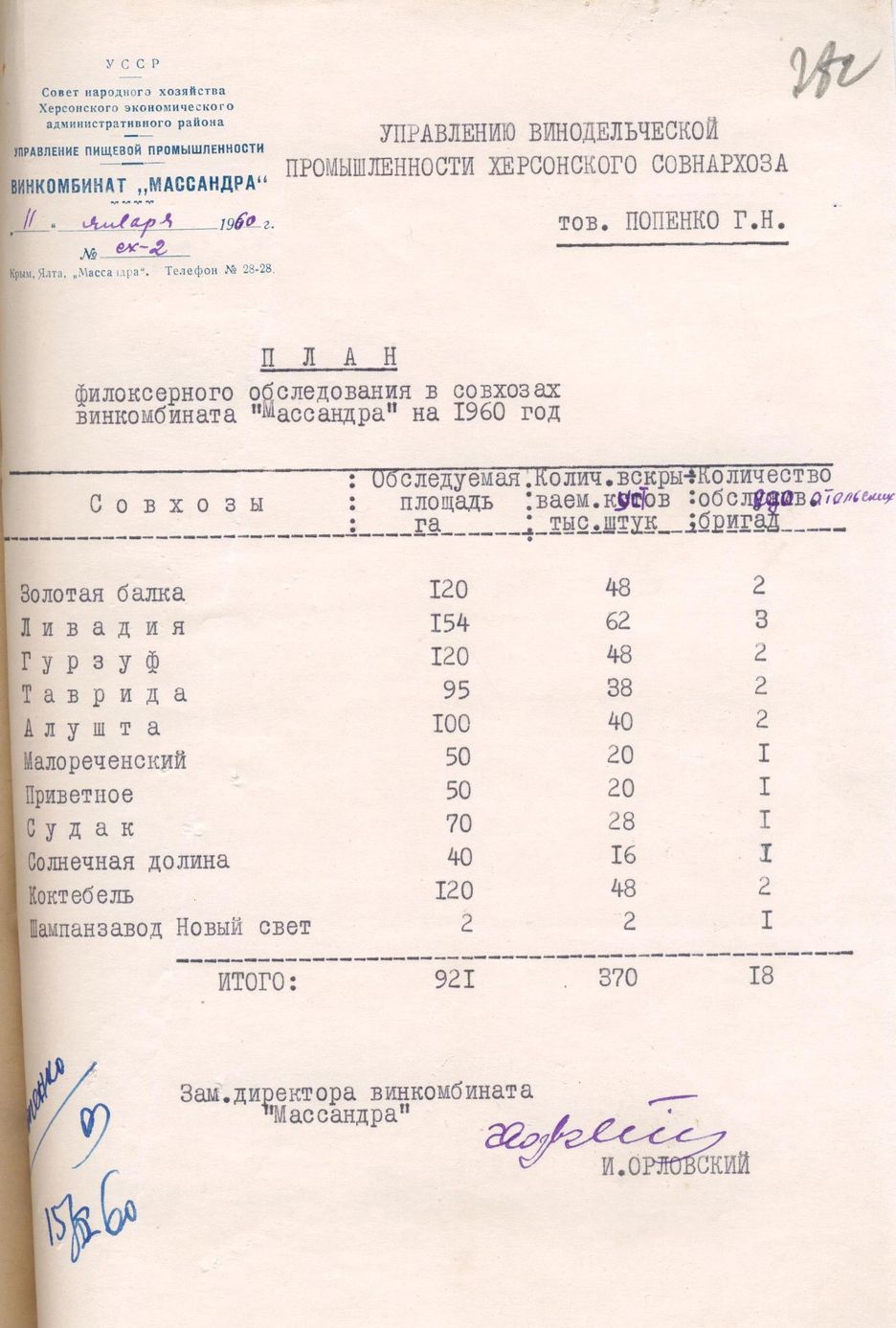
State Archive of Kherson Oblast, F. R-3266, Op. 9, File 41, Sheet 282.
During those years, through joint efforts, it was possible to plant 128,000 hectares of vineyards on the peninsula (more than in the entire previous history of Crimea) and reach the figure of 152.5 thousand hectares in 1960 (9 times more compared to 1955). In parallel, the scientific research identification and refinement of the optimal grape assortment depending on natural zoning was carried out; at that time, about 70 pure varieties were recommended for the Crimean Oblast. Preparations began for the creation of the Sevastopol winemaking combine "Zolota Balka" specializing in the production of sparkling wines. The planting of windbreaks and orchards of fruit, nut, almond, and dogwood species in the winemaking economies was designed.
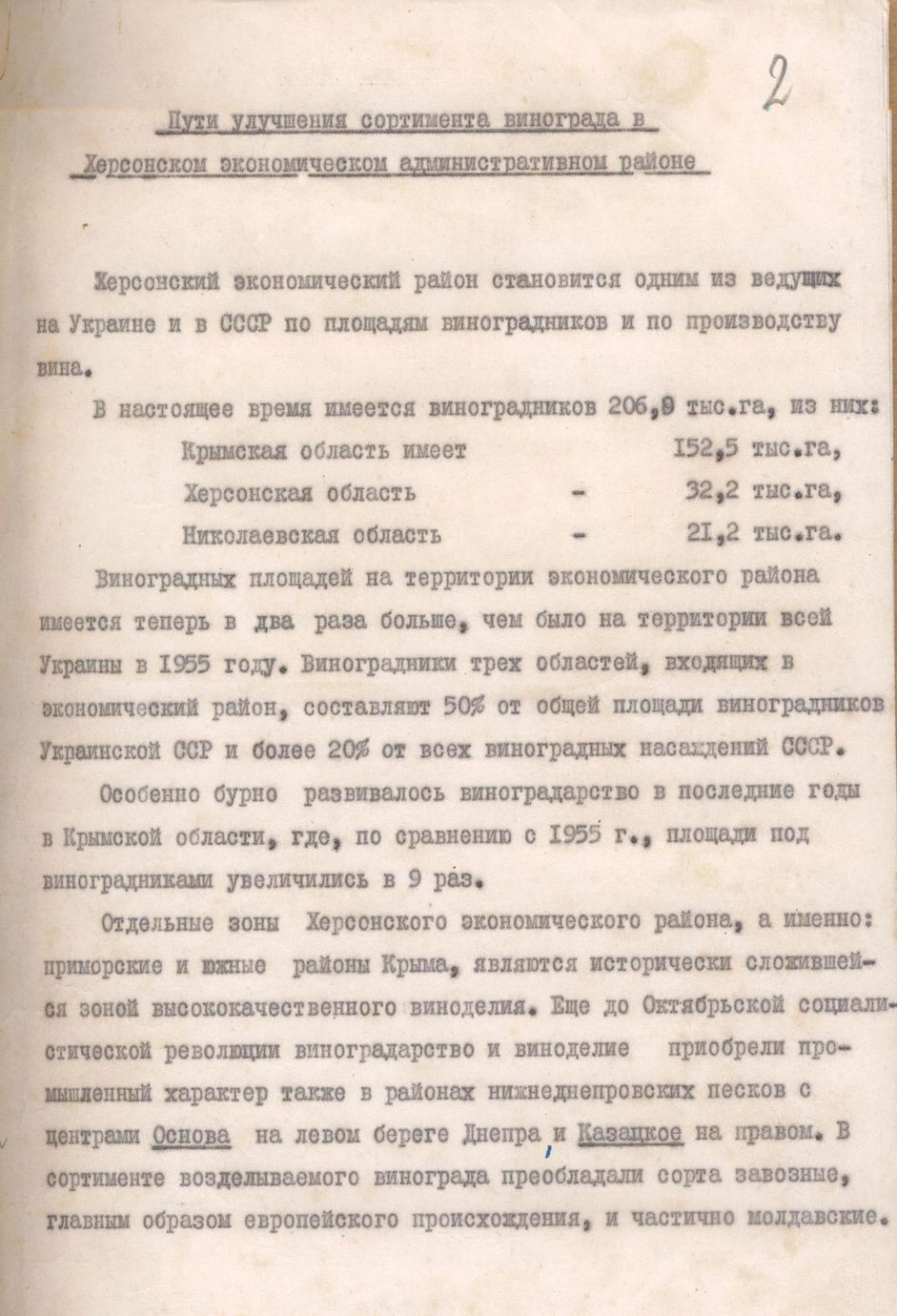
State Archive of Kherson Oblast, F. R-3266, Op. 9, File 28, Sheet 2.
From June 1, 1960, the peninsula's industry fell under the jurisdiction of the newly created Crimean Economic Council. For a number of reasons, the positive effect of the economic councils did not last long, but it was during this period that Ukraine finally managed to overcome the post-war decline of the Crimean Oblast and begin moving forward. Documentary evidence of the "Kherson" period of Crimea's economic development is partially preserved in the holdings of the State Archive of Kherson Oblast.