The Mystery of the "Admiral Nakhimov"
The connection of nuclear testing in the Soviet Union and the fate of the cruiser "Admiral Nakhimov".
Valeriy Verkhovskyi. Newspaper "Krymska Svitlytsia", 2018, Issue No. 45
Of course, everyone knows that sparsely populated areas in the east of Kazakhstan, the Novaya Zemlya islands in the Arctic Ocean, and the Totsky test site were designated for nuclear testing in the evil empire. Underground nuclear explosions for "peaceful purposes" were carried out in the USSR 124 times, including twice in Ukraine (in 1972 in Kharkiv Oblast and in Yenakiieve in 1979). However, for almost three decades now, information has surfaced from time to time that a nuclear weapon test did take place once in the Black Sea near the Crimean Peninsula.
At least, sailor and journalist Vitaliy Kostrychenko, as well as the president of the Sevastopol "Marine Assembly," retired Captain 2nd Rank Volodymyr Stefanovskyi, called this version "not groundless" in the media.
The light cruiser "Admiral Nakhimov," built in the early 1950s, served only until July 29, 1960, and was decommissioned as "obsolete," although 13 of its "twin brothers" of Project 68-bis safely lasted until 1990; apparently, the "moral obsolescence" of the other "admirals" passed unnoticed. Mothballed in the 1960s, they returned to naval service in the 1970s, during the Brezhnev-Ustinov military buildup.
The fate of the "Nakhimov," however, was tragic, to say the least. In V. B. Ivanov's book "Secrets of Sevastopol," a Captain 2nd Rank, who wished to remain anonymous, says: "I am surprised by this fuss about the 'Nakhimov,' since everyone has known for a long time that a T-5 nuclear torpedo was detonated under it. In the late 50s, I served in Feodosia on a Project 613 submarine. It was our submarine that was entrusted with the high honor of firing an atomic torpedo at a target. Eyewitnesses later said that the cruiser, whose name I don't recall, literally flew out of the water with its entire hull, being lifted up by a powerful explosion.
And then we were all forced to undergo decontamination, and the ships that participated in those tests were quickly scrapped, because the metal of their hulls began to emit high levels of radiation due to contact with radioactive water." An anonymous source, of course, does not inspire much trust, so from here on, only confirmed facts.
So, the fact is that in 1958–1961, the Soviet Union observed a moratorium on nuclear testing, the decision for which was adopted by the Supreme Soviet of the USSR. If such a test did take place during this period, it had to be: a) kept secret from the international public; b) underwater or underground; c) conducted not at the Novaya Zemlya or Semipalatinsk test sites, but in another location unexpected for enemy intelligence.
How else to explain the surprisingly quick decommissioning of the new cruiser immediately after the 1960 exercises? Kostrychenko claims: "All the wooden deck planking was stripped off the cruiser, and the hull was scraped and then coated with a very expensive paint—red lead. This was just before it was scrapped!" It is also a fact that seismic activity was recorded on the bottom of the Black Sea—the time (December 4, 1960) and location of this earthquake (the Gulf of Feodosia between Cape Meganom and Cape Chauda) coincide with amazing accuracy with the location of the Black Sea Fleet exercises.
But what about the report by the "RIA Novosti" agency from April 16, 2014, which cites data from the Ministry of Emergency Situations of the Russian Federation: "Water and soil samples indicate the presence of radionuclides cesium-137 and strontium-90 in the sea. Permissible limits of these substances are exceeded by 70 times in some points of the water area. According to data from the MES of Russia, an elevated level of cesium-137 and strontium-90 is characteristic of the entire coast of the northeastern part of the Black Sea. This is due to the atmospheric fallout of radioactive products of nuclear testing, as well as the influx of products from the accidental release at the Chornobyl nuclear power plant."
Can the Chornobyl disaster be blamed for the 70-fold excess of radioactive substances? After all, the Dnipro River does not empty into the Black Sea anywhere near Feodosia. The first of the cited reasons does not seem so groundless...
However, to present at least a few points of view, we turned for comment to someone who understands this issue—Radij Radutnyj.
"The version presented in the article seems extremely unlikely to me, and for the following reasons. It would be impossible to carry out such an operation secretly. Even in land-based tests, which are much simpler to conduct, hundreds of people are involved. Not all of them sign non-disclosure agreements, and of those who did, far from all remain silent, especially for so many years. A leak of information is inevitable, but where is it? Where are the memoirs, where are the recollections of the participants? None. An anonymous Captain 2nd Rank is not a source. Moreover, the described picture does not match the documented, well-studied images during tests. The zone of the 'column' (the plume of water ejected during an underwater nuclear explosion - Author's note) and the release of the gas bubble significantly exceeds the size of the ship. If a ship gets caught in it, it sinks rather than jumps.
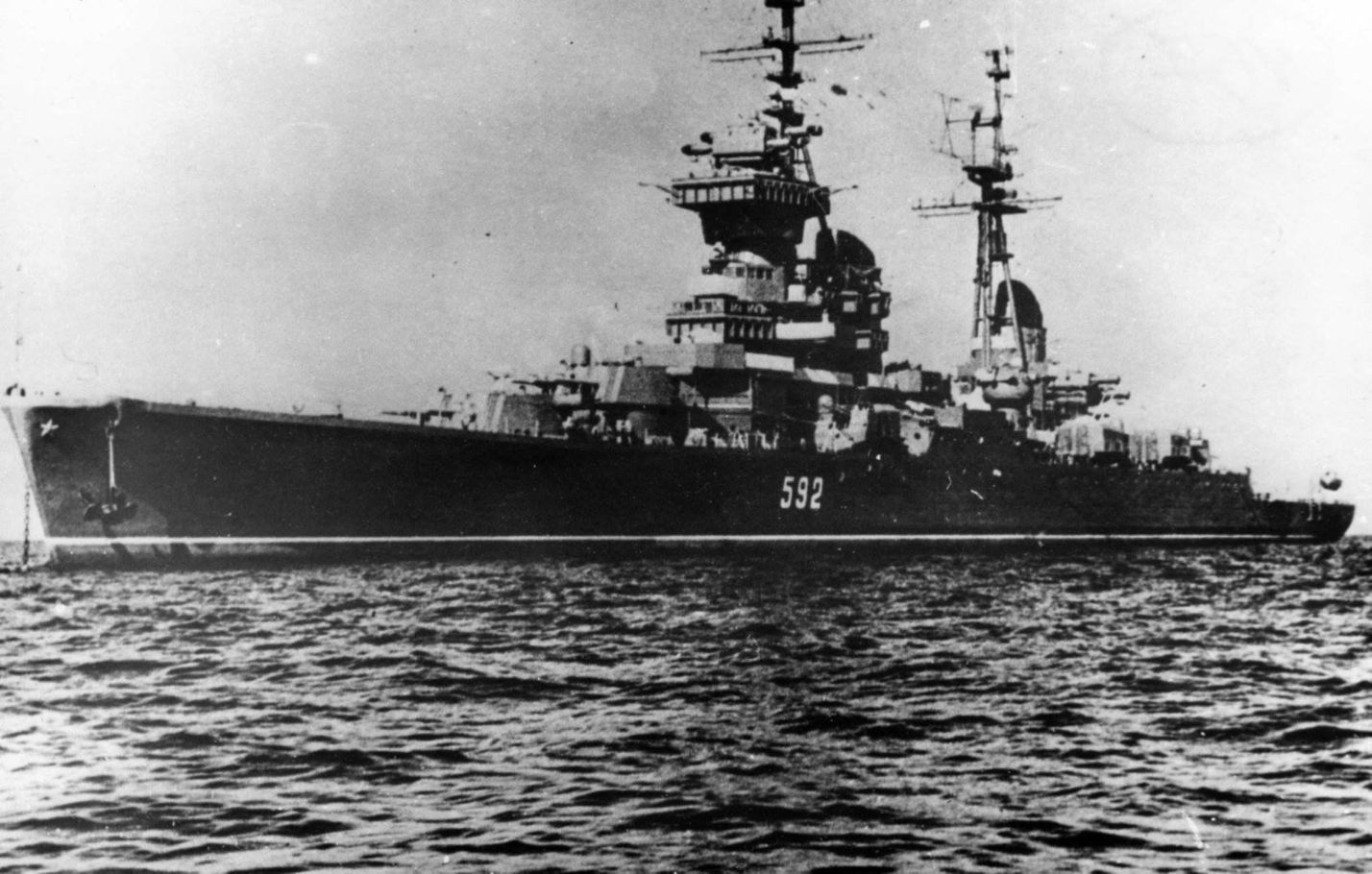
Cruiser "Admiral Nakhimov"
The fate of the "Admiral Nakhimov" is not an exception, but rather the rule. Practically all ships of this project have a very similar biography. The "Nakhimov" was commissioned in 1953, the others also entered service in 1952–1953, and in the early 1960s they began to be given away to potential allies (for example, "Ordzhonikidze" went to Indonesia), or converted for other tasks, in particular for missile weaponry. The era of Khrushchev's rule, as is well known, is well characterized by the term "voluntarism."
Let's put it this way: there was never a bigger mess in the USSR, neither before nor after. So there is nothing surprising about cruisers first being repaired, then modernized, mothballed, converted, painted with red lead, and finally decommissioned. Seismic activity in the Black Sea occurs regularly. For example, during the writing of this comment, an underwater earthquake with a magnitude of nearly 5 occurred. Radioactive pollution of the Black Sea is not news. It was detected by an expedition in 1999, and has been monitored by many scientific institutions, ecologists, physicists, and simply tourists. Estimates vary, very noticeably so.
Nuclear explosions have a specific "radiation signature" that allows one to determine even the type of charge, let alone distinguish it from Chornobyl or natural sources of pollution (indeed, there are natural sources of radiation in the Sea of Azov). And finally, the main question: why? Why detonate a charge in an area with a dense population, with the dachas of Soviet leaders, almost on the border with then-hostile Turkey? Hiding an explosion with a yield of 3.5 kilotons is not difficult in other places.
Precisely at that time, methods of concealment were being born, for example, the so-called "decoupling," which, according to calculations, allowed the seismic signature of a nuclear explosion to be reduced by two hundred times. Hiding an explosion in a typical location, in Chernaya Guba (Black Bay) on Novaya Zemlya, would have been much easier. Especially since in 1961 several launches of the mentioned T-5 torpedoes in Chernaya Guba were indeed carried out..."
P.S. For now, we can only hope that someday all the assumptions regarding the cruiser "Admiral Nakhimov" will be either refuted or confirmed. The closed archives of the former metropolis promise us many "wonderful discoveries"...