The Flourishing and Death of Alla Horska
You know, all the time I want to write in the Ukrainian language. You speak Ukrainian—and you begin to think in the Ukrainian language.
Valeriy Verkhovskyi. Newspaper "Krymska Svitlytsia", 2017, Issue No. 39
You know, all the time I want to write in the Ukrainian language. You speak Ukrainian—and you begin to think in the Ukrainian language. From a letter by Alla Horska to her father, 1961.
While poetry or prose have only one tool—language, and theater and cinema belong to a particular culture based on the language of their dialogues, instrumental music, painting, or visual arts, which would seem to be understandable without translation, depend less on which language the artist considers native. But it is not that simple, and the example of Alla Horska confirms this.
Growing Up
Alla Horska was born on September 18, 1929, in Yalta, into the family of Oleksandr Horskyi, director of the Yalta Film Studio. From Yalta, the family moved to Moscow because her father received a promotion, and later to Leningrad. The war caught them in this city. The Germans, surrounding Leningrad, which in their military-topographical coordinate system remained Saint Petersburg, did not storm the city. A situation, strange from the perspective of war logic, arose where peaceful citizens found themselves hostages to Bolshevik ideological principles: not to surrender Lenin's city. Those who did not manage to evacuate suffered from hunger.
Oleksandr Horskyi was not with his family at that time; having returned from Mongolia, where he worked on film shoots, he was assigned to Alma-Ata. Their son Arsen died, having volunteered for the front. Alla and her mother survived two hungry Leningrad winters, and in the summer of 1943, they moved to join him in Alma-Ata. However, at the end of 1943, the family moved again—this time to Kyiv, where Oleksandr Horskyi took the position of director of the film studio (which was later named after Oleksandr Dovzhenko).
This means that all of her childhood up to the age of fourteen was spent either in Crimea or in Russia.
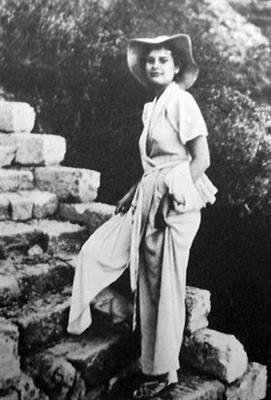
Alla Horska on vacation in Odesa. Late 1940s
In Ukraine
From 1946, Alla studied at the Taras Shevchenko Kyiv Art Secondary School, graduating in 1948 with a gold medal. Her teacher was Volodymyr Bondarenko, an artist and student of Fedir Krychevskyi. There was no hesitation in her subsequent choice: Horska entered the painting department of the Kyiv State Art Institute. In the summer of 1952, she married Viktor Zaretskyi, who studied at the same institute. Two years later she graduated from the institute and began working in the field of easel and monumental painting. In 1959, she was admitted to the Union of Artists. For some time she taught drawing at the Republican Art School. Together with her husband, they had an art studio on Filatova Street in Kyiv.
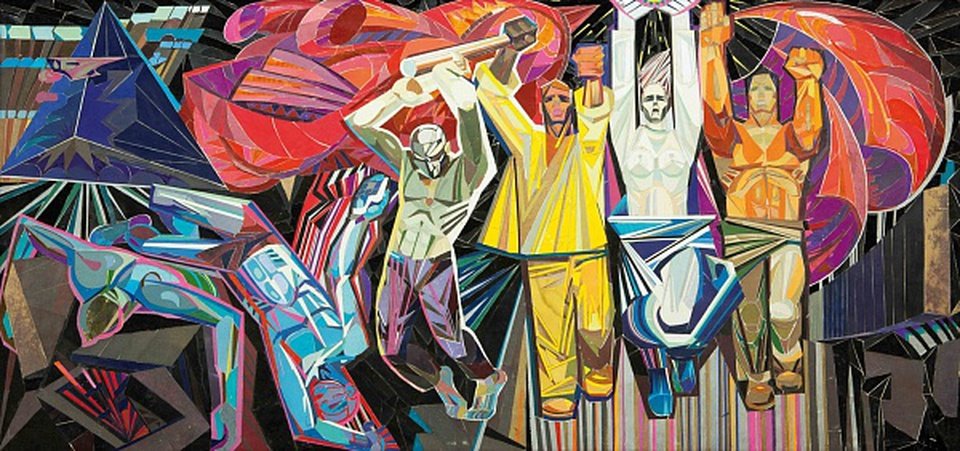
Mosaic panel "Banner of Victory, or Relay," 1969. Alla Horska, Viktor Zaretskyi, Borys Plaksiy
Another Reality
In the summer of 1961, 32-year-old Alla Horska went to paint studies in the village of Hornostaipil in Kyiv Oblast. Together with her husband, they stayed in the house of Volodymyr Shevchuk, who lived in the same dorm room as Viktor. In Kyiv, the couple spoke Russian, but in the village they plunged into the Ukrainian language. In a letter to her father, Alla, who had once been exempted from studying the Ukrainian language, confessed that she felt a growing desire to speak Ukrainian. Oleksandr Valentynovych corresponded with his daughter in Russian. Upon returning to Kyiv, the couple already spoke Ukrainian to each other.
For Alla, this transition was difficult, and so, inviting her artist friends Halyna Sevruk and Liudmyla Semykina to join, she took lessons from Nadiia Svitlychna. This helped Alla master the language well. The "Suchasnyk" (Contemporary) Club of Creative Youth brought together such enthusiasts. The club was divided into five interest sections: writing, art, music, cinema, and theater.
A jazz ensemble and the "Second Ukrainian Theater" operated at the club. This took place in the October Palace, which in the late 1930s had served as an NKVD torture chamber. At the club, which arose on the wave of Khrushchev's "thaw," a commission was created to gather materials about Stalinist repressions. Horska took an active part in it. Together with the poet Vasyl Symonenko and director Les Taniuk, who headed the club, they interviewed people who were fortunate enough to return from the Gulag. Together they made a trip to Bykivnia—the site of mass graves of the Chekists' victims.
What they saw there and heard from local old-timers made an incredibly horrifying impression on Alla Horska. The club's activities were shut down in 1964. By that time, Vasyl Symonenko was gone; he died a year earlier from police torture. Alla Horska was destined to live only a few more years—under the close surveillance of the direct heirs of the Cheka-NKVD.
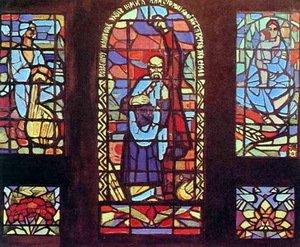
Stained glass window "Shevchenko. Mother"
Tragedy
She died on November 28, 1970. Twenty-one years later, some would repeat that Ukraine gained independence without bloodshed...
A few days before her death, she filed a protest with the Supreme Court of the Ukrainian SSR regarding the illegality and cruelty of the sentence of Lviv historian Valentyn Moroz. This was not the first time she openly opposed the regime. And the regime took action...
She went to the town of Vasylkiv to pick up a Singer sewing machine from the house of her father-in-law Ivan Zaretskyi, but she did not return and could not be reached. Therefore, her husband Viktor went to Vasylkiv (as late as December 1). The house was locked; they had to call the local police officer to break down the door. The officer refused due to the late hour. The next day, Viktor Zaretskyi returned to Vasylkiv, joined by Nadiia Svitlychna.
After breaking down the door, they searched the house but found nothing. Only upon looking into the cellar did they see the dead body of Alla Horska.
Acting in accordance with the logic of Soviet punitive organs, investigators arrested Viktor Zaretskyi himself, placing all suspicion of his wife's murder on him. Soon after, his father Ivan Zaretskyi was hit and killed by a train, and Viktor was released, with the blame for the murder of the daughter-in-law laid on the father-in-law.
The funeral took place on December 7 at the Berkovetske Cemetery in Kyiv.
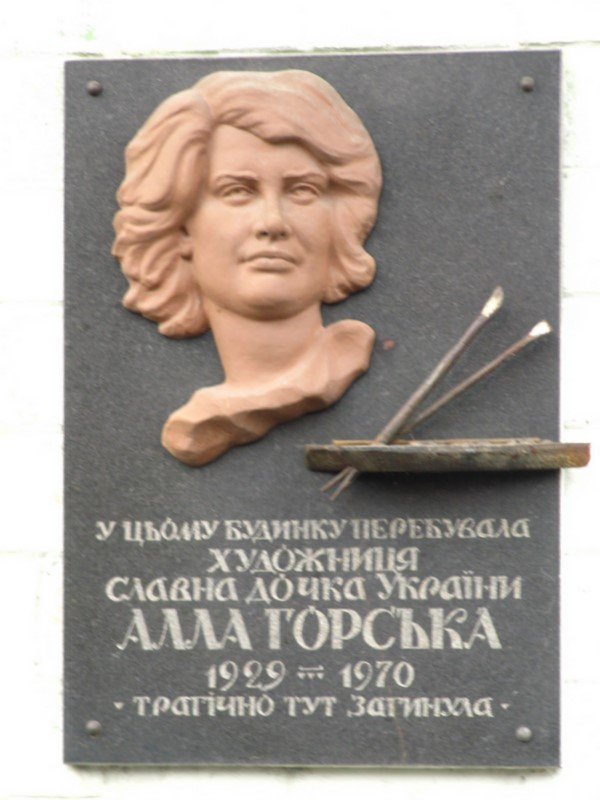
Memorial plaque on the house in Vasylkiv where A. Horska died
Legacy
The stained glass window "Mother," created in 1964 by Alla Horska, Liudmyla Semykina, Opanas Zalyvakha, Halyna Sevruk, and Halyna Zubchenko, was destroyed by order of the party leadership. Have her mosaics survived in Donetsk and Krasnodon? Her paintings have survived—they adorn Ukrainian and European museums.
Her short and tragic fate itself became her main creation.
She is one of those iconic figures without whom Ukrainian Crimea is impossible. Although she left Crimea as a child and began learning the Ukrainian language as an adult, Crimean Ukrainians have every reason to be proud of such a compatriot. And it is precisely through her example that we can see how the Ukrainian idea sprouted in seemingly entirely "normal" Soviet people.