A Thousand Years Deep
The thousand-year history of the settlement of Alupka, which later became a Crimean city.
Maxim Dubovyaz. Newspaper "Krymska Svitlytsia", 2018, Issue No. 31
Somewhere there, in the serpentines of the Crimean Mountains, lies Alupka. Along the Black Sea, between Miskhor and Simeiz, it stretches for four and a half kilometers. The first stones in the masonry of the fortification on the mountain above the city were laid in the 8th century. And we have known the name of Alupka for two millennia now: in 960, the Khazar Khagan Joseph, the ruler of Crimea at the time, mentions the settlement of Alubyko. In Greek, "aloupo" means "fox."
During the early Latin colonization, the area was called "Lupico." In Latin, "lupus" means "wolf." But by the end of Genoese rule, the "a" returned, and the Wolf's place became Fox's place once again.
Three hundred years passed since the last Genoese—and in Alupka appeared that which made it famous throughout the world, for which we are indebted to Mikhail Vorontsov. Prince Vorontsov, military commander and statesman, governor of Novorossiya, governor-general of Bessarabia and the Caucasus, the largest landowner in the empire... But he is best known for the diabase wonder that is one of Crimea's hallmarks and one of the most beautiful palaces in Ukraine.
The "Vorontsov Palace," a masterpiece of English architectural genius and the 20-year labor of stonemasons brought by the Prince from the outskirts of Moscow and Voronezh, seems to have hidden the rest of Alupka in its shadow. Numerous visitors to this most popular excursion site in Crimea do not even see Alupka itself. Excursion buses and liners await them on the highway and in the sea; they have no time for Alupka, which is less than a fifteen-minute climb from that castle...
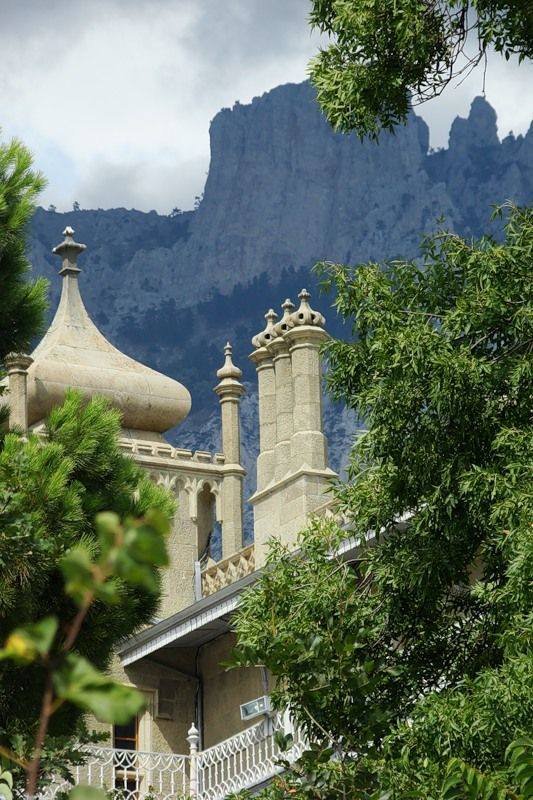
The hallmark of Alupka - Vorontsov Palace
Notably, this wonder, which in the spirit of the era combined features of Eastern palaces and the castles of Albion, is rarely called a "castle." Perhaps because local toponymy gave this designation to another object, entirely unknown to the mass tourist.
This is Alupka-Isar. "Isar" is translated from Turkic languages as "walls" or, in fact, "castle." Unlike the "living" Vorontsov Castle, Alupka-Isar has preserved only two tiers of stonework: the original cyclopean and the added medieval one. In its time, it towered like an eagle's nest over this coast, as evidenced by the name of the peak—Alupka-Isar, now known as "Krestovaya (Cross) Mountain" because, upon taking possession of the land, Vorontsov ordered a cross to be erected on the mountain. The Prince kept his finger on the pulse of the village's life—he built a mosque and a Christian temple in it. The latter was in the classical antique style and was called the "Temple of Theseus." However, 60 years after its construction, the temple was destroyed by a landslide.
Alupka was left without a church. Only at the end of the 19th century did a medical professor from the capital, Oleksandr Bobrov, settle here. With the perseverance of a specialist and enthusiast, he gathered funds from benefactors and organizational efforts, and in 1902 opened a sanatorium in Alupka for children suffering from bone and joint tuberculosis. The first in the empire, the first in Europe, maybe even the first in the world.
The Bobrov Sanatorium in Alupka still restores the health of children. Oleksandr Bobrov also organized the construction of an Orthodox church in Alupka. In 1904, the devotee completed his earthly path. The post of chief physician was taken over by Petro Izergin, who served in this role with honor for the next 30 years.
And the Church of the Archangel Michael was opened in 1908. Experts believe that if there were no palace in Alupka, this temple would have been the main adornment of the city. Because it is the largest Christian church on the entire Southern Coast of Crimea!
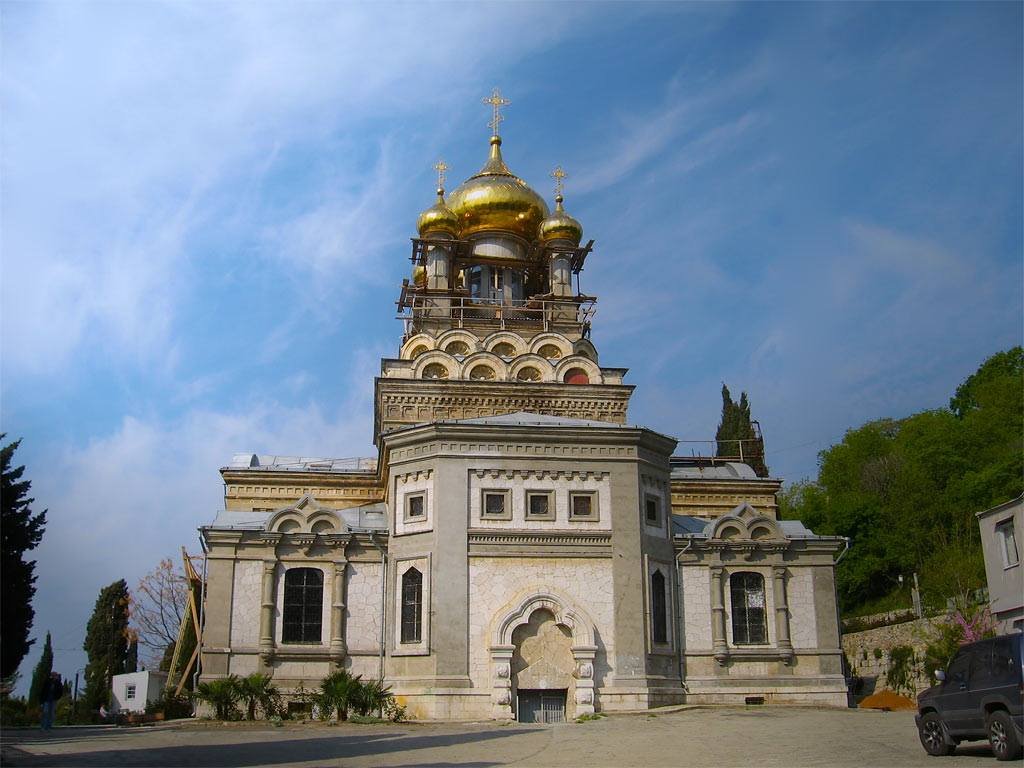
Church of the Holy Archangel Michael
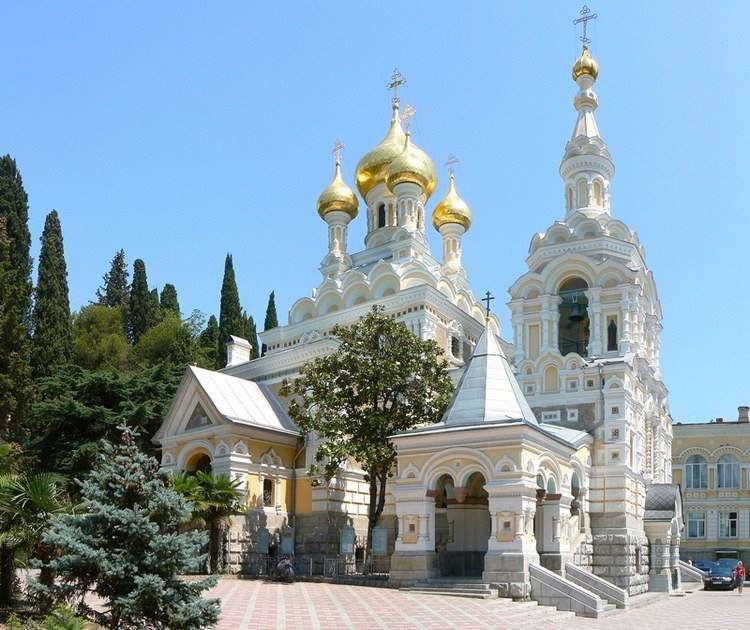
Church of Saint Alexander Nevsky
For over a thousand years, Alupka was a village. It received the status of a town exactly 80 years ago. Like every former Soviet town, it has its own monument to Lenin. The main street bears the same name, with the Church of the Archangel Michael at its beginning, and its near-contemporary, the Church of Alexander Nevsky, at the end.
This street is the only one that is more or less straight; the rest of the streets in old Alupka are mountain serpentines. But, as local guidebooks note, everything worth seeing and visiting here is located at the beginning of just five streets radiating from the city's central square.
And on one of them, named Aviators (Liotchykiv) Street, stands a monument about which probably far more people know than actually live in Alupka. This monument is an official bust that, according to Soviet law, had to be erected in the homeland of a person who had been twice recognized as a Hero. The great pilot Amet-Khan Sultan received his second Gold Star in 1945. For the next 10 years, the hero insisted—and succeeded!—that the monument legally owed to him should stand not in Yaroslavl, not in Kaspijsk, not even in Stalingrad, but where Sultan came into this world in his Crimean family—in Alupka...
A tiny town, seemingly just one of the pearls of the Crimean coast, yet its depth spans a thousand years.