Ambitious Intentions and Plans. Ukraine revives Crimean horticulture and viticulture
Ukraine revives Crimean horticulture and viticulture.
Petro Volvach, full member of the Shevchenko Scientific Society (NTSh), member of the National Writers' Union of Ukraine (NSPU), Honored Worker of Science and Technology of the AR Crimea, Crimean with 60 years of experience. Newspaper "Krymska Svitlytsia", 2017, Issue No. 49
Life convincingly proved that settlers to Crimea from the deep regions of Russia during the first post-war decade were never able to adapt to hot and arid Crimea and master the southern agriculture unfamiliar to them, especially fruit growing, viticulture, vegetable growing, and tobacco farming. And the special settlers of the first wave of population replenishment of the peninsula, who were carefully selected from among former NKVD officers, SMERSH agents, GULAG guards, and informants to develop the Southern Coast and the Crimean Foothills, turned out to be largely unfit for difficult agricultural work. Therefore, it is not surprising that in the first post-war decade, Crimean orchards and vineyards, not only in most farms but also in the household plots of Russian settlers, turned into impenetrable thickets or dead dry wood.
To rebuild the homes of the population that remained on the peninsula, blooming orchards and generous vineyards were ruthlessly destroyed, with a mass cutting down of not only dry wood, but also still living, productive fruit trees and grapevines. Due to this barbarism and unpunished plunder, the area of commercial orchards and vineyards in the war and post-war years sharply decreased by several times.
There were also years when there was no one to harvest the good crop of fruit and grapes, and it was eaten by all kinds of forest animals or domestic livestock. As sad as it is to state, during the ten post-war years, Crimea never achieved the 1940 figures in terms of the yield of orchards and vineyards. In the majority of not only farms but also entire districts, the productivity of orchards and vineyards was catastrophically low, not even reaching 20-25 centners/ha. Thus, the productivity of the post-war Crimean orchard was equivalent to the output of a single old, robust tree of the local apple variety Sary Sinap.
The catastrophic state of the Crimean economy, especially horticulture and viticulture, in the first post-war decade became the main motivation for the Kremlin leaders to change its administrative subordination. The Kremlin leaders understood well that only transferring Crimea to Ukraine could save the decayed peninsula. Nikita Khrushchev, one of the best Kremlin experts on Ukraine's agricultural potential, quite reasonably linked the further development of Crimean fruit growing and viticulture with Ukraine and the industrious Ukrainian people. His catchphrase, recorded by journalists of the time, that Ukrainians—who not only understand agriculture but also love orchards and vineyards—are capable of reviving Crimea, defined the main priorities for Crimea after its transfer to Ukraine.
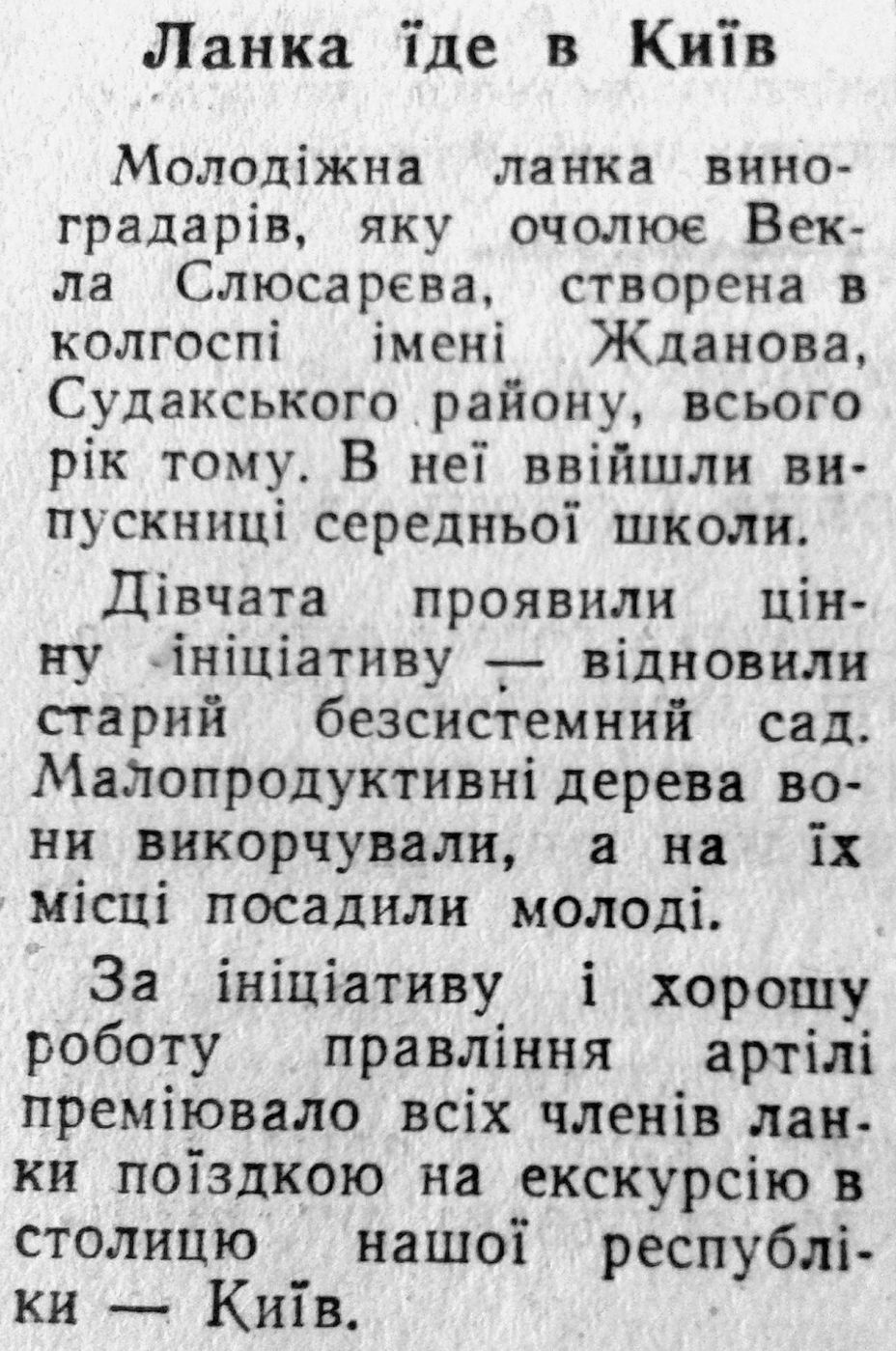
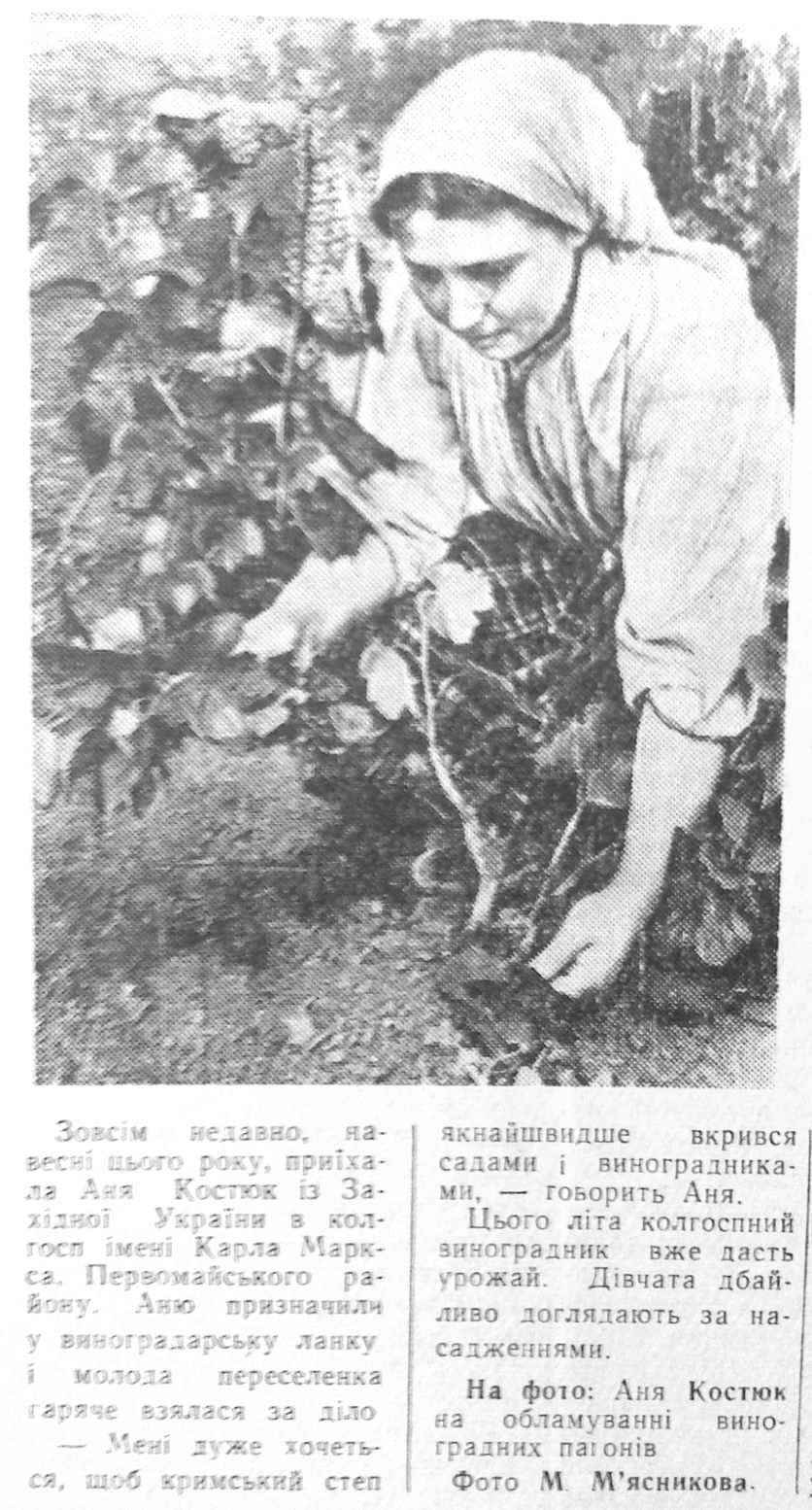
This is how the press of the time covered the revival of Crimean horticulture and viticulture. From the archive of the newspaper "Soviet Crimea" (1956-1958)
An extract from the report that Moscow provided to the First Secretary of the Central Committee of the CPU, Oleksiy Kyrychenko, in early January 1954 on the state of agriculture in the Crimean Oblast, which at that time was still part of the RSFSR, is convincing proof of the validity of this opinion. Familiarity with documents, previously hidden in party and government archives, concerning the first decade of the Crimean Oblast's inclusion in Ukraine allows us to understand that reviving the former glory of Crimean fruit growing and viticulture became one of the main tasks for the Ukrainian leadership.
Already in early April 1954, the Chairman of the Council of Ministers of the Ukrainian SSR, Nykyfor Kalchenko, and the First Secretary of the Central Committee of the CPU, Oleksiy Kyrychenko, addressed the Council of Ministers of the USSR and the Central Committee of the CPSU with a letter "On the necessity of implementing special measures for the restoration of agriculture, cities, and resorts of the Crimean Oblast." This document notes that the leadership of Ukraine, together with the Crimean Regional Committee of the CPU and the Regional Executive Committee, prepared a draft resolution "On measures for the further development of agriculture, cities, and resorts of the Crimean Oblast."
The first point of the draft resolution envisaged a significant expansion of vegetable crop cultivation, an increase in commercial plantings of orchards, vineyards, and berry fields, and the introduction of measures aimed at sharply increasing the yields of all agricultural crops and livestock productivity. The plans of the Ukrainian leadership regarding the development of fruit growing and viticulture in Ukraine's youngest oblast were quite ambitious. Over the course of five years, the area of commercial orchards was supposed to grow by 10-12 thousand hectares annually.
Considering that even in 1940 this figure was only 12.3 thousand hectares, and during the first post-war decade the area of existing plantings had decreased by several thousand hectares, the intentions of Kyiv officials were indeed revolutionary. Unquestionably, increasing the commercial plantings of fruit crops nearly fourfold in five years required enormous financial and material resources. Indeed, in addition to laying new orchards, during this tight five-year period it was necessary to organize and reconstruct almost 2 thousand hectares of existing orchards in the oblast and repair sparse plantings on an area of 6.1 thousand hectares.
Moreover, to fulfill this fantastic task, it was necessary to attract thousands of specialists and tens of thousands of skilled hands. Therefore, it was planned to resettle about 20 thousand families from Ukraine under the state program of Crimean population replenishment. To train mid-level fruit-growing and viticulture specialists, the admission of students to the agricultural school at the Crimean Horticultural Station and the Yalta Agricultural College was significantly increased starting in 1954. The admission of students to the Faculty of Pomology and Viticulture at the Crimean Agricultural Institute was also significantly increased, and courses for training specialists and management personnel were introduced there.
Kyiv officials also took decisive steps to revive Crimean viticulture. This economically important branch, once well-developed on the peninsula, was also in a highly neglected state. During the ten post-war years, the Russian administration on the peninsula had been unable to expand the area of commercial vineyards to the 1940 level or achieve pre-war yields. In 1953, the area of vineyards in the Crimean Oblast was 7.1 thousand hectares (almost 2 thousand hectares less compared to 1940). And the yield of commercial vineyards, which was 355 centners/ha in 1940, decreased to 20 centners/ha.
Ukraine tasked the Crimean Oblast with planting 10,500 hectares of new grape plantations in collective and state farms over five years (from 1954 to 1958), thereby nearly doubling the existing area. During the same period, the farms of the oblast were to reconstruct 1,975 hectares of existing vineyards and repair almost all the highly thinned grape plantings that existed at that moment (over an area of nearly 10 thousand hectares).
Since their own planting material was insufficient to establish new and reconstruct existing plantations, it was planned to import almost 6 million grape saplings from Central Asia.