A Son of Evpatoria Who Represented Ukraine in Europe. In Memory of Anatoliy Ponomarenko
In Memory of Anatoliy Ponomarenko
Serhiy Konashevych. Newspaper "Krymska Svitlytsia", 2017, Issue No. 51
On December 22, Ukraine celebrates one of its professional holidays – the Day of Diplomatic Service Workers. This date was established in accordance with the Decree of the President of Ukraine "On the Day of Diplomatic Service Workers" dated November 21, 2005, No. 1639/2005 – as stated in the document, "taking into account the important role of workers of the diplomatic service of Ukraine in maintaining peaceful and mutually beneficial cooperation between Ukraine and members of the international community, while ensuring the national interests and security of Ukraine, as well as protecting the rights and interests of citizens and legal entities of Ukraine abroad."
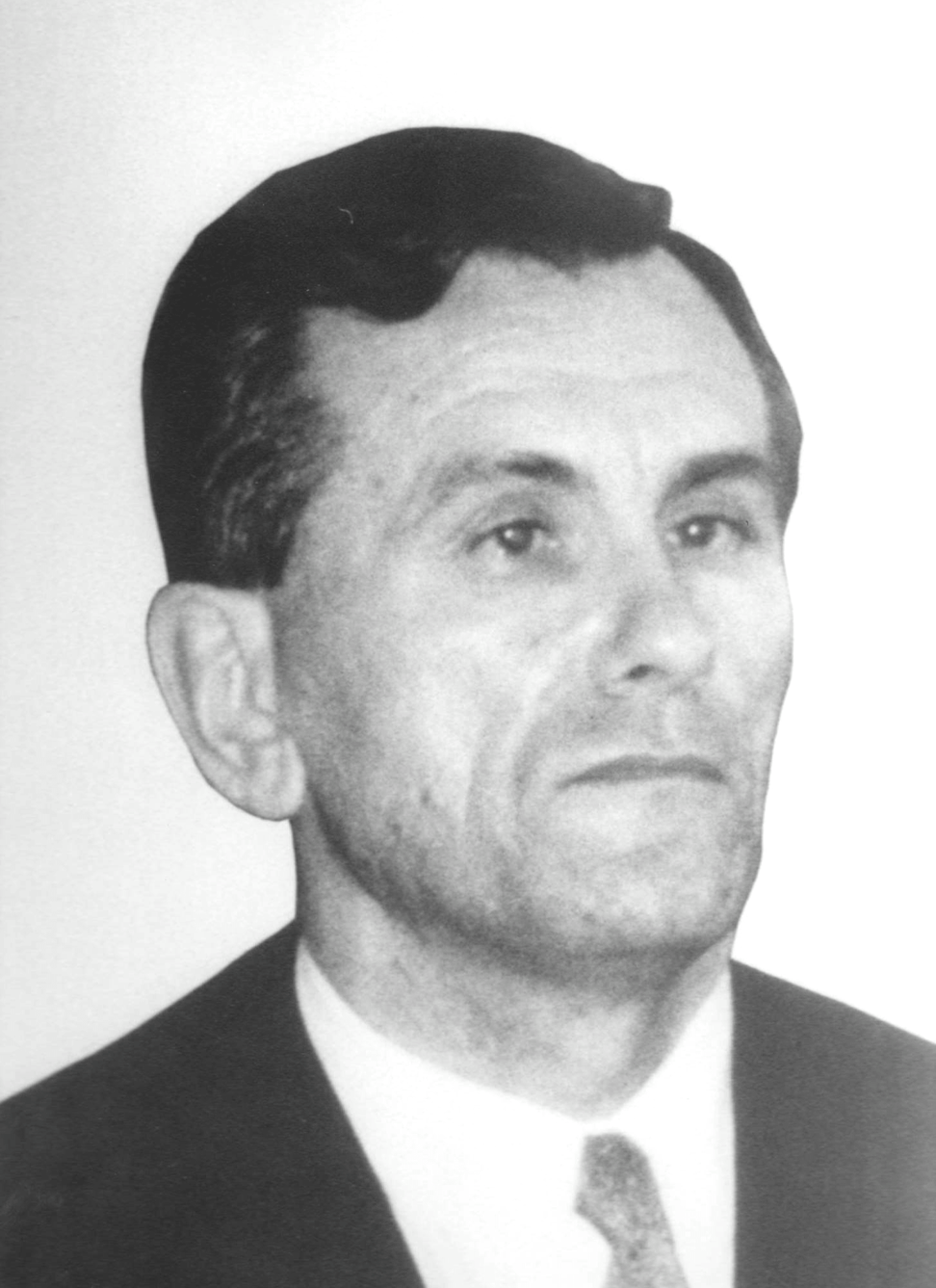
Anatoliy Ponomarenko, 1992-1994
Back in early November, the President of Ukraine Petro Poroshenko emphasized the need for consideration and voting in the Verkhovna Rada on a new version of the Law "On Diplomatic Service," calling Ukrainian diplomats "our army on the foreign policy front": he submitted this bill to the VR for urgent consideration. On December 7, it was adopted. The new version of the law proposes to establish new legal and organizational principles for the functioning of the diplomatic service as a civil service of a special character: it consists of the professional activities of officials related to the implementation of the foreign policy of Ukraine, the protection of its national interests in the field of international relations, as well as the rights and interests of citizens and legal entities of Ukraine abroad.
According to Iryna Lutsenko, Member of Parliament of Ukraine and representative of the President in the VR, this step introduces the transition of the diplomatic service from post-Soviet templates to the European model; she also added that this law should be an excellent gift for domestic diplomats on the centenary of Ukraine's diplomatic service, which the President had spoken about earlier.
It is worth noting that among the individuals who have worthily and effectively performed and continue to perform this high and honorable mission, there are also natives of Crimea. The figure of the first General Consul of independent Ukraine, Ambassador Extraordinary and Plenipotentiary of Ukraine Anatoliy Ponomarenko, who could have celebrated his 70th anniversary this spring, deserves special attention.
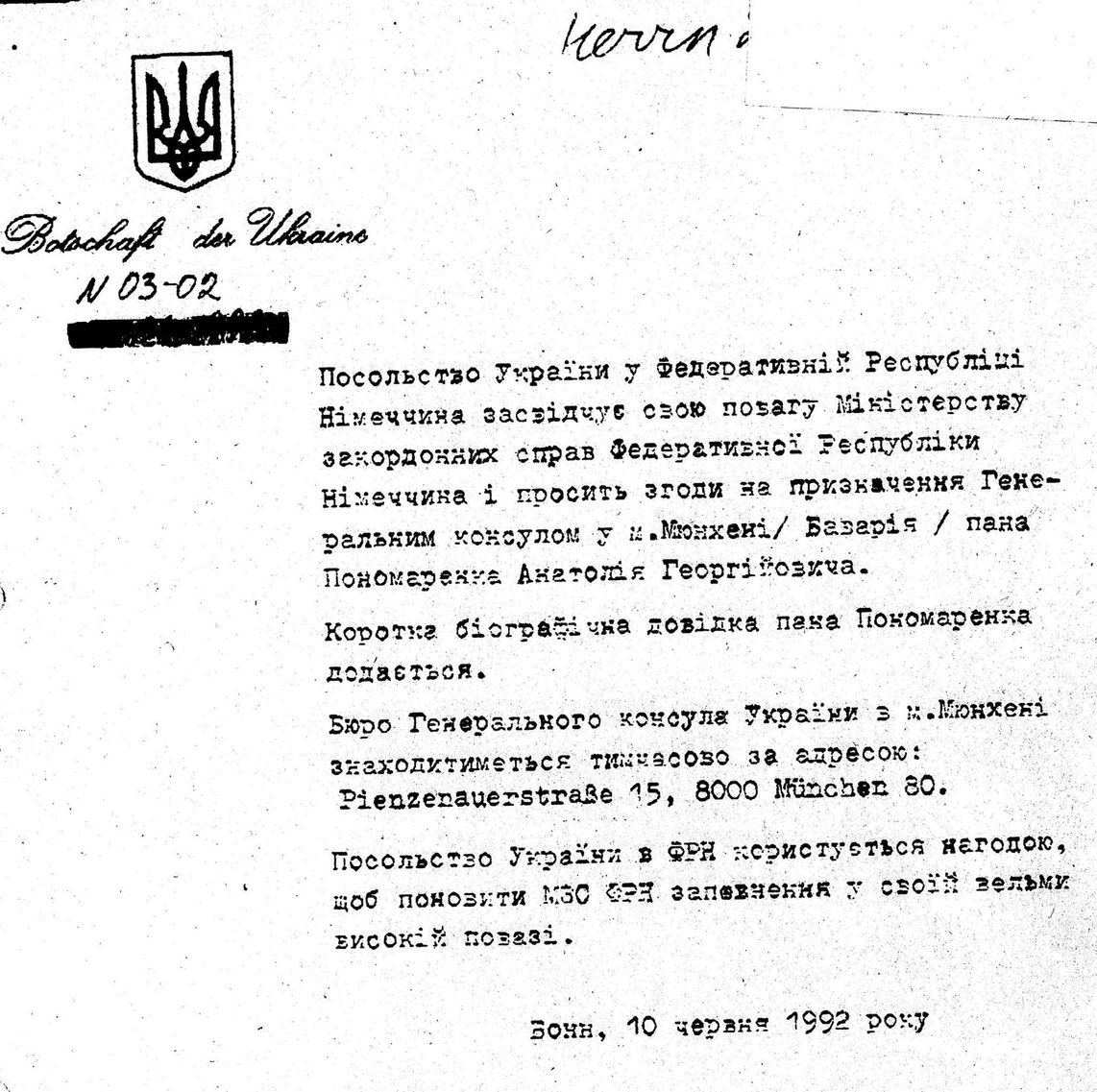
Letter from the Embassy of Ukraine in the FRG to the German Ministry of Foreign Affairs on Ponomarenko's appointment as Consul General
Anatoliy Heorhiyovych was born on March 4, 1947, in Evpatoria. In 1971, he graduated from the Faculty of Foreign Languages of the Crimean State Pedagogical Institute; he spoke Russian, English, and German. From then until 1978, he was a referent for international relations at the Crimean Regional Committee of the Leninist Young Communist League of Ukraine, as well as a senior referent and deputy chairman of the Committee of Youth Organizations of the Ukrainian SSR. In 1978–1983, he was the 2nd Secretary of the USSR Embassy in India, and in 1983–1984, the 2nd Secretary of the Ministry of Foreign Affairs (MFA) of the Ukrainian SSR. In 1984, he entered the Diplomatic Academy of the MFA of the USSR, graduating in 1987, after which, until 1989, he held the post of 1st Secretary of the MFA of the Ukrainian SSR. He held a PhD in History.
In 1989, Anatoliy Ponomarenko became a consul at the USSR Consulate General in Munich (Federal Republic of Germany, FRG), and in 1992, after Ukraine gained independence, the consul general of the Consulate General of Ukraine there, which in the early 1990s was located within the walls of the Ukrainian Free University. From 1994 to 1997, he worked directly in the Ministry of Foreign Affairs of Ukraine—as head of the Western Europe Division, deputy head of the Directorate for Europe and America, and later as head of this Directorate.
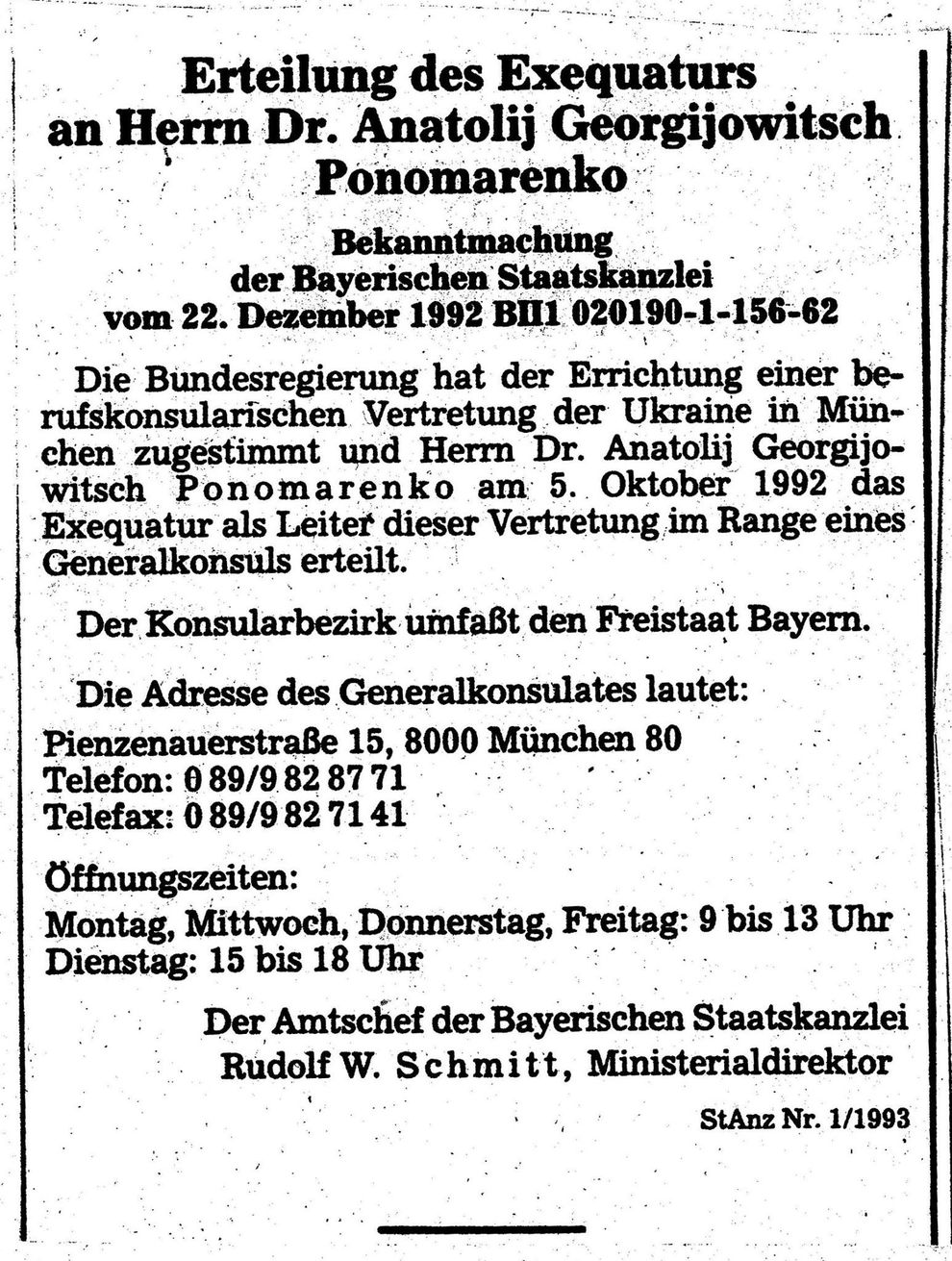
Patent
From September 2, 1997, to November 26, 2003, Anatoliy Heorhiyovych served as Ambassador Extraordinary and Plenipotentiary of Ukraine to the FRG (his diplomatic rank was granted in 1999); during this time, he earned immense trust and respect among the Ukrainian diaspora. In September 2001, in an interview with the newspaper "Den" (The Day), he spoke about the celebration of the 10th anniversary of Ukraine's independence in Berlin: a thematic conference took place at the FRG Ministry of Foreign Affairs, after which Ukrainian diplomats in Germany and diaspora representatives laid a wreath on the grave of the President of the West Ukrainian People's Republic, Yevhen Petrushevych, whom Anatoliy Heorhiyovych viewed as an important figure in our history and equated in political significance to the President of the UNR, Mykhailo Hrushevskyi.
In his time, the Ambassador made sure that every Ukrainian politician who arrived in Berlin visited Petrushevych's grave, honoring both the President of the ZUNR and the history of the liberation struggle in general. Also, with the participation of the then-Minister of Culture of Ukraine, the famous Ukrainian actor Bohdan Stupka, as well as representatives of the Berlin government and the FRG MFA, within the framework of the Days of Ukrainian Culture in Germany, a memorial plaque to the outstanding film director Oleksandr Dovzhenko was unveiled on the wall of the building at 69 Bismarckstrasse (one of the central streets of West Berlin), where he lived when he worked as secretary of the consular department of the trade representation of the Ukrainian SSR.
Anatoliy Ponomarenko viewed this act to some extent as a commemoration of a colleague: "I too once engaged in consular activities and I think that for Dovzhenko, as a creative person, this was not easy. But he also used his stay to communicate with famous German artists. Dovzhenko visited art salons, and he was very well received by German film actors and directors famous at that time.
The result was that in the 1930s, cultural days of the Ukrainian SSR were held in Berlin, and the premiere of Dovzhenko's film 'Arsenal' took place here, which the Berliners liked very much: today, one of Berlin's cinemas at Potsdamer Platz is called 'Arsenal.' This is not a random name – it is the title of Dovzhenko's film, which has been preserved to this day." Finally, the Ambassador assured that the Germans were ready to cooperate with our people and help establish the foundations of civil society, which would facilitate Ukraine's further progress into the European space and proximity to the standards of the European Union.
In 2004–2006, Anatoliy Ponomarenko held the post of director of the Second Territorial Department and member of the Board of the Ministry of Foreign Affairs of Ukraine. On December 6, 2006, he was appointed Ambassador Extraordinary and Plenipotentiary of Ukraine to Sweden. In 2007, he was awarded the Order of Merit, 3rd Class. On May 20, 2008, in Stockholm, the Ukrainian diplomat passed away prematurely at the age of 61.
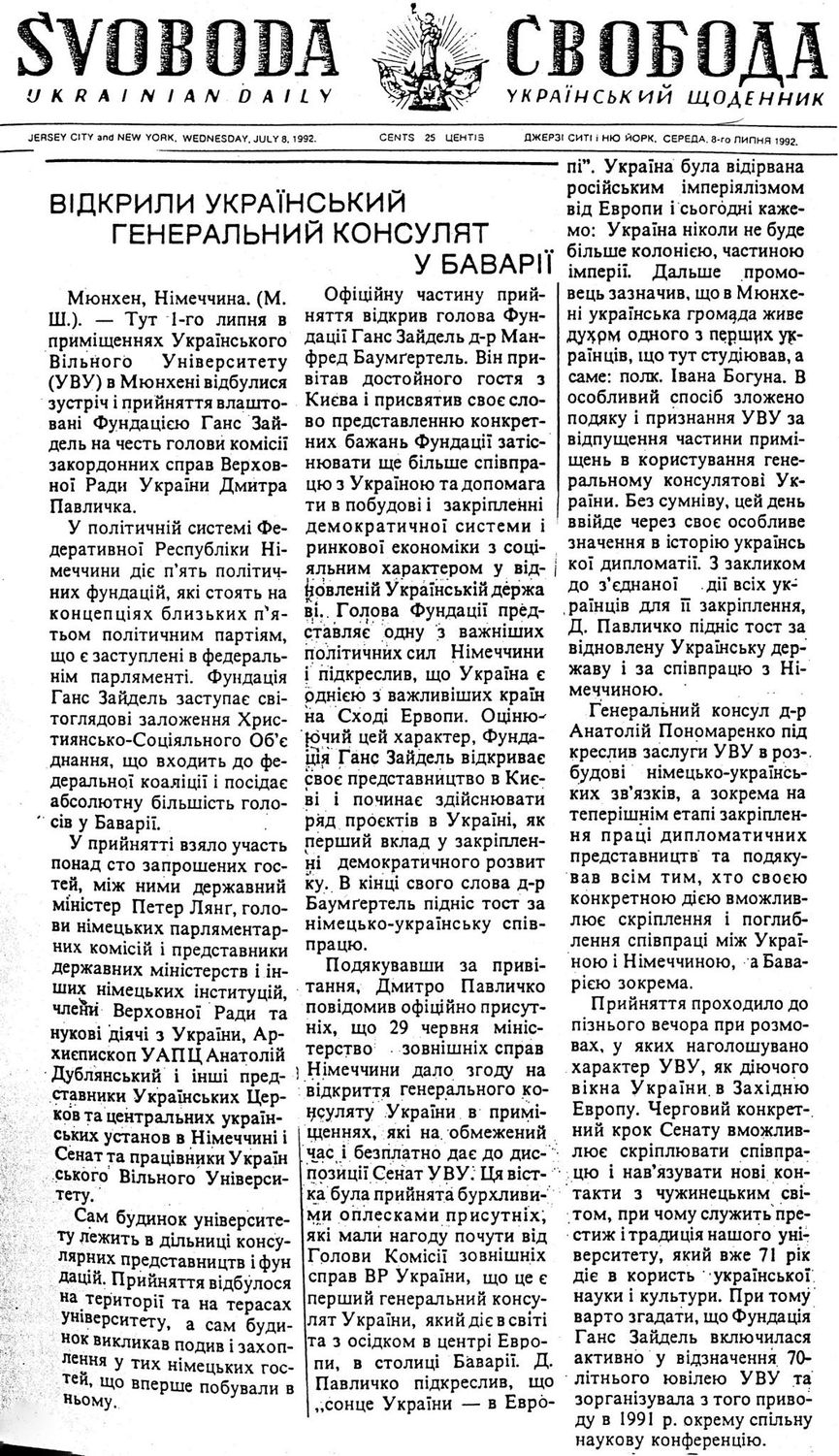
Media report on the presentation of the exequatur to Ponomarenko in "Svoboda Ukrainian Daily" dated July 8, 1992
In the opinion of many representatives of the Ukrainian diaspora, Anatoliy Ponomarenko was one of the best diplomats and, perhaps, even the best ambassador of Ukraine. It was repeatedly emphasized that he had the honor of restoring the functioning of the Ukrainian diplomatic mission in Germany: the Ukrainian embassy in Berlin and the consulate in Munich had existed since the times of the Ukrainian Liberation Struggle. Quite naturally, Anatoliy Ponomarenko was compared with the UNR Ambassador to Germany, Roman Smal-Stocki, who succeeded in rallying the diaspora: as is well known, the task of an ambassador is not only to establish and maintain interstate relations, but also to settle relationships between immigrant groups and their leaders.
According to the memoirs of Ukrainian activist from Berlin Volodymyr Romanchuk, who communicated with Anatoliy Ponomarenko in 1999–2004, the diplomat's period of service can be called a whole chapter in the modern history of Ukrainians in the German capital. It is noted that throughout this time, the Ambassador, among other things, cared for Ukrainian religious life in Berlin and the publication of relevant periodicals—in particular, "Khrystyianskyi Holos" (Christian Voice), to which he contributed himself. "From the very first months of his service in Berlin, he became a regular member of the parish, together with his family and staff he often attended services on the occasion of various holidays and events, and was open to meetings and conversations with representatives of the church environment.
He made sure that people from the then still small community were present at events organized by the Embassy, and at general receptions, he addressed the Ukrainians present with greetings in Ukrainian. His meticulous approach to his duties regarding the church caused surprise, because a person who came out of the "Soviet school" and began professional work in the USSR could not, given the circumstances, be connected with religious traditions.
One had to talk with him about church affairs more often than with other people, because at that time there was an ongoing crisis without a permanent priest, and no one even mentioned the opening of an independent parish in Berlin. It was from him that I heard for the first time, a year before the event: 'You will see, we will still open a new Ukrainian parish in Berlin together.' Then it seemed like exaggerated optimism.
After he left Berlin – the lack of contact with the church community was clearly felt for years, whereas the Ambassador, after services, would sit among the people, provide information about current events in Ukraine (for example, election results), or offer holiday wishes. He was a member of the community not only symbolically. His activities brought people to the church and were written in civic life in golden letters," recalled Mr. Romanchuk in 2008, after Ponomarenko's death.
Being a sincere supporter and friend of the Ukrainian community in Germany, Anatoliy Heorhiyovych left behind wonderful memories both as a diplomat and as a personality. "His experience and Ukrainian patriotism were at the highest level. In conversations—both serious and casual—he was accessible, open, friendly, and paid attention even to unrealistic proposals, politely explaining why they were unrealistic. He understood the importance of publishing for the development of the diaspora's public life and willingly contacted representatives of radio and the press.
He made significant efforts to strengthen Ukrainian-German friendly relations, to build political, economic, and cultural ties, and was friends with politicians and diplomats not only in Germany but also in other countries," contemporaries testify. Such was our compatriot. And one really wishes to see and feel that among today's highly respected representatives of Ukraine abroad there are active, patriotic individuals like Anatoliy Ponomarenko of Evpatoria.
The editorial board of "Krymska Svitlytsia" expresses its sincere gratitude for the materials provided by Mr. Dmytro Shevchenko – Consul of the Consulate General of Ukraine in Munich, a native of Evpatoria.