Ashik Umer. Aşık Ümer. Singer of Love
Biography of the prominent Crimean Tatar poet Ashik Umer.
Gulnara Abdullaieva. Newspaper "Krymska Svitlytsia", 2016, Issue No. 50
Among the hundreds of names of Turkic-speaking poets, the name of the Crimean Tatar Ashik Umer of Kezlev (Gezlev) is mentioned in the front rank of the most popular authors. Ashik Umer was destined to gain immense popularity during his lifetime, thanks to his unsurpassed talent as a folk poet-akyn.
Abdullah Kendje-oglu would not have been a Kezlevite had he not considered his native town of Kezlev to be marked with the special grace of Allah. A well-to-do furrier and owner of his own shop, he was respected by the townspeople. However, he did not yet know what mercy the Almighty had bestowed upon him, sending him and his young wife a son in 1621. The infant was named with the ancient Crimean Tatar name Umer.
Since childhood, the boy had not shown any special talents. However, his father considered it his duty to give his son a good education. He enrolled him in a prestigious medrese of that time, at the Khan's Mosque. Yet studies did not come easily to Umer. He received poor grades and complaints from his mentor Sherefi-effendi. One day, a regular reproach from the teacher sank so deeply into the heart of the impressionable schoolboy that after class, he went outside the main city gates and wandered towards the old cemetery.
As legend has it, upon arriving at the cemetery, the young schoolboy lay down on the ground, closed his eyes, and began to ask the angel of death to quickly take him, a failure, from this world. In his fervent prayers, Umer did not notice how he fell asleep. In a dream, a celestial maiden appeared to him and gave him a musical instrument – a saz, explaining that he was destined to become the first among the chosen, to compose songs, to wander the earth, and to sing to people about life and love.
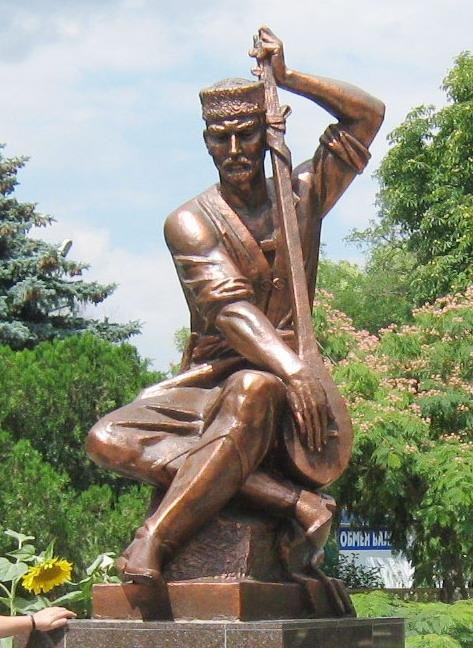
Awakening, Umer saw a saz beside him—exactly like the one in his dream. In the morning, the schoolboy went to the medrese. And here a miracle happened. Whatever questions the teacher asked, Umer answered brilliantly! But the most amazing thing was that he spoke... in verse! Something that had never happened to him before. Poetic lines with rhymes easily formed in his head. The young man recited them melodiously, as if singing. Very soon he became devoted to writing, and his fame as a poet-akyn spread throughout the town.
It is unknown how his father received this news. Perhaps he wanted to see his son continue his business and had insisted on it. But after Umer was introduced to Khan Bahadir Giray and favored with his grace, he did not stand in the way of his son's unexpected talent.
Having matured, Ashik left his native town and set off on a journey. He wandered everywhere and scourged the customs of his contemporaries in his songs. The poet from Kezlev was seen in many countries of the East. Most frequently, he appeared in Konya, the Sufi center of the Ottoman Empire.
Having traveled nearly half the world and grown old, Ashik Umer—already the author of more than 2,000 verses and poems—returned to his native town. He was wealthy and famous. He was joyfully welcomed by his compatriots. The last years of his life the poet dedicated to building mosques. Near the walls of one of them, in 1707, he found eternal rest. Since then, the mosque has been called Ashik Umer. There is also another version, according to which Ashik Umer was buried on the Karantynna Spit in a sand dune near the sea.