Stargazers Powerless Against Boors
Crimea is known in world astronomy on a quite solid level. There are mountains here, albeit small ones, relatively clean air, and very often cloudless skies.
Valeriy Verkhovsky. "Krymska Svitlytsia" newspaper, 2020, issue No. 1
Crimea is known in world astronomy on a quite solid level. There are mountains here, albeit small ones, relatively clean air, and very often cloudless skies. The working conditions are also more comfortable than in the center of Central Asia.
The Crimean Astrophysical Observatory traces its history back to the private observatory of Mykola Maltsov, a wealthy astronomy enthusiast, founded at the beginning of the 20th century in Simeiz, on Mount Kosh-kaya (also known as Kishka). In 1912, he donated it to the Pulkovo Observatory in Saint Petersburg, the leading astronomical center in the Russian Empire. In 1926, an English-made reflector with a diameter of one meter, the most powerful in Europe at the time, was installed on Mount Kosh-kaya.
After all, Gissar, Byurakan, Baksan, or other powerful mountain observatories of the Soviet Union did not exist yet. Their time would come later. During World War II, the Simeiz Observatory was destroyed. Ultimately, the Germans and Italians contributed: a 40-centimeter reflector manufactured by Carl Zeiss Jena, which Hitler had prepared as a gift for Mussolini for the Italian astronomical observatory, ended up in Crimea under the reparations program. Over time, mirrors for telescopes began to be manufactured right on site, in the observatory's own workshop.
Since the observatory in Simeiz suffered irreparable losses during the war, after World War II (formally even before its end) on March 30, 1945, it was decided to locate the main observatory in a place very suitable for studying the starry sky, which is now called the settlement of Nauchnyi in the Bakhchysarai district. In the end, the Simeiz Observatory was restored, but it became a branch of the Crimean Astrophysical Observatory in Nauchnyi.
The construction of the observatory took place in 1946-1955. During its first 30 years, it became one of the leading scientific centers on the planet. The location of the observatory was chosen after carefully studying the strip from Feodosia to Sevastopol. This location, as it turned out, is the best in all of Crimea for astronomical observations: far from large cities, with a state reserve located to the south. Its untouched forest tract, extending for several kilometers, neutralized dust and prevented air turbulence, which greatly contributed to atmospheric transparency.
With the annexation of the Crimean Peninsula to the Ukrainian SSR in 1954, this observatory was and still is the largest in Ukraine. One and a half thousand (!) asteroids, three comets, and many stars were discovered here. It was here in 1958 that Mykola Kozyrev first recorded gas emissions in the Alphonsus crater on the Moon, which became a world sensation, as it indicated the possibility of volcanic activity on another celestial body, and for a whole half-century this case remained the only such observation.
Outstanding astronomers worked here, and famous international projects were implemented.
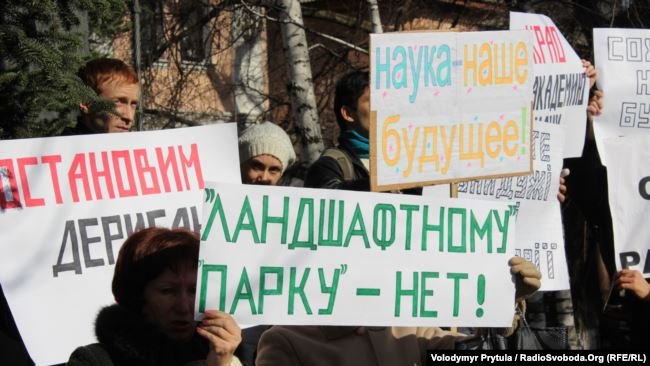
Picket of observatory employees in Simferopol against the so-called reorganization of the scientific institution, February 2013. Photo - https://www.radiosvoboda.org
For instance, the oldest observatory in Russia, Pulkovo, can no longer function properly because it has been gradually swallowed up by Saint Petersburg over decades; residential quarters are located near it, from which light radiates at night. Light pollution extremely complicates observations. This weakens the capabilities of telescopes. A similar situation is observed with the Kyiv Observatory in Holosiiv, where the "little Ukrainian" Yushchenko allowed the construction of a medical complex. Of course, clean air and picturesque landscapes attract not only scientists. The new masters of life in Crimea — not even the lords, but the underlings of Putin's henchmen — noticed this beautiful place for construction long ago.
The first attempts were noticed long before the seizure of Crimea by "little green men", back in 2009. The construction firm "Konsol", which, as is known, belongs to none other than Volodymyr Konstantinov, developed a project for an elite town, where it was planned to place houses, entertainment venues, and restaurants right between the domes of the telescopes.
Observing the stars is incompatible with the "high life" of the bourgeoisie. Excess lighting nearby will interfere with the telescope optics, while the noisy restaurant crowd and prison songs conflict with the concentration of scientific search. Back then, ten years ago, protests by scientists caused a wave in the media, and Konsol's attempts to grab the "trump" plot failed. However, Konstantinov turned out to be stubborn and insolent and did not stop his attempts. The project gained a second wind with the coming to power of the Regionals: in 2011, local accomplices of pro-Russian forces easily, as if cutting a birthday cake, cut off pieces of protected Crimean lands personally for Yanukovych and Yanukovych Jr. We are talking about thousands of hectares of mountainous Crimea.
To bypass the legislation, they decided to implement the idea of creating a landscape park with an area of 9,000 hectares, that is, a separate legal entity that could independently manage the land and grant building permits.
In the capital, lobbying for the project was personally handled by Dmytro Tabachnyk, Minister of Education and Science. His ministry, by its order, liquidated the research institute "Crimean Astrophysical Observatory" by merging it with Kyiv National University. Thus, with the loss of its legal entity status, the Crimean Astrophysical Observatory lost its right to the land and the buffer zone around it.
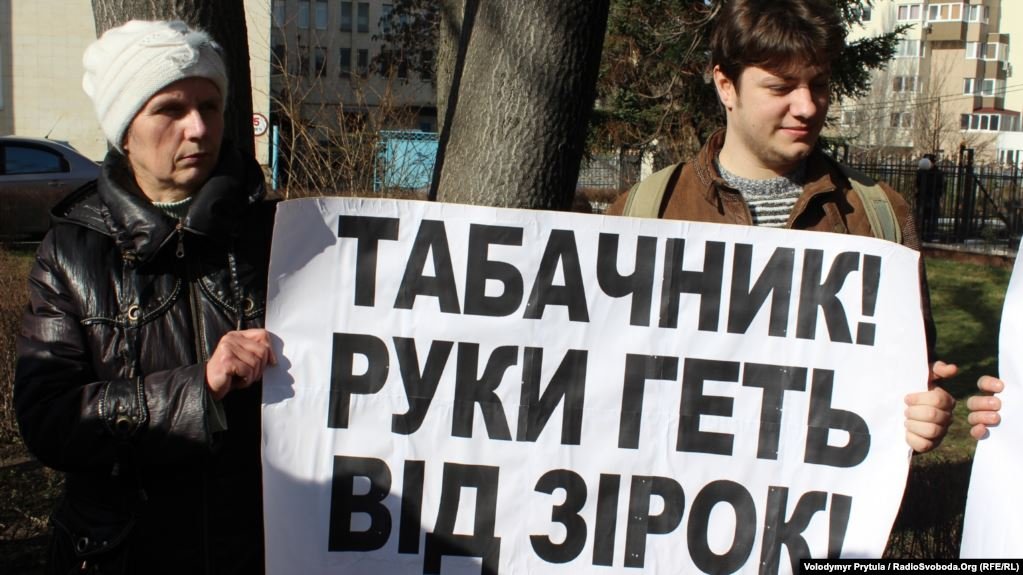
And soon the occupiers arrived in Crimea, and Konstantinov, who was and remains the first servant of the Putinists, got all the opportunities to implement the project. "Konsol" has already announced the sale of housing in the elite settlement. And we are no longer talking about cottages, but about high-rise buildings: a new 12-story building with a SPA complex, allegedly a rehabilitation center for veterans of the war against the Afghan people, and also, probably, both Chechen wars (and over time, probably, the current anti-Ukrainian war as well?). In 2015, the "Konsol" firm had already built a residential complex with the cynical name "Lisovyi" (Forest). When the forest is chopped, woodchips fly, and apartments are sold?
Before the Russian annexation of the peninsula, astrophysicists repeatedly protested against the development of the buffer zone, appealing to the "central" government in Kyiv. Back then, someone was still listening to them. If in 2014 some of the Crimean scientists had confidence that the arrival of the Russian "new order" would resolve the painful issues, now they too have realized that there is no more order, and protesting is no longer allowed.
Oleksiy Baklanov, scientific secretary of the Crimean Astrophysical Observatory, in an interview with the "Krym 24" TV channel, said that new buildings near the telescopes will obstruct observations of the starry sky with their light: "Even now, our observatory cannot observe such objects as the satellites of Uranus and Neptune. Over time it will only get worse, so measures are needed to resolve this issue. Such a measure could be the introduction of a buffer zone around the observatory. Right now, a draft resolution is in the Russian government, and we hope..." — and so on, and so forth. Hoping, unlike dreaming, is often very harmful. Especially considering that a treaty with Russia is not worth the paper it is written on.
In December 2018, a private developer from Moscow started construction work directly in the 3-kilometer buffer zone of the observatory. And in the current year of 2019, construction work on the "Konsol" hotel continues. It is good that it is not "Konstantinov" at least...
The boors, who finally gained power on the peninsula with the beginning of the occupation, also want a place under the sky, in a picturesque area, and also want to breathe clean air.
The Crimean Observatory was nominated by Ukraine as a candidate for inclusion by UNESCO in the list of World Cultural Heritage sites, but, unfortunately, the consideration of the issue hung in the air due to the occupation of Crimea. If only, if only, if only...
If only Crimea remained Ukrainian... If only close state attention were paid to scientific research in Ukraine... If only UNESCO had included the observatory in the list of world heritage sites, then the development of this territory would have been banned. But without civilized control and support from UNESCO, that status is meaningless.
The starry sky above us and the moral law within us — this phrase of the philosopher matches remarkably well what is happening today in Crimea with the Crimean Astrophysical Observatory. Especially if individuals with a primitive inner world, who do not care about the fundamental questions of the structure of the universe and the search for truth, become leaders of society and snatch power.
Supported by the Ukrainian Cultural Foundation