Crimea in Works of Foreign Literature: «Let's smile! Let's smile!»
The novel of the English writer Beryl Bainbridge 'Master Georgie' and what place Crimea occupies in it.
Valeriy Verkhovsky. "Krymska Svitlytsia" newspaper, 2018, issue No. 26
English writer Beryl Bainbridge was born in 1932 in Liverpool. Her creative debut took place in a rather arbitrary form back at school — she was expelled for an indecent poem. However, Beryl was soon playing in a local theater, and later wrote the novel "Harriet Said". Her debut publication was the novel "A Weekend with Claude" (1967), followed by "Another Part of the Wood" (1968) and "The Dressmaker" (1973). For the book "The Bottle Factory Outing" (1974) she was awarded the Guardian Prize, and the novel "Injury Time" (1977) brought her the Whitbread Award. The novel "An Awfully Big Adventure" (1989) was filmed, with Hugh Grant playing the lead role.
Bainbridge also writes on historical themes, in particular, in 1998 she released the novel "Master Georgie", which is worth talking about, as Crimea occupies a significant place in it.
In the first part of the work, the action takes place in Victorian England, but this is still the exposition and exposition: Master Georgie, after whom the novel is named, is a surgeon and photographer (one of the first pioneers of photography); Myrtle is an orphan girl in love with him, and more than a mistress; Georgie's apprentice in photography is Pompey Jones, a former street comedian; the geologist and naturalist is Dr. Potter, a good friend of George Hardy.
In the second part of the book, this entire company goes to the Crimean War. The Crimean War entered history with many innovations. In particular, photo reports from the theater of operations and the appearance of the service of sisters of mercy in the war.
"We landed on the western coast of Crimea on September 14. No one knew if the Russians had information about our invasion, and bad premonitions about what awaited us tore my heart. In fact, we were met by absolutely nothing, at least — we did not meet any people. The shore was empty, and on the distant mountain ridges there were also neither troops nor guns."
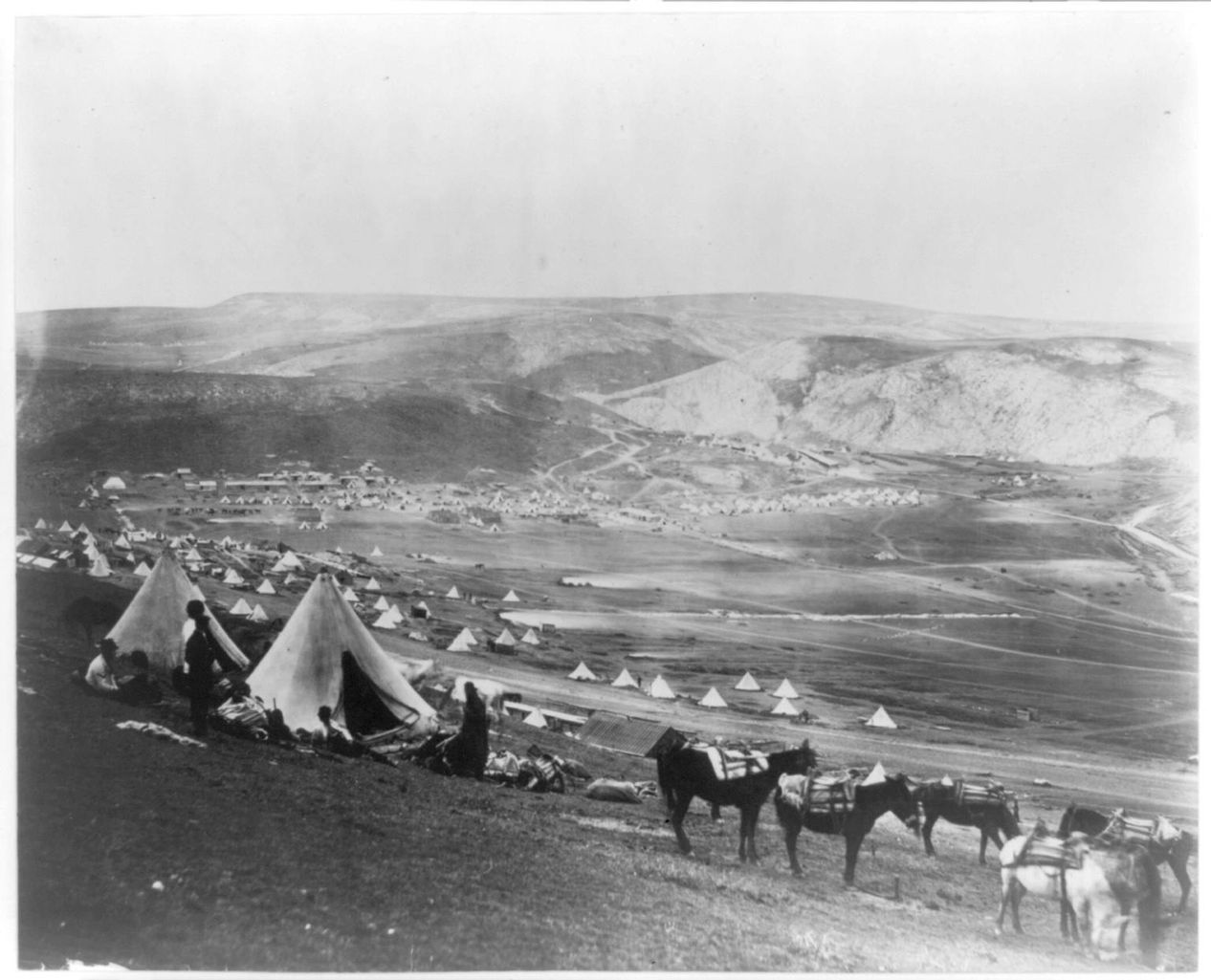
Balaklava, 1855
George Hardy's friend, geologist and naturalist Dr. Potter, had been to Crimea for scientific purposes long before the war; his knowledge could be useful to the British army. Myrtle is ready to go to the ends of the earth just to stay close to Georgie. Pompey Jones is already an assistant photographer to a photojournalist of an influential newspaper, and George himself has become a surgeon of the British army. "The valley in which we are located resembles the outlines of the Isle of Wight, Balaklava is located to the east of us, and Sevastopol is to the south. From the steep slopes of Sapun Mountain, a panorama of the Chorna River and the town of Balaklava is visible."
In war, as in war: "It is useless to guess who will survive and who will not." George Hardy is assigned to a military hospital, and Myrtle becomes a sister of mercy. That mercy, which in this hell was a rare phenomenon.
"Potter and Myrtle settled with George in the field hospital, only now it resembles a meat pavilion more. Not a single day passes without a new batch of wounded. Seven have already lost either a leg or an arm, and for the rest they had to be amputated... At first, Dr. Potter fled the tent when George took up the saw. Now he remains, but sits by the stove, pretending to read his book." Nurses and military doctors saw the war from a different side...
Not a battle, but pain: here in the hospital, you won't see shiny medals and brave parades; there is no heroism here — it all remained on the line of contact, at the "zero". No one shouts "hurrah" here, they howl like beasts from pain. They do not glorify Her Majesty here, because it is not she who rules in this place, but the One with the scythe. There is not even a division into allies and enemies here, because everyone here is a victim. Here is blood, severed arms and legs, and lots and lots of suffering.
The writer does not spare epithets and metaphors in depicting this "backside" of war. Master Georgie is killed while carrying a wounded man from the battlefield, but the photographer of the "influential newspaper" gathers the living in front of his camera lens. He needs to record the survivors of this slaughter for the chronicle. He lacks "manpower" for the photo report back home; he asks for "one more soldier", then grabs the dead and intact Georgie, with arms and legs, stands him in the middle of the group, and calls to those present: "Let's smile! Let's smile, people!".
Just an extra drop of the cynicism of war in a sea of absurdity and cruelty...