Crimean Roadlessness
Development of Crimean roads.
Petro Volvach, Full Member of the Shevchenko Scientific Society (NTSh), Member of the National Writers' Union of Ukraine (NSPU), Honored Worker of Science and Technology of the AR of Crimea, Crimean resident with 60 years of experience. "Krymska Svitlytsia" newspaper, 2017, issue No. 22
The Crimean War of 1854-1856, ignominiously lost by the Russian Empire, highlighted one of the most painful problems of the Russian Empire — the lack of transport infrastructure. It was this factor that became the main reason for Russia's actual loss of this war. After all, the lack of a railway connection with the mainland of the country did not allow for the provision of the army with weapons, ammunition, food, and medicines in sufficient volumes. Due to the blockade of most Crimean ports, the overland communication route and horse-drawn transport turned out to be the only ones possible to supply the Russian army and the Black Sea Fleet.
Realizing this, already in the first postwar years, the Tsarist government set an ambitious task for the country — to connect the mainland and the Crimean Peninsula, and above all Sevastopol, with a railway network. After the reform of 1861, the construction of the railway was widely launched in Crimea, which connected the main Crimean cities and ports of the Black Sea with the industrial centers of the country. And this, in turn, had a very positive effect on the development of both domestic and foreign trade, breathed new impulses into economic life, and stimulated the development of a whole range of industries in Crimea.
In 1875, the construction of the Lozova-Sevastopol railway line was completed. It largely revived the economic development of the city and contributed to increasing the defense capability of the Black Sea Fleet. To connect the central agricultural regions of Crimea with Feodosia and the Kerch Peninsula, the Dzhankoy-Feodosia line was built in 1892, and in 1920, the Vladyslavivka-Kerch railway branch was put into operation. Thus, almost the entire Crimean railway network was created long before the Bolshevik coup in 1917, and the Soviet government used this heritage inherited from the Tsarist authorities without making special efforts for several decades.
Active road building from the Foothills to the South Coast began in 1824. It took almost 25 years to build the Crimean Mountain Highway. In 1826, they finished the section from Simferopol to Alushta, and in 1837 — from Alushta to Yalta. The next 10 years were spent building roads from Yalta to Sevastopol. Due to a rather complex relief and constant landslides, the construction of the South Coast road was completed only in 1848.
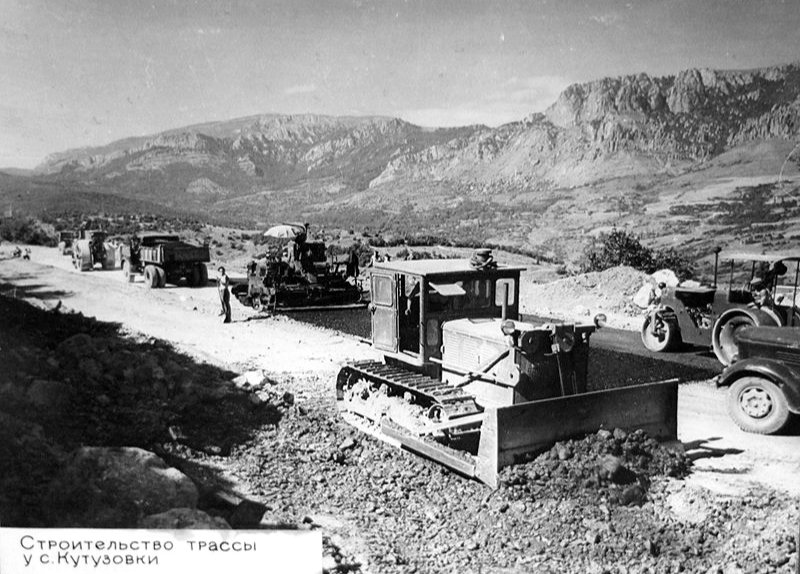
Perhaps the most significant achievement of the first decade after World War II in Crimea was the construction of the Moscow-Simferopol highway. The road was built by tens of thousands of German and Romanian prisoners of war, and therefore the quality of the road surface was high. The mentioned highway was preserved until the construction of the North Crimean route. Some sections in the Dzhankoy and Krasnohvardiiske districts are preserved to this day.
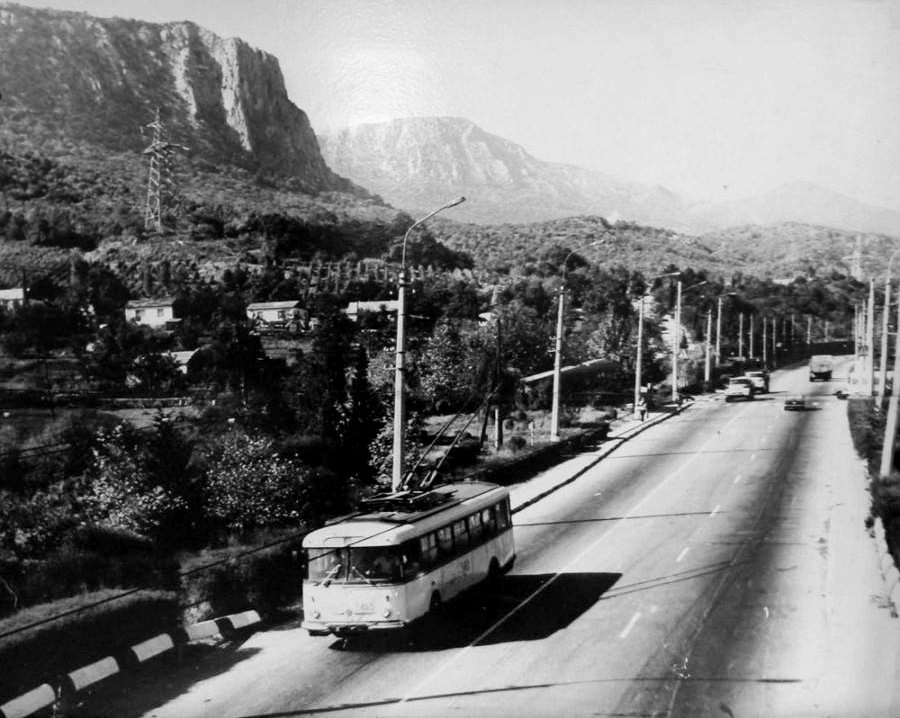
Construction of Europe's first mountain trolleybus route Simferopol-Yalta
A reference prepared by the department of party bodies of the Crimean Regional Committee of the Communist Party of Ukraine (CPU) of the Central Committee of the Communist Party of Ukraine, dated August 1954, testifies that the railway lines on the territory of Crimea in the postwar years were part of the Stalin Railway with a branch in Simferopol. The total length of railway tracks on the peninsula was 800 km. The region had five railway divisions — Simferopol, Sevastopol, Dzhankoy, Aivazovsky, and Kerch. More than 10,000 workers and employees worked in the railway sector. The average daily load in 1953 was 757 cars per day.
Grain, fluxes, sinter, mineral, and construction materials were mainly transported by rail. To service road transport and highways in Crimea, there was a specialized trust of the Union Ministry of Transport and Highways. It included 8 city and district transport enterprises, which had 250 trucks, 230 buses, and 124 cars. The trust employed 2,400 people. In total, there were 17,000 cars in the region, including 4,000 passenger cars. The total length of roads of III-IV class of Union significance in the region as of August 1954 was 884 thousand km. At that time, a highway between the cities of Feodosia and Kerch, with a total length of 120 km, was still being built.
Ensuring the vital activity of the South Coast, servicing the sanatorium and resort sector, and delivering and removing vacationers from resorts forced the authorities to constantly think about options for laying a railway to the South Coast, a question that arose back in 1890. Since then, many fantastic projects have been submitted to government structures for consideration. A special commission was even established under the Ministry of Railways, which studied all submitted projects. Having calculated all the costs provided for by the projects, the commission concluded that it was possible to implement even one most optimal project only by using state resources.
At the request of the government, the South Coast Railway was supposed not only to serve the resort sector but also to perform important military-strategic tasks. There were several attempts to start the implementation of this ambitious project. In 1905, the war with Japan prevented the project's implementation. The provisional government also tried to implement the project. But due to revolutionary events and the civil war, this construction was stopped.
In 1926, at the direction of the People's Commissariat of Railways, a project was developed for the construction of an electrified railway from Sevastopol to Alushta. But the destructive earthquake of 1927 cooled hot heads, and the project was never implemented. Another construction project envisaged building a primary railway not from Sevastopol to Alushta, but from Simferopol to Simeiz. A technical design for this railway was even drawn up, but its construction was never started.
In 1944, the Union People's Commissar of Railways, Kaganovich, issued another order by letter to start survey work for the construction of a railway from Yevpatoria to Feodosia. For this, it was planned to use the already existing railway section from Feodosia to Kerch and further to the Kerch Strait and the Caucasus. But it turned out that the route could not meet the requirements of the project. Therefore, they had to bypass some problem areas, namely: the problematic Livadia Park in the area of the Upper Highway. But despite this, the railway cut through not only resort areas but also residential areas.
As the authors of the project, which was never implemented, noted, the construction of the future railway was planned to be carried out much higher than the Upper Route. In the area of Frunzenskoje (now Partenit), it was to join the route of the Ministry of Railways. The length of the Yevpatoria-Feodosia line with access to Alushta was to be 398 km. Fortunately, this adventurous and ecologically dangerous idea for the nature of the South Coast was never implemented.
When the Crimean region was transferred to Ukraine, Ukrainian specialists proposed to lay a high-speed, environmentally friendly trolleybus route from Simferopol to Yalta, with a length of over 90 km. This option turned out to be the most optimal and environmentally friendly. Therefore, the huge merit of the Ukrainian state and our people lies in the fact that we saved the unique nature of the South Coast from inevitable disaster.