White Sands of Belyaus
Contrast landscapes of the Crimean Peninsula coast.
Maksym Dubovyaz. "Krymska Svitlytsia" newspaper, 2017, issue No. 14
Crimea, like a tiny continent, is rich in contrasting landscapes. Except that tundra and taiga cannot be found on this peninsula, which can be walked around in a summer. It is not limited to the almost tropical luxury of the Yalta mountain sub-Mediterranean, nor to its boundless steppe. The gentle Black Sea, which embraces it almost from all sides, creates something on its shores that seems close, but as if from some strange distance. And only modern means of overcoming space squeeze all this into a pile of barely noticeable wonders that the average holidaymaker leaves outside the scope of summer rest.
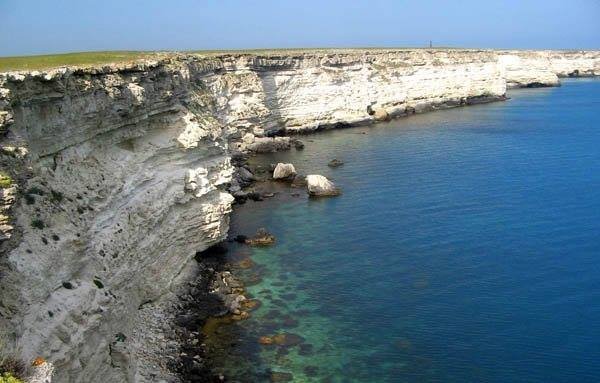
Anyone who traveled through Western Crimea, or even just drove from Simferopol towards Yevpatoria and perhaps further, felt strange changes in the interaction of space and time there. Especially if a person is already familiar with the South Coast, where each cape is like a modern work of art, each subsequent peak is distinctly different from the previous one... And here suddenly flat space, the engine hums, the car rushes, the long minutes flow and... almost everything around is unchanged. The steppe is flat, right to the horizon, and the sea, distant and shiny, is somewhere beyond the edge. And besides the light rustling of tires, there is a ringing desert silence... And one can imperceptibly rush onto Tarhankut, without ever knowing the purity of the white sands of Belyaus.
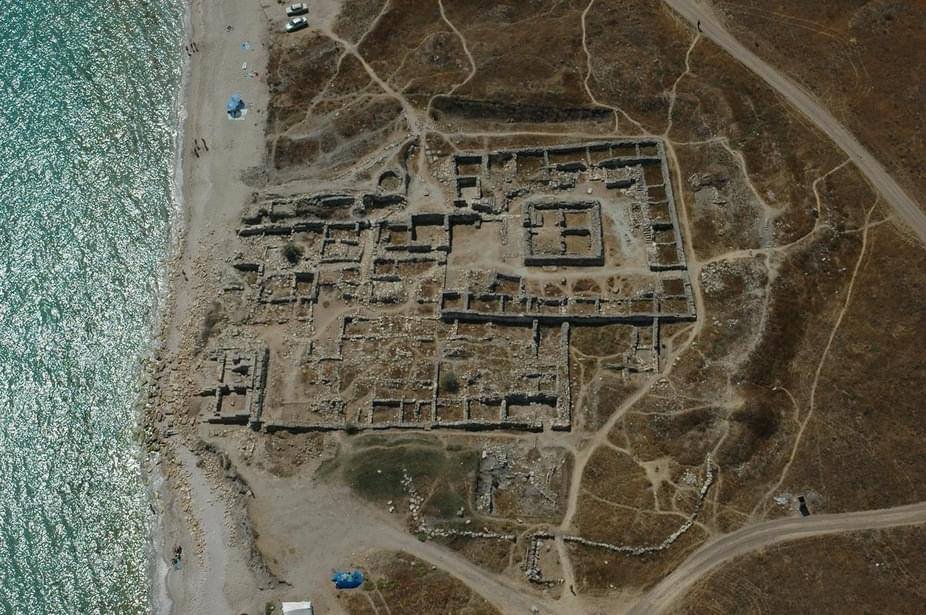
This is the present, but two millennia ago there was a fairly large city here, and archaeologists have been carefully excavating Belyaus for many years. People lived in this city 400 years before the beginning of the common era, and already in the new Christian era, probably for about a hundred years. Stones carefully carved and fitted into the masonry of the former powerful combat tower testify to a developed culture of construction. Yes, they were Hellenes. The archaeological fame of Belyaus attracts the curious, and primarily it is known precisely as a monument of antiquity.
Spoiled by the requirements for comfort of rest, the ordinary vacationer does not come here. Nearby are several small villages, behind — Yevpatoria, 60 km away, but Yevpatoria is a completely different story. And between it and Belyaus is Donuzlav. We also need to talk about it separately, here it is worth mentioning only that it was a lake until recently. In the 1960s, it was connected to the sea by cutting the spit that separated them. Two spits were formed; the northwestern of them is Belyaus.
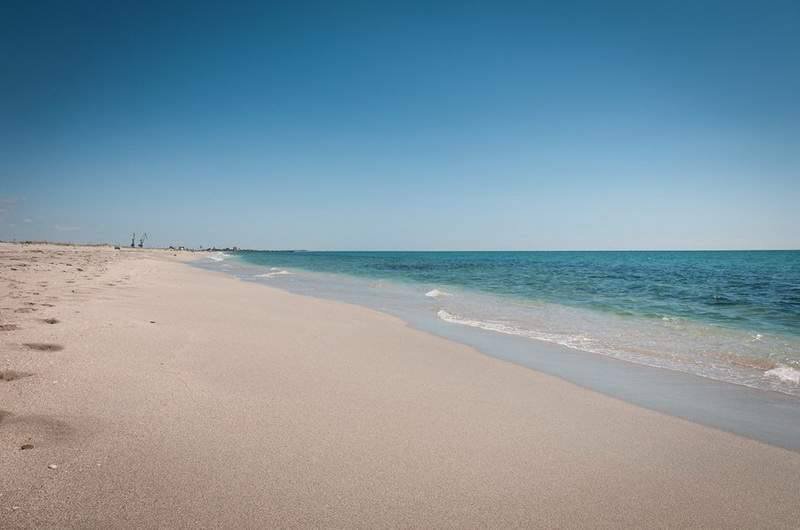
Here is the cleanest sea in Crimea. There is no silt in the sand; it is made of shells crushed by the sea, and this clean sand is slowly mined, and the Martian figures of two industrial lifting mechanisms decorate the deserted landscape. But their remote presence does not bother those who choose these places for recreation. On the opposite side of the spit from the sea, one can find a patterned shade under the mounds of wild olive, and enjoy the silence and purity of the sea and the glow of white sand. The rest must be brought with you. So this fragment of the mosaic of Crimea's diversity is not for everyone to choose, and therefore there are not many people here.
Further the coast becomes more rocky, further to the west — only 20 km away — is Tarhankut, and this is a completely different story, but a legend, as if from another space or time. Crimea is different. Tiny like a continent. Not everyone will find Belyaus in it. The Hellenes found it two thousand and more years ago. And they did not leave it for half a millennium. Apparently, there is something there that does not let go, some force of Crimean gravity, one of many, not like the others.