Blockade of Crimea – 1918
Economic blockade of Crimea by the Ukrainian State of Hetman Pavlo Skoropadsky.
Serhiy Konashevychev. "Krymska Svitlytsia" newspaper, 2018, issues No. 33-34
A century ago, in mid-August 1918, the economic blockade of Crimea by the Ukrainian State of Hetman Pavlo Skoropadsky began. Like the peninsula itself, it was under the actual control of the German army. However, in the summer of 1918, Skoropadsky had "Great Ukrainian" ambitions, desiring the expansion of the state's territory — including at the expense of Crimea, as well as the acquisition of the Black Sea Fleet, the loss of which "would be a painful blow to the national pride of the Ukrainian people."
In his memoirs, he noted: "Ukraine cannot live without owning Crimea: it will be some kind of torso without legs. Crimea must belong to Ukraine. Under what conditions — it does not matter, whether it will be a complete merger or broad autonomy: the latter will depend on the desire of the Crimeans themselves. But we must be completely secure from hostile actions from Crimea. In the economic sense, Crimea actually cannot exist without us. I resolutely insisted on the transfer of Crimea under any conditions, of course, taking into account all the economic, national, and religious interests of the population.
The peninsula, relatively sparsely populated by Ukrainians, was not part of Ukraine. One has only to look at the map to understand immediately how much such a state lacks the data to be viable. If under some conditions such borders could finally be established, without a doubt, Crimea would become the bitterest enemy of Ukraine." The Hetman understood the great economic dependence of Crimea on Ukraine, which supplied grain, sugar, fats, wood, metal, coal, etc., in exchange receiving salt, wine, tobacco, fruit, etc.
At the meeting of the Council of Ministers on May 7, the issue of Ukraine's borders was considered; at the same time, it was prescribed to "pay special attention to the need to annex Crimea." On May 10, the Hetman sent an official note to the German Ambassador Alfonse Mumm von Schwarzenstein, emphasizing the need for Ukrainian control over the peninsula: "The establishment of its borders, especially the southern one, and thus the possession of Crimea, is of particular importance for the revival of Ukraine. The annexation of Crimea would be of such importance for the Ukrainian State that it would be provided with essential products. The possession of Crimea would also make it possible to save a lot of money in Ukraine by organizing new and rebuilding old resorts.
In addition, by owning the southern coast of Crimea, Ukraine would receive natural ports such as Sevastopol and Feodosia. Without Crimea, Ukraine was cut off from the Black Sea. Ukraine could not become a strong state without Crimea, especially from the economic side. Unnaturally cut off from the sea, Ukraine would definitely have to strengthen its desire to capture the sea coast, and at the same time, relations with the state to which the possession of Crimea would be transferred would aggravate. Moreover, from the ethnographic side, the existence of the planned Tatar state would be unjustified, because Tatars make up no more than 14% of the Crimean population."
On May 16, a meeting on the Crimean problem was held at the Ministry of Foreign Affairs with the participation of government officials, military personnel, and scientists, during which it was noted that without Crimea, Ukraine would be thrown back to the east and north, into the arms of Moscow, and its independence would be illusory. On May 30, the head of the department Dmytro Doroshenko communicated the official position of the Ukrainian government on the Crimean issue to the German and Austro-Hungarian ambassadors, noting: "Standing on the principle of self-determination, not wishing to violate the will of the population, finally, understanding the different features in the life of Crimea, the Ukrainian government believes that the annexation of Crimea can take place on autonomous bases, in connection with which a corresponding draft will be developed; knowing the mood of the vast majority of the population of Crimea, keeping in mind the interests of this population and its long-standing ties with the Ukrainian government, there is no doubt that the will of the population of Crimea can be expressed only in favor of union with Ukraine."
He also addressed the German government with a note explaining the discrepancy between Ukraine's demands on the "Crimean issue" and the decisions of the III Universal of the UNR, noting that in November 1917 only the main parts of the territory of Ukraine were established, and "those lands where the Ukrainian population does not have an absolute majority will join later." Considering that Ukraine became an independent state, and the Ukrainian army "with the help of the friendly German army took Crimea into its hands," the question arose of annexing Crimea to it. However, the last word belonged to the German military.
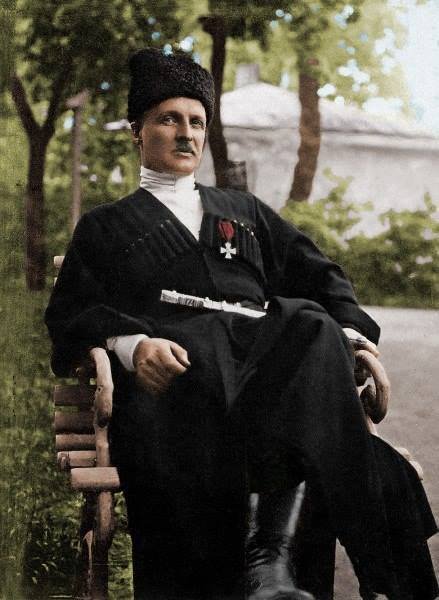
Hetman Pavlo Skoropadsky, 1918
Doroshenko recounted in his memoirs: "The matter of annexing Crimea to Ukraine was quite complicated due to the special policy of the Germans. When Ukrainian troops, together with them, cleared Ukraine of Bolshevik bands, the advanced detachments crossed Perekop, occupied the strategically very important station of Dzhankoy, and marched on Simferopol. The local population welcomed the Ukrainians with enthusiasm. But the Germans forced them to hold back and then leave Crimea. Only northern Tavria remained with Ukraine.
Under the protection of the Germans, the national Tatar assembly 'Kurultay' met again, but nothing came of it: power was seized by Russian elements of Crimea, who organized the regional Crimean government, which included mainly former prominent officials of Tsarist Russia — the former Russian ambassador to Constantinople Charykov, Count Tatishchev, Senator Akhmatovich, and others. This government, of course, regarded itself as temporary, transitional, until a single and indivisible Russia was rebuilt. It did not even want to hear about any dependence on Ukraine.
But we could not give up Crimea for a number of very serious reasons: political — not wishing to have a Piedmont for a future Russia close at hand, strategic — not being able to leave Sevastopol in foreign hands as a base for the Ukrainian fleet and the key to dominance in the Black Sea; finally, there were purely ethnographic reasons — the high percentage of the Ukrainian population in Crimea. I do not even mention the close economic relations of Crimea with Ukraine, without whose products it could not survive.
We relied not only on historical, economic, and other arguments, but also on the will of the population itself — in fact, it wanted to join Ukraine: both Tatars, German colonists, and Ukrainians. Only the Russians who found themselves in power did not want this. They became great Crimean independence advocates and, bypassing Kyiv, wanted to have direct relations with Berlin."
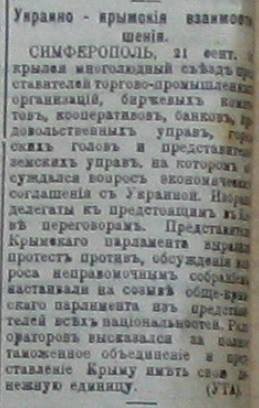
Press publications of the time
With the permission of General Robert von Kosch, who commanded the corps quartered in Crimea, the so-called Crimean Krai Government was formed in June, headed by Lieutenant General Matvey (Suleiman) Sulkevich — a Lithuanian Tatar, former commander of the 1st Muslim Corps, a convinced monarchist of pro-Russian orientation. In the government appeal to the population, the independence of the peninsula was proclaimed until its international situation was clarified, "restoration of law and order"; furthermore, a strict ban was imposed on any discussions regarding this declaration.
However, the very first weeks of Crimea's "independence" demonstrated the complete economic dependence of the peninsula on Ukraine: "The citizen is used to receiving any amount of bread freely — now, with the presence of cards, he stands in line near bakeries since evening. There is almost no oil and fats on the market. Prices for products rise every day."
The leadership of the Ukrainian State did not recognize the new Crimean government. In his memoirs, Skoropadsky told how "one fine day" at the end of June, the Chairman of the Council of Ministers Fedir Lyzohub came to him and informed him about a telegram from Sulkevich, in which the latter proclaimed that he was at the head of the government, "and along with the instruction, in a very insolent form, that he does not understand the Ukrainian language and in future insists that his government be addressed in Russian" (at the same time, Russian was proclaimed the state language in Crimea, while Crimean Tatar and German could officially be used). "The beginning was bad.
All correspondence and, in general, all official relations with states and citizens took place in the Ukrainian language. We were answered in our own language, that was the way it was. In Ukraine, the official language was Ukrainian, and it was not up to Sulkevich to change the established order. After some time, we learned that the new Crimean government pursued a new policy, not at all friendly to Ukraine, and pursued the goal of creating an independent state; at the same time, the whole direction clearly breathed some kind of antagonism," the Hetman recalled.
The "antagonism" manifested itself in the fact that telegrams and official papers in the Ukrainian language were not accepted, Ukrainian district starosts appointed to Crimea were forced to leave the peninsula, and persecution of the Ukrainian press began. In particular, Doroshenko's memoirs note that to support the Ukrainian cause and orientation in Crimea, the Ministry of Foreign Affairs financed three local newspapers that promoted the idea of the great benefit for the peninsula of joining Ukraine; also, communities of Crimean Ukrainians were subsidized through the unofficial "Committee of Steppe Ukraine" specially established under the ministry, whose task was to spread the ideas of joining Ukraine in Crimea.
Next, Sulkevich issued an order "not to enter into any relations with the government of Ukraine, and in case of receiving demands from the government of Ukraine, not to fulfill them" and an instruction on establishing the border with Ukraine, trying to leave Chongar with salt mines and the Arabat Spit to Crimea. In turn, the Ukrainian government wanted to establish the border south of Perekop; consequently, two dumas and commandants' offices were formed in the town, and shootouts between border guards were not uncommon.
In July, the Ukrainian municipal government issued an order to sell grain grown by local peasants after threshing in Ukraine, and not in Crimea. On August 9, the Perekop district head addressed a report to the Ministry of Internal Affairs of Crimea: "I informed the Ukrainian commandant that from August 5, entry to and exit from Crimea is prohibited, and that the German command considers the border of Crimea to be running 8 versts north of Perekop." Both sides tried to enlist the support of the German command, but Berlin tried to maintain the status quo, leaving both state entities as satellites of Germany.
"Then we had to apply repressions on our part. There was no need to wage war with Crimea — it was enough to declare an economic blockade of the peninsula," wrote Dmytro Doroshenko in his memoirs, who became its actual initiator: in particular, he insisted in the Council of Ministers on the start of a "customs war" in mid-August, when "any movement of goods and sea communication was stopped, except for what went to the needs of the German garrisons in Crimea," as well as railway and sea connections, trade operations, postal communication, etc. "The harvest of vegetables was approaching, which turned out to be very good that year.
Crimean horticulturists needed slats for vegetable boxes, shavings, sawdust for packing; all this was brought, of course, from Ukraine, but now the delivery was stopped. They also needed sugar for preserving vegetables, firewood for drying — and none of this was available either. Finally, bread was needed for the population. In a couple of weeks, prices for all products in Crimea jumped terribly. The harvest began to rot without preservation, the situation of gardeners was becoming catastrophic. The Germans had already bought many vegetables in advance, fresh and dried, and now all this was perishing. It was impossible to carry them by sea, because no Crimean vegetables could withstand long transport by sea and then a new reloading on the railway," he recalled.
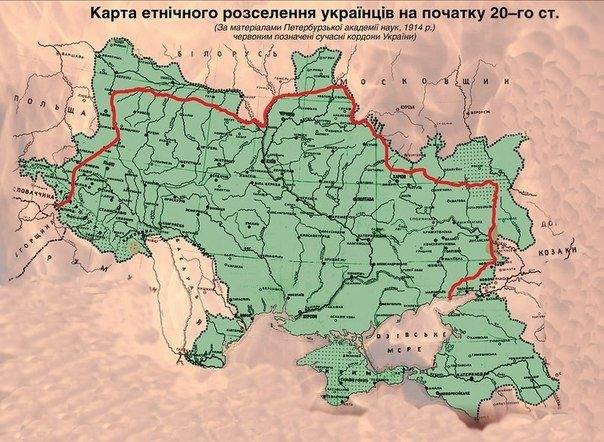
Map of ethnic settlement of Ukrainians at the beginning of the 20th century
In essence, the Ukrainian blockade of Crimea began back in June. Thus, in the twenties of June, the provincial starost of Northern Tavria, by his order, prohibited importing butter, eggs, and other products to Crimea, and later the Ukrainian government ordered the requisition of all goods going to Crimea. Consequently, Crimea was deprived of Ukrainian bread, and Ukraine of Crimean fruits. This significantly worsened the food situation in Crimea. From the end of the month, the municipal administration of Simferopol introduced bread cards (1 pound per day per person), and Sevastopol at times found itself on the verge of starvation.
According to other sources, the blockade of Crimea began on the initiative of the Ministry of Finance of the Ukrainian State on July 7, 1918. In mid-July, "people of the merchant class" emigrated from the peninsula. The August economic isolation of Crimea soon led to a significant worsening of the food situation of the population, which was aggravated by the drying up of rivers and springs and the disappearance of water from wells, as well as periodic outbreaks of cholera.
Industrialists, gardeners, local bodies of zemstvo and municipal self-government began to put pressure on Sulkevich's government, demanding the restoration of relations with Ukraine up to the inclusion of Crimea in its composition on autonomous principles.
So, for example, the congress of the Tavria Union of Millers spoke in favor of economic union with the Hetmanate, and the Simferopol Union of Gardeners appealed to the Ukrainian and Crimean governments with a call to cancel the tariff blockade; the representative assembly of delegates of trade and industrial organizations, banks, cooperatives, stock exchange societies, and food administrations also spoke in favor of a customs union with Ukraine. It even came to attacks on the buildings of self-government bodies.
However, Sulkevich's government continued its policy of confrontation with Ukraine, and its emissaries in Berlin sought pressure from the German government on Skoropadsky to lift the economic embargo. However, Germany's summer failures on the Western Front made its leadership more compliant regarding the Hetmanate's plans for Crimea. "From June 25 to September 9, we did not receive a single demand, proposal, or request from Ukraine — they simply did not speak to us and by all means sought only one thing — the subordination of Crimea, unconditional surrender," stated officials of the Crimean government. On September 12, Minister of Education Sokovin, Minister of Food Rann, Deputy Minister of Internal Affairs Prince Gorchakov, and State Controller Nalbandov resigned: "The resignation was caused by their demand that public figures be invited to the ministry because important issues had to be resolved, including the relationship with Ukraine."
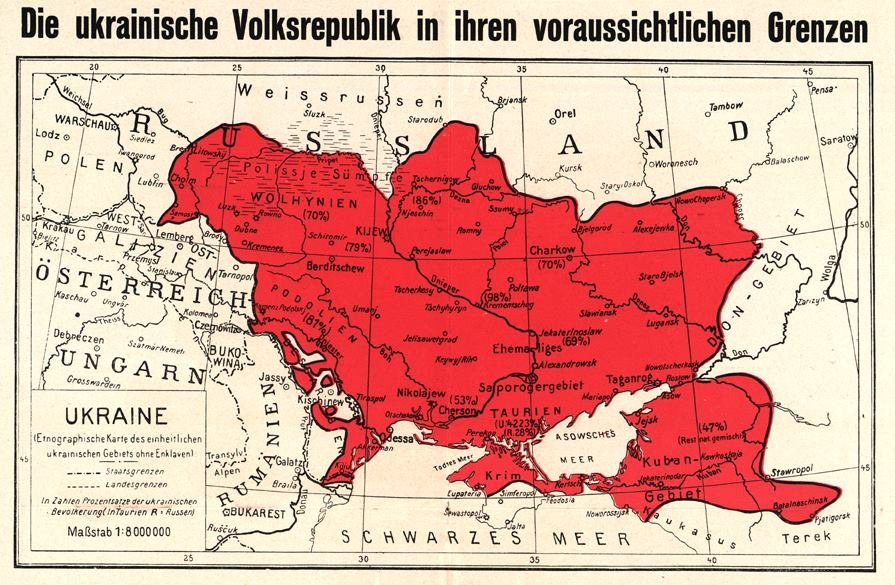
Ethnographic map of Ukraine, German edition of 1918
When food supplies from Crimea to Germany were on the verge of breakdown, the Chief of Staff of the German occupation forces in Ukraine, Lieutenant General Groener, addressed the Chairman of the Council of Ministers Lyzohub with a telegram of the following content: "Relations between Ukraine and Crimea in recent weeks are so strained, both in political and economic terms, that if changes do not occur in the near future, there is a possible threat of a further increase in the difficulties that take place, and which harm the interests of Ukraine and Crimea."
The Ukrainian Premier agreed to negotiate with representatives of Crimea if they "addressed the Ukrainian government directly or through the Oberkommando." "We gave an answer that the Ukrainian government had undertaken obligations to supply products to Germany, but we did not take such an obligation on ourselves with regard to Crimea; we are ready to meet the interests of the Crimean population, but this depends entirely on the Crimean government, which until now did not want to come to an agreement with us. The Germans did not address us anymore, and Sulkevich's government had to capitulate: a telegram came to us from him that he was ready to begin negotiations on the form of state union with Ukraine. The blockade was lifted," Dmytro Doroshenko wrote in his memoirs.
The precondition was Skoropadsky's state visit to Germany in the first half of September, when consent was actually obtained for the inclusion of Crimea in the Ukrainian State. In Berlin, the Hetman met with the Deputy Minister of Finance of Crimea, Count Vladimir Tatishchev, who "completely changed his views on the Crimean issue" and believed that the merger of Crimea with Ukraine was quite possible, but on condition of ending the economic boycott.
Having taken a number of measures for this, the German side insisted on the creation of a union of Crimea with the Ukrainian State; in case of Sulkevich's refusal to carry out this course, the issue of his replacement was considered. Consequently, on September 18, the Council of Ministers decided to temporarily suspend the customs war on condition of the immediate arrival of Crimean plenipotentiaries for negotiations in Kyiv (at the same time, by the way, the recently appointed Crimean Minister of Food Moldavsky resigned). Telegraphic and postal communications between Crimea and the mainland were also restored.
The first experience of negotiating in Kyiv at the end of September turned out to be fruitless. Doroshenko blamed the failure of the negotiations on the Crimean delegation, which "showed a very unstable tone and in every way bypassed the directly posed question of union with Ukraine, spoke about the rights of peoples to self-determination, about the will of the Crimean population, etc." The Ukrainian ministers declared that they did not recognize the Crimean delegates as competent to express the will and desire of the entire population of the peninsula, demanding the arrival of representatives of the main national groups.
A week later, leaders of the Ukrainian, Crimean Tatar, and German communities arrived in Kyiv. While Simferopol proposed to start work by discussing economic issues, Kyiv insisted on the priority of political ones: at a joint meeting of delegations on October 9, a declaration outlining the principles of the regional constitution was published, which began with the fact that Crimea "unites with Ukraine on the rights of an autonomous region under the single supreme power of the Hetman."
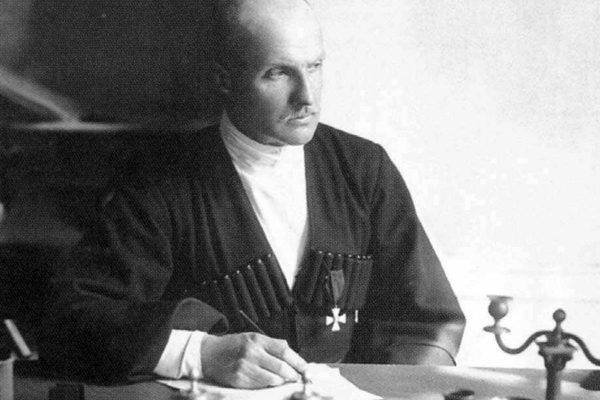
Pavlo Skoropadsky
In total, the list of "Main grounds for the union of Crimea with Ukraine" included 19 positions: according to them, international relations, management of the army and navy, civil and criminal legislation, appointment of senior officials of the autonomy and approval of local laws, financial and customs systems, and communications were to be in the competence of Ukraine (true, Crimea could have its own armed forces), while local self-government (regional government and people's assembly with the right to draft local legislation), trade, local budget and taxation, industry and agriculture, farming, public education, religious, national, and judicial affairs, healthcare, and transport routes (except railways) would be subject to Crimea.
The peninsula had a chance to receive quite a wide autonomy as part of Ukraine, but the Crimean delegation, insisting on its "complete independence and sovereignty", assessed the "Grounds" as a project of "enslavement" rather than union, and proposed to establish a federal union with the Ukrainian State and conclude a bilateral agreement. The Ukrainian side ignored this demand and on October 10 interrupted the negotiations, stating that "everything further will be polemics and private conversation."
"Our guests sat at dinner in such a mood, as if at a funeral. Representatives of the nationalities felt more cheerful, but, apparently, in the presence of their ministers they did not dare to speak up. The next day, official negotiations began in the presence of a representative from the German High Command, the young Prince Reuss, which lasted a whole week. The Crimean delegates argued a lot, clung to every word, and made long speeches.
Finally, they agreed and drew up preliminary conditions: Crimea received internal autonomy, its own regional parliament, territorial army, and a state secretary for Crimean affairs in the Council of Ukrainian Ministers. These conditions were taken to Crimea to be discussed at the meetings of the 'Kurultay' and some public and national organizations. We agreed to this because we were sure of a favorable settlement of the matter: this was quietly stated to us by the delegates from the nationalities who arrived in Kyiv," recalled Dmytro Doroshenko.
At the end of September, the Crimean Krai Government refused to register the charter of the Sevastopol Ukrainian Club. In parallel at the same time, representatives of the peninsula's food organizations, after returning from the Don and Kuban, brought messages from the governments there that they could supply products to the peninsula — but in exchange for "such goods as are not in Crimea." At the same time, the Crimean government allowed the export of three million puds of salt to the Don, Kuban, Turkey, and Ukraine. Representatives of the "union-city institutions" sent a memorandum to the Prime Minister of the Ukrainian State, Lyzohub, "in which they spoke in favor of the union of Crimea with Ukraine" (at the same time, the Minister of Foreign Affairs of Crimea, Jafer Seydamet, resigned). The assortment of food products on the markets expanded significantly.
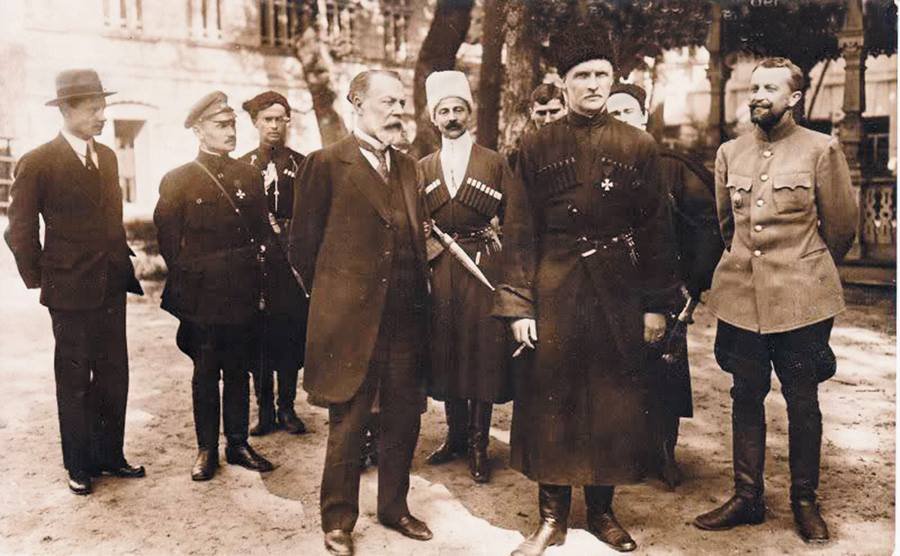
Pavlo Skoropadsky and the head of his government Fedir Lyzohub
The politician and publicist Makar Kushnir, one of the founders of the OUN, responded to the problems of Crimean-Ukrainian relations in his article "Crimea and Ukraine", published in "Nova Rada" (No. 180 of 05.10.1918, p. 1):
"These days, political and state relations between Crimea and Ukraine must finally be clarified. As is known, a delegation of the Crimean government arrived in Kyiv to decide the bases on which Crimea is to join Ukraine. For the Ukrainian public, it was obvious from the very beginning that Crimea has no grounds for being an independent state, that for the population of Crimea after the disintegration of the former Russian state, the best political-state combination should be joining Ukraine on certain political conditions that would provide the Crimean population with wide political autonomy in domestic life.
We proceed from the fact that the population of Crimea is very heterogeneous, that its economic resources are extremely small, that the international situation under such circumstances will be unstable, and because of this its independence will be fictitious, disadvantageous for the Crimean population and harmful to Ukraine.
Indeed, if Crimea were inhabited exclusively by Tatars or Russians, then one could still speak seriously about annexing it to Turkey or Russia, if one does not take into account its close economic connection with Ukraine. But when Tatars make up only 40% of the population, Russians about 20%, Ukrainians up to 25%, and the rest — other nationalities, when economically Crimea cannot survive at all without Ukraine, which was especially evident during the recent economic-customs struggle, when the population itself speaks in favor of joining Ukraine — the attempts of the Crimean government, which, following the Don government, declared the temporary independence of Crimea, waiting for the moment when the restoration of the former Russia begins, suffered a complete fiasco.
Not only the bodies of zemstvo and municipal self-government, but also trade and industrial circles, disagreeing with their government, submitted detailed memoranda to the Ukrainian authorities and made statements in the press about the union of Crimea with Ukraine on autonomous grounds.
Only the representatives of the Crimean government have not yet abandoned their clever plans and insist on a federation of such a nature that resembles more a confederation or union of two independent states. We are deeply convinced that the political and economic interests of Crimea and Ukraine dictate to them the closest form of union, under which the Crimean population would have the greatest benefits and at the same time have an autonomous structure in internal affairs.
Obviously, the financial and trade-industrial policy, railways, post and telegraph, military affairs and the courts, foreign policy and legislation must be common to Crimea and Ukraine. In return, all other affairs of internal life and structure, such as education, agriculture, self-government, etc., must remain in the competence of the Crimean legislative body.
We consider the resolution of Crimean-Ukrainian relations in this way to be the best for both sides and wish that the Crimean-Ukrainian negotiations end as soon as possible, because the interests of the population of both regions demand this. The political and economic interests of Ukraine dictate resolutely that the form of union should be the autonomy of Crimea or a federation of a limited type, and in no case a confederation or union, as demanded by some circles of the Crimean government, emphasizing that they still hope for a world congress that will finally decide the fate of Crimea. For me it is clear that these circles wish to annex Crimea to Russia, and because of this they will now create various difficulties for a quick resolution of the matter. We will hope nevertheless that the Crimean-Ukrainian negotiations will take a different path than the Russian-Ukrainian ones."
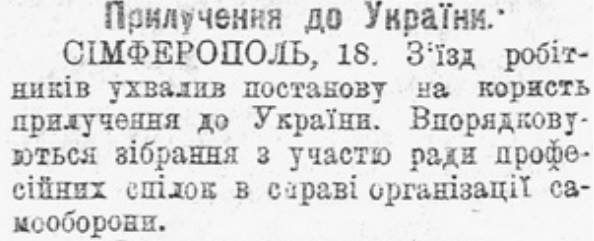
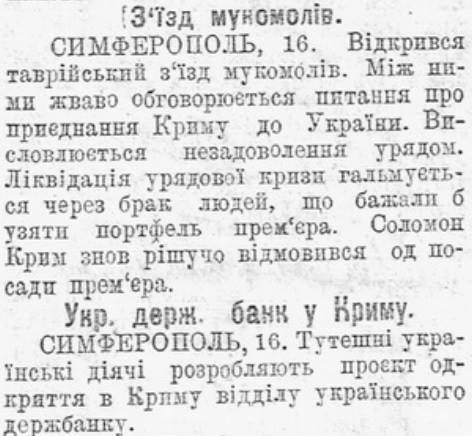
In the first half of October, the border established by the government of the Ukrainian State on the Arabat Spit was removed — however, the customs control "due to an oversight of the Ministry of Finance" was not completely removed, but only slightly relaxed: in particular, the customs office near Melitopol remained. At the same time, the management of Crimean tobacco factories announced intentions to transfer production to mainland Ukraine in case of unsuccessful protests due to a tenfold increase in the excise duty on cigarettes. After some time, barter of Crimean flour and tobacco for oil and kerosene from Batumi, which were scarce for the peninsula, was allowed.
At the same time, a crowded meeting of the Ukrainian community took place in Sevastopol, during which a resolution was adopted demanding the annexation of Crimea to Ukraine. At the end of October, the "customs war" between Crimea and Ukraine resumed, in view of which the Crimean Krai Government thought about interacting with the markets of the Don and Kuban, as well as using its "dominant position" in the Kerch Strait; however, it soon became clear that the Kuban was unable to give Crimea the necessary products. At the same time, the powers of the actually abolished Ministry of Foreign Affairs of Crimea passed to the corresponding commission.
The Council of Ministers made the final decision to lift the embargo on the supply of goods to the peninsula on November 15 — when power on the peninsula passed to a new pro-Russian Krai Government. "The movement in favor of a single Russia is gaining increasingly spontaneous dimensions in Crimea every day and is felt even among the Tatars. The agreement of the left wing of the Kurultay with the Russian socialists took place on the platform of a united federative Russia. The breath of oncoming events causes an unexpected change in orientations," wrote the press of the time.
Before that, on November 13, a congress of Crimean Ukrainians took place, at which the idea of convening a Crimean "pre-parliament" was put forward. On November 25, an extraordinary provincial zemstvo assembly of Crimea decided to initiate a petition to the governments of Ukraine and Crimea for a long-term loan of two million karbovanets: "The recently restored democratic municipal and zemstvo self-governments are experiencing severe financial difficulties. The cash desks are empty, debts reach 40 million karbovanets. The zemstvo, to obtain funds for current expenses, pledges real estate to the Bessarabian Land Bank."
At the same time, the provincial zemstvo board resigned in full. A "congress of cities and zemstvos of Ukraine, Crimea, the Don, and Kuban" was announced for December 30, which was to take place in Simferopol with the participation of only delegates elected in 1917.
In mid-December, the UNR returned to replace the Ukrainian State. After that, it was reported that a customs conference was to be convened in Simferopol with the participation of representatives of governments, trade-industrial, and agricultural associations to regulate customs tariffs between Crimea, Ukraine, the Don, and Kuban. Whether it took place and what its consequences were could not be established.