An Uninitiated People
Hardly among the national groups of Crimea is there another one that has a more transparent history than the Bulgarians.
Stepan Chuzhynsky. "Krymska Svitlytsia" newspaper, 2017, issue No. 10
Hardly among the national groups of Crimea is there another one that has a more transparent history than the Bulgarians. Officially, they moved to Crimea recently, two centuries ago, so we have documents regarding the process of Bulgarian colonization of Crimea. True, back in the 7th century, the ancestors of the Bulgarians entered the peninsula, settled in the steppes, and… dissolved over the centuries among the native nation that was already forming.
Bulgaria, as is known, suffered for many centuries from Ottoman pressure. At the beginning of the century before last, the Russian Empire, concerned with the colonization of conquered Crimea, began to interest peasants of its own and neighboring countries with the Crimean perspective. German, Czech, Polish, and Estonian colonies appeared on the peninsula; the devastated land of Crimea demanded even more effort and willing people from the Empire. This was already big politics, the interests of which could sharply change the lives of ordinary people, peasants, and artisans.
The first 63 families of Bulgarian peasants from the Ottoman Empire arrived in Crimea in 1802. The newcomers settled in Staryi Krym, where they created a settlement that still bears the name Bolharshchyna. The other two Bulgarian colonies of that period in Crimea were Kyshlav and Bala-Chokrak. Unable to compete in the market with the products of traditional farming, the Bulgarians relied on quality and novelty. It was they who bred fine-wool sheep, hitherto unknown in Crimea, and thanks to Bulgarian gardeners and vegetable growers, the peninsula was enriched with new varieties of fruit and vegetables.
The archaic system of land ownership and high demographic indicators of Bulgarian colonies quickly led to the search for new lands; the Bulgarians reached the sea, settling Koktebel and Otuzi. Ancient Bulgarian buildings, wattle-and-daub houses or two-story brick houses with 4-5 rooms, without a balcony or gallery, are still preserved there. As ancient researchers testified, Bulgarian families usually did not even "live" in the rooms, but spent their time together in a small room between the house itself and the farm buildings of the courtyard.
In subsequent years, Bulgarian colonists appeared in Crimea due to migration processes in the Empire itself. There were two more waves of immigrants from Bulgaria. The first was favored by another Turkish war of 1826-1828, the second was caused by another outflow of Crimean Tatars from Crimea as a result of the Eastern (Crimean) War. But the situation in the Balkans was already completely different, the Bulgarian Renaissance was gaining strength, whose leaders called on Bulgarians to stay and build their Bulgaria. From the last batch of Bulgarian emigrants who arrived in Crimea in 1861-1862, almost no one remained on the peninsula.
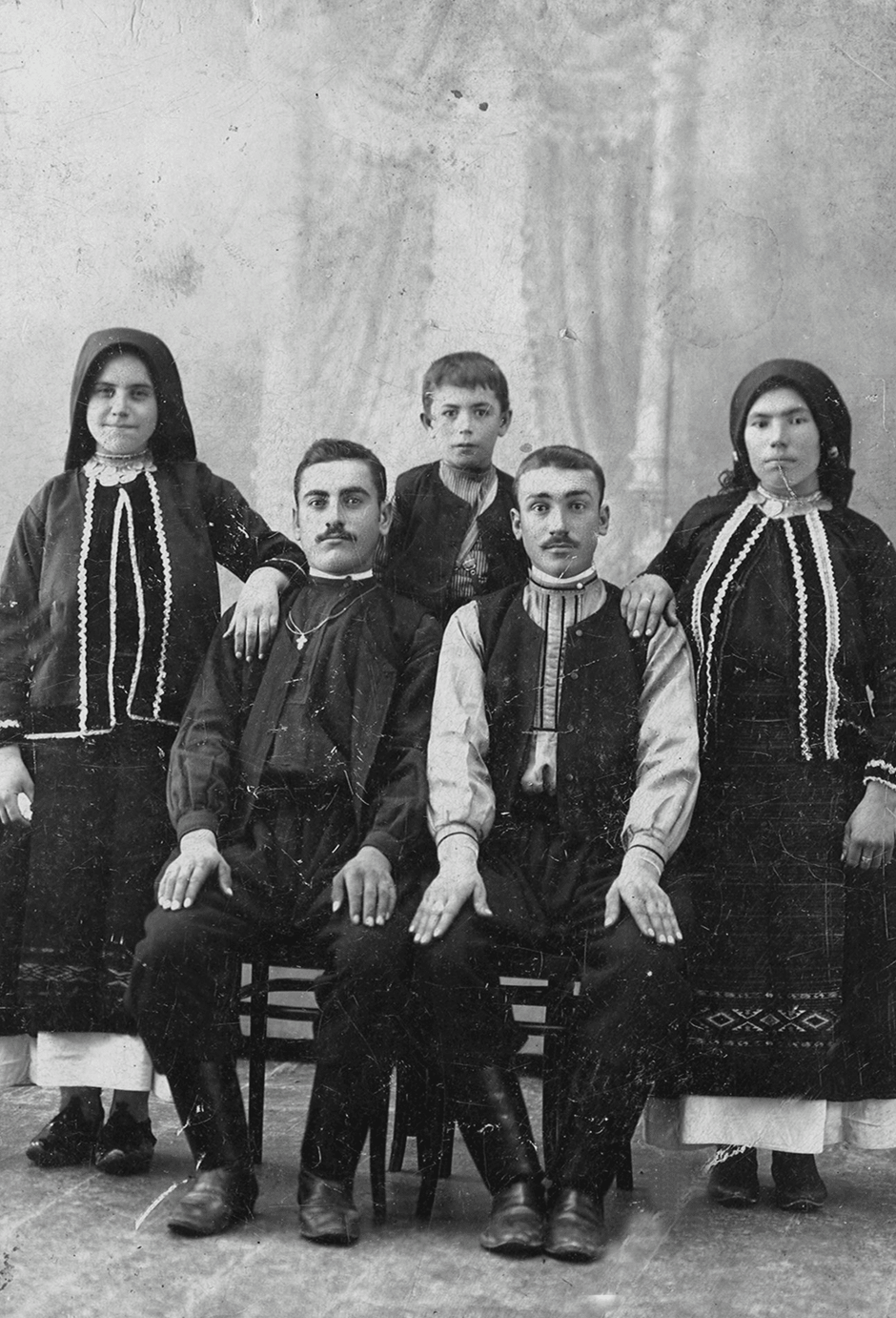
Photos from websites: http://www.eurochicago.com/ and the Crimean Ethnographic Museum
Bulgarians - Bulgarians of Crimea from the village of Kyshlav (now the village of Kurske, Bilohirsk district) in traditional costumes. Photo - early 20th century, from the collections of the Crimean Ethnographic Museum
Subsequently, the Tsarist government no longer provided the Bulgarians with land to create new colonies, settling them in the existing Ukrainian villages of the foothills and steppe, and on the other hand, settling Ukrainian and Russian new settlers in Bulgarian settlements. The Bulgarians' resistance to this was purely humanitarian. Thus, having learned a lot in farming and culture from their neighbors, mainly from the Crimean Tatars, the Bulgarians firmly held onto their customs and mother tongue.
In each Bulgarian settlement there was a church, in almost all of them — primary schools; by the level of literacy, Bulgarians in Crimea in 1916 were fourth — after Germans, Czechs, and Estonians. Before World War II, there were over 15,000 Bulgarians in the Crimean ASSR. In World War II, Bulgaria was an ally of Germany. Perhaps it was for this that the Soviet authorities deported the Bulgarians from the peninsula as well. The combat merits of the partisans and the loyalty of the population as a whole no longer mattered: on the night of June 24, 1944, 12,000 Bulgarians of Crimea were deported...
Gradually, the Bulgarians returned. In 1991, residents of Simferopol founded the Bulgarian Cultural and Educational Association. Later, the republican Bulgarian community was created, which included 22 local communities. At the turn of the millennium, there were almost 2,000 Bulgarians of Crimea. The Bulgarian component was a bright line in the spectrum of the Crimean cultural field. Currently, there are almost as many Bulgarians on the peninsula, their number has not increased. Apparently, they traditionally preserve elements of their own cultural space... But as for the prospects of development, we have to wait for the restoration of at least the status quo in Crimea.