The Battle for Crimea: An Inconvenient History
Little-known real facts and events that took place on the Crimean peninsula during World War II.
Valeriy Verkhovskyi, Hans Bautenbach. "Krymska Svitlytsia" Newspaper, 2017, Issues No. 3–5
The Kerch-Feodosia landing operation and in general the events of 1942 in Crimea are still one of the most closed topics of the course of World War II on the Soviet-German front. Despite the initial success, the operation ended in complete defeat: three Soviet armies were surrounded and destroyed. Total losses amounted to more than three hundred thousand people, including one hundred and seventy thousand prisoners of war.
The heroism shown en masse by Soviet soldiers, the courage of partisans and underground fighters could not overcome the fierce resistance of the Hitlerite invaders and the influence of poorly developing objective circumstances... This is how official Soviet and post-Soviet military historiography writes about it. But the task of historical science is to study, analyze, and learn from the mistakes of the past in order to avoid them in the future. We, the authors of this article, fundamentally do not use Russian-language sources and offer a point of view that differs from the usual Soviet one.
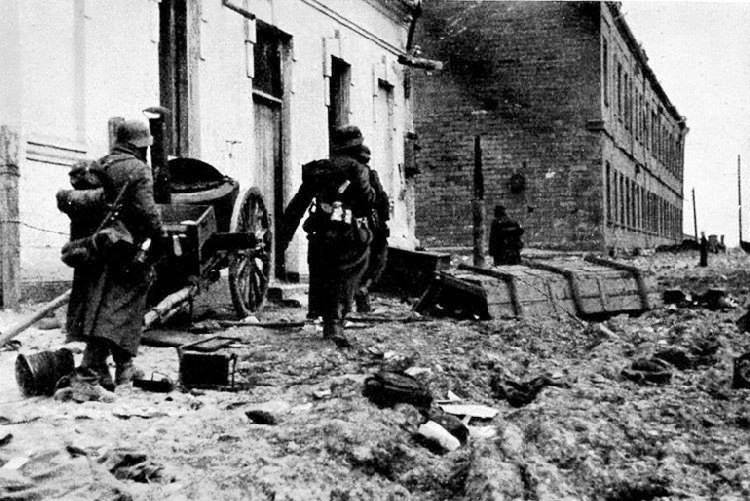
Feodosia, 1942
Useful for us is the acquaintance with the German view on these events, which is an example of successful maneuver warfare and victory despite the numerical superiority of the enemy.
The first stage lasted from December 24, 1941, i.e., the landing of Soviet troops in eastern Crimea (in Feodosia and Kerch), to January 17, when Feodosia was completely under the control of German troops, and the front line stabilized on the Kerch Peninsula ("Crimean Front").
So, Sevastopol is still holding the defense, but the rest of the peninsula is occupied by German troops and their allies, the Romanians. The Soviet command is developing plans for a landing in Crimea. But it turns out that the Germans expected the landing and prepared to fight back.
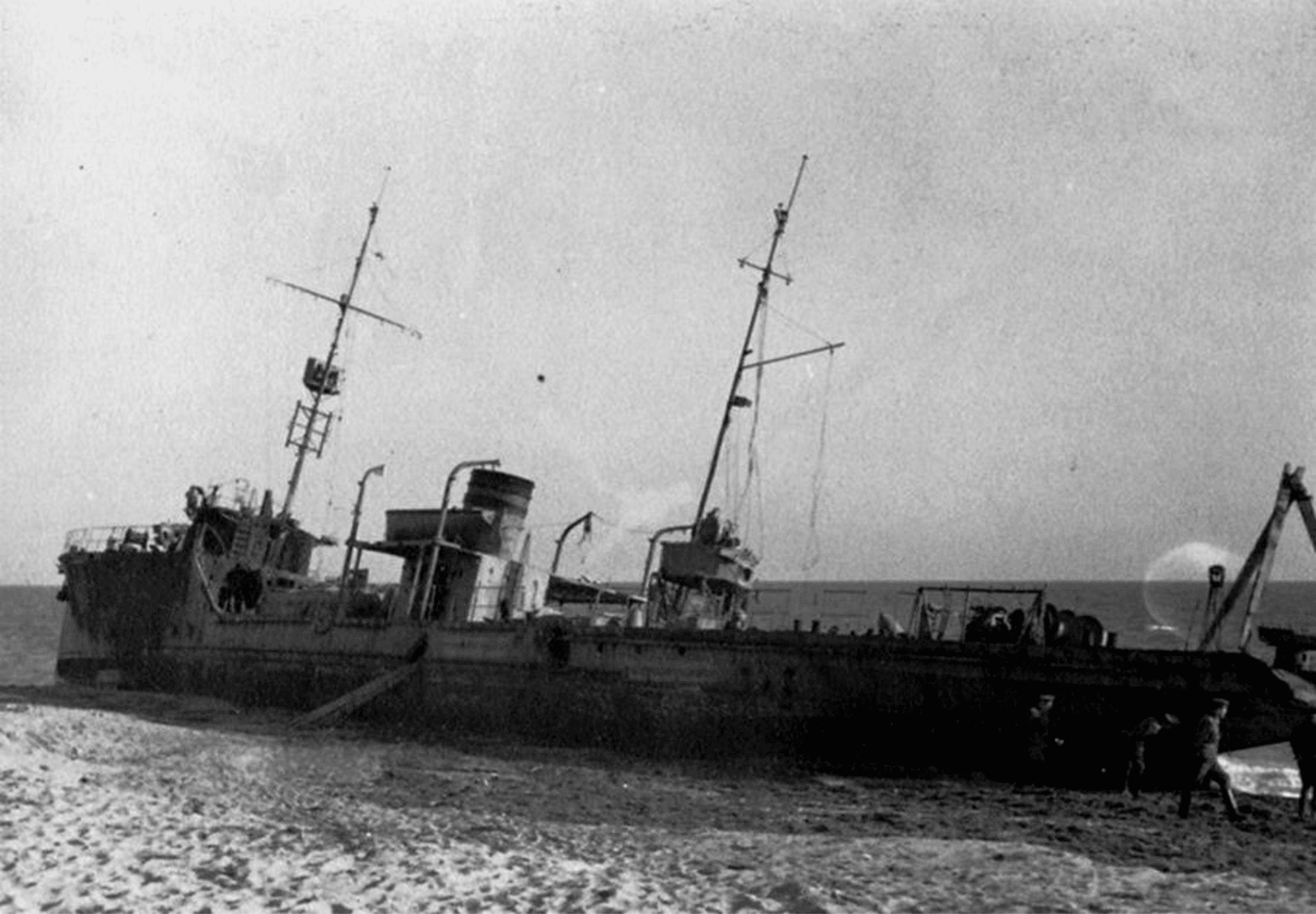
On December 24 and 26, at least two rifle divisions were landed in the Kerch area; the landing losses amounted to twenty thousand soldiers, meaning almost everyone died. There is no point in looking for mentions of the December 24 landing in Soviet sources; it was erased as if it had never happened.
A naval landing operation can be successful only under conditions of careful preparation and clear planning. No army has ever won without food, weapons, ammunition, reconnaissance, and communication. A single Soviet army of four rifle divisions required a daily supply of 55 tons of various cargoes, primarily ammunition. Delivering this had to be done across the Black Sea or the Kerch Strait in winter — and we, Crimeans, know what the Black Sea is like in winter — which was a risky business, and it had to be done under enemy shelling and air raids.
But the staff planners did not care about this, and they did not take care of air defense for the troops. The Soviet command did not provide for field hospitals or the evacuation of the seriously wounded at all during the preparation of the operation. There was not even a medical sanitary battalion in the landed forces. On December 29, the Soviet 44th Army landed in Feodosia, and the 51st Army crossed the Kerch Strait on the ice. And already on December 30, both armies began an offensive towards each other. As a result, the Kerch Peninsula was captured by Soviet troops and held by them until May 1942.
But Manstein later noted: \"In the first days of January 1942, for the enemy troops that landed near Feodosia and were approaching from Kerch, the path to the life artery of the 11th Army, the Dzhankoy-Simferopol railway, was actually open. The weak security front we managed to create would not have stood under the onslaught of powerful forces\"... The Red Army had a 16-fold numerical superiority on this patch!
However, German troops, together with their Romanian allies, stopped the offensive of the 44th Army on Simferopol, which unfolded in early January.
What is this, was the Red Army unable to win either, as Suvorov bequeathed, by skill, or by numbers? To fail an offensive, having sixteen times more troops, could only be done by \"geniuses\" of military thought armed with Marxism and Leninism.
An interesting fact, which we know from Manstein's memoirs: in Feodosia, there were eight thousand captured Soviet soldiers in a camp. The Romanians guarding the camp fled as soon as the landing forces landed. However, these eight thousand prisoners, finding themselves without guards, fled... to Simferopol, to the Germans, instead of rushing to meet the Red Army. So who did they consider a liberator?
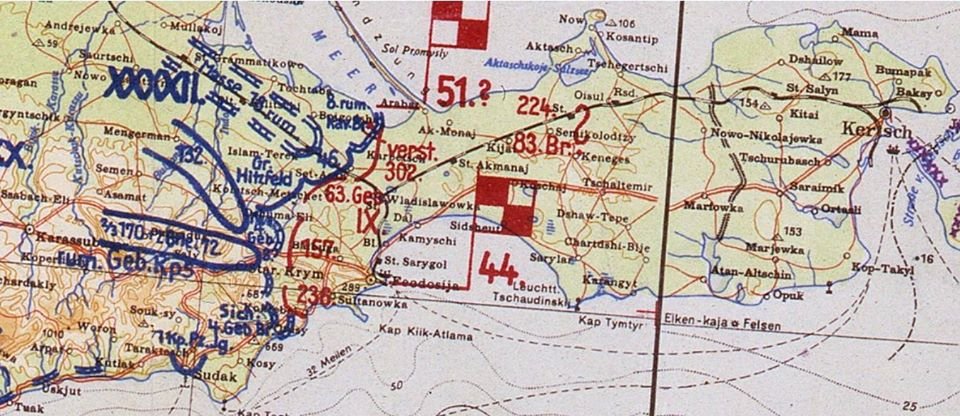
Another eloquent testimony of the \"humanism of Soviet liberators,\" which cannot be found in Soviet sources: German wounded who could not be evacuated remained in the city. Field Marshal Manstein writes with pain: \"In Feodosia, the Bolsheviks killed our wounded who were in hospitals, and some of them who lay in plaster casts, they dragged to the seashore, poured water over them and left them to freeze in the cold wind.\"
On January 5, the Soviet command landed a force in Yevpatoria as well. A landing that lasted only three days, although the Bolshevik underground supported it with an uprising. German troops destroyed both the landing force and the underground fighters.
(It is interesting that in 2015, a children's \"patriotic\" club was created in Yevpatoria, called \"Yevpatoriyskiy desant.\" The idiocy of Russian chauvinism no longer terrifies, but brings a smile — the club's slogan is \"Where we are, there is victory\", even though it refers to a landing that was completely and very quickly defeated). On January 6, another army, the 47th, with over 50,000 soldiers, arrived in Feodosia. But a completely absurd order came from the staff for the Soviet troops to advance north along the Arabat Spit. What the command forgot there remains a mystery, but as a result of staff madness, the forces needed in the Simferopol direction ended up in a completely different place.
In addition, the needs of the Soviet grouping increased; vessels had to bring even more cargo. But the landing forces lacked reliable air defense. The German aviation once again proved the weight of air power in modern warfare, bombing the landing force with impunity and sinking transport ships with ammunition.
And the nearest Soviet airfield was in the Kuban, the nearest hospital was in the Kuban...
On January 16, German troops began an offensive on Feodosia: with three infantry divisions, they broke the defense of eight Soviet rifle divisions, and by the 18th the city belonged completely to them.
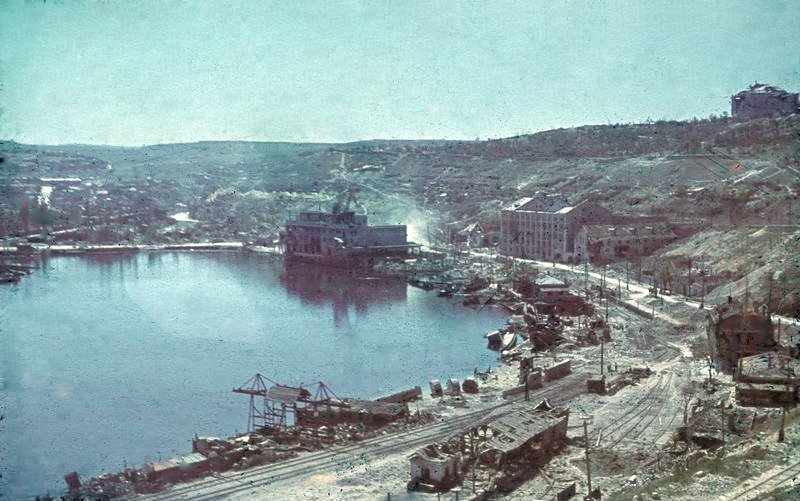
Sevastopol Bay after its capture by German troops
So, after January 16, only the Kerch Peninsula remained under the control of the Reds. From January 28 to May 19, this narrow strip of the isthmus was officially called the Crimean Front.
What caused the failure of the powerful landing force? After all, the numerical superiority was on the side of the Soviet troops. In the first wave, there were over 80,000 soldiers — for comparison, on June 6, 1944, in Normandy, the Allies landed a 156,000-strong force.
The absence not just of hospitals or the possibility of evacuating the wounded, but of the very idea of proper medical support for the troops does not only lead to excessive human casualties. The morale of someone who feels they are treated as a disposable object will never be truly combative and victorious.
One way or another, in all armies of the world, there are elite volunteer units entrusted with the most dangerous tasks. But in the Red Army, everyone except the staff generals had to be suicide soldiers.
The lack of air defense equipment indicates the incompetence of the command, which was preparing for the previous war with cavalry approaches to tactics and strategy.
Coordination between the armies, as well as between the landing force and the navy, was poorly organized. All radio transmission was in the open, and the Germans could intercept all communications of the Soviet troops. In the first part, we wrote about the fact that the Germans knew back on December 1, 1941, where the Soviet landing force would land. This happened not thanks to some super-spy who, having penetrated the very heart of the Soviet staff, stole a secret map. The Germans simply had well-organized radio intelligence. The Soviet troops did not have it at their disposal.
The more complex the tactical situation is and the smaller the forces at the disposal of a commander, the greater his urge to interfere in the domain of his subordinate commanders. But what will be decisive is only how much he relies on his subordinates. Two principles define the German approach to training: \"A soldier can only act in war in the way he has learned in peacetime,\" and also: \"Do not teach a soldier everything he must forget on the very first day he gets into real combat.\"
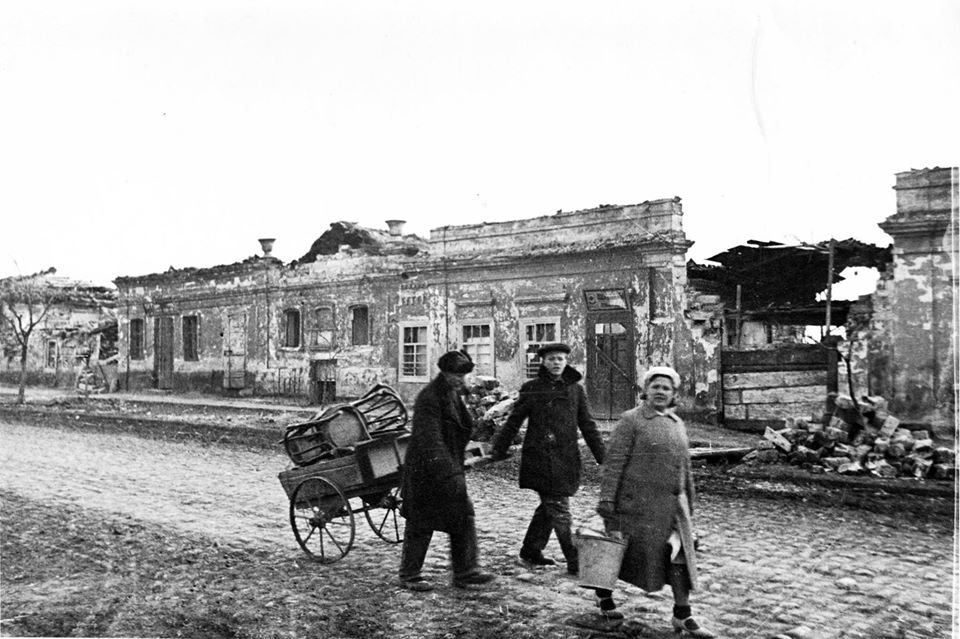
A particular advantage in command of troops for the Germans was that subordinate commanders were given maximum freedom to make independent decisions; they were given tasks, and they could choose the method of execution at their own discretion. This principle has distinguished German military art since the time of Moltke from the traditions of the Red Army. Soviet commanders were not only denied freedom in operational and tactical matters, but were also given lengthy and detailed instructions regarding the methods of performing the assigned task. Or tactical actions were fitted into a dead scheme. The Germans considered such a method harmful.
World War II was not just a lightning war; it was a maneuver war. Maneuver warfare is extremely dependent on communication lines through which all types of supply pass. Mountains and heights are of particular value. It is convenient to observe the enemy from them; not without reason, in military terms, they are called \"key terrain areas.\" The one who controls them will control the surrounding area, as well as keep their own communications safe.
Partisan, reconnaissance, and sabotage activities are of great importance. But in 1942, the coordination of Soviet forces was broken, and the right hand did not know what the left was doing: the Crimean Front was fighting its own war, it had no time for the actions of the Crimean partisans. The Primorsky Army defending Sevastopol also had its own war. For the local population, the German occupation was no worse than the Bolshevik occupation; they did not perceive the so-called \"partisans\" who fell from the sky on Soviet parachutes as their own.
What did a \"partisan detachment\" in Crimea look like: \"On January 9, 1942, in the area of the town of Staryi Krym, a special group of paratroopers under the command of Sergeant Jurgenson was dropped by a separate parachute battalion of the Crimean Front. Cargo parachutes were carried beyond Mount Agarmysh, and the group was left without a radio station, food, or ammunition...\"
Sergeant of State Security is a rank corresponding to an army lieutenant. A Chekist sergeant leads a group of Soviet airborne soldiers — this can be called a classic definition of a Soviet hybrid military force. \"The local Tatar population is successfully being armed... by the Germans, the goal is to fight the partisans. It should be expected that in the near future they will begin to practice fighting us. We are ready for this, although we understand that the armed Tatars are much more dangerous than the Germans and Romanians,\" reported the head of the Second Partisan District, Senior Lieutenant of State Security I. Genov on January 31, 1942.
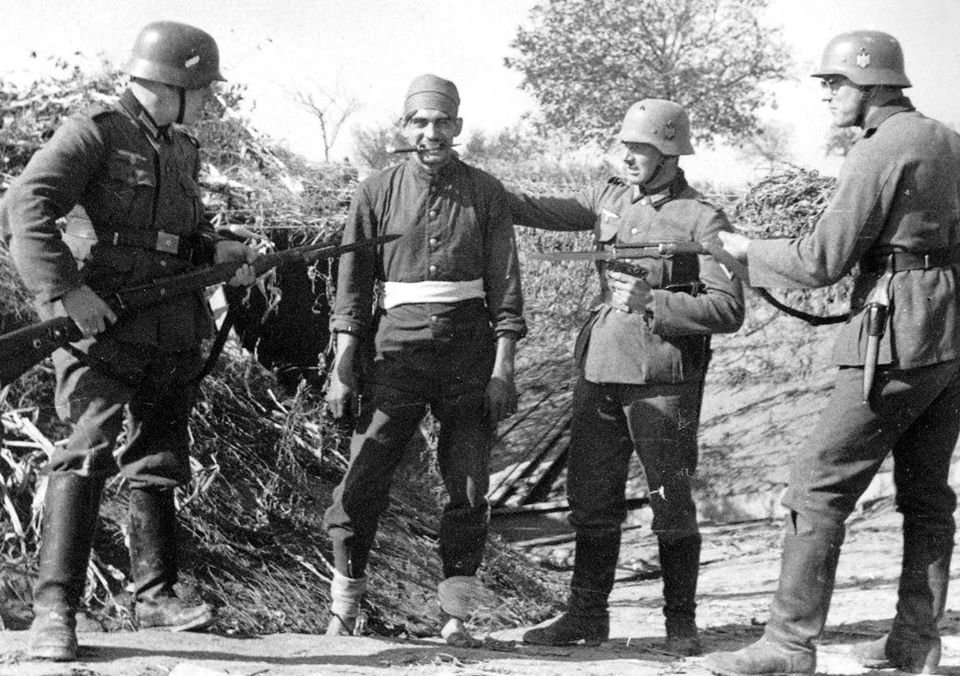
The village of Koush became a symbol of resistance of the Crimean Tatars to the Soviet \"partisan-Chekists.\"
\"Koush... How many of our best people, patriots, have we lost as a result of the treacherous actions of the majority of the inhabitants of this village!\" recalled the commander of the partisan brigade, Captain of State Security L. Vikhman. Note — Captain of State Security. And the deputy chief of staff of the Crimean Partisan Movement, Ye. Popov, even proposed: \"Level Koush to the ground\" to facilitate the struggle of the \"partisans.\" After all: \"By their own forces, the partisans are unable to take this and some other settlements because they are... heavily fortified.\" So, instead of real sabotage and reconnaissance work, the \"partisans\" fought with the local population. The Chekists continued to act as they had been used to for the previous twenty-five years — fighting their own people, for the security of the state against the local population.
To level Koush to the ground — two years later, the commissars managed to fulfill this dream. The Stalinist regime accused the Crimean Tatars of betrayal. As was the case with Ukrainians, and with all the peoples of the USSR — some fought in the Red Army, others collaborated with the occupiers... It should not be forgotten that Crimean Russians also collaborated with the occupiers, and obviously they should have been deported too. Instead, Iosif Vissarionovich, congratulating the country on the new year of 1946, highlighted only the \"great Russian people,\" one million sons of whom, however, fought for Hitler.