The Crimean Trace of the Black Death
The medieval plague in the lands of the Crimean peninsula.
Valeriy Verkhovskyi. "Krymska Svitlytsia" Newspaper, 2017, Issue No. 22
Terror seized Medieval Europe: parents abandoned children to their fate, priests left their flocks and fled, doctors refused to visit the sick... The terrible epidemic of bubonic plague wiped out tens of millions of people, put an end to the Middle Ages, changed the way of life, and redrew the map of the world of that time. Coming from the East, the pestilence penetrated Europe precisely through Crimea, as if through wide-open gates...
"We are hearing of the pestilence. In the villages they are tolling the knell after burials. Nine times for a man, three times for a woman, once for a child. Then an hour of steady tolling. In Eshcote there were two this morning. Oseney has been tolling without cease since yesterday evening. The bell to the southwest, which I heard after crossing, has fallen silent. I do not know why that is — whether the plague is there or not, or if there is no one left alive to strike the bell."
Connie Willis, "Doomsday Book"
East – West
The epidemic began in 1331 in China and spread with incredible speed, wiping out one hundred percent of the population in some counties of the Celestial Empire. It took fifteen years for the pestilence to reach Europe via the Great Silk Road. And the first point of Europe on this path was Caffa, which was Genoese at the time.
In the west of Europe, a war was already ongoing for ten years, which historians would later call the Hundred Years' War — senseless, endless, and ruthless. In the east of Europe, an equally bloody war was waged for the inheritance of the Kingdom of Galicia-Volhynia — Poland, the Grand Duchy of Lithuania, and Hungary flew to tear the remains of the kingdom apart all at once, and further east stood the menacing, though already weakened by internal strife, Dasht-i Kipchak.
In 1346, Khan Jani Beg, the victor of this bloody contest, set off for the Genoese-controlled southern coast of Crimea and besieged Caffa. According to legend, the siege lasted so long and the defenders of the city fought so fiercely that cases of plague, which had already managed to cause havoc in Kipchak itself, began in Jani Beg's camp. And then, perhaps for the first time in history, the khan used "bacteriological" weapons: he began to catapult plague corpses over the city walls. This version was left to posterity by the notary Gabriele de' Mussi, who witnessed the events of that year in Crimea; here is what he recorded: "Countless tribes of Tatars died from a sudden and incomprehensible disease, that people die in three days, covered with painful ulcers and spots, and turn black immediately after death."
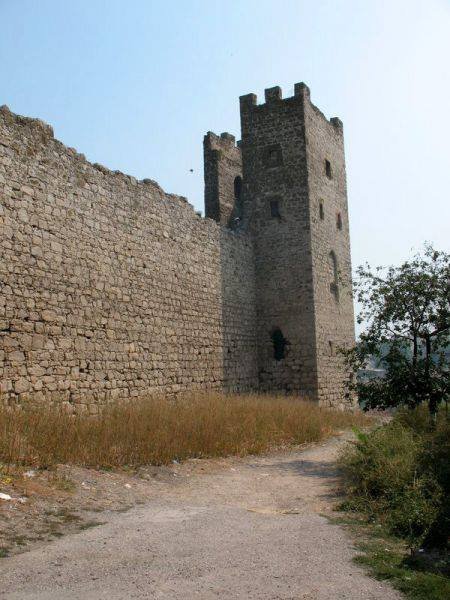
Caffa Fortress
Reality More Terrifying Than Tales
In the hole a rat, on the rat fleas, in the fleas bacilli, and in those bacilli — death. Just like in a fairy tale, only the tale is terrifying and ends tragically. In bubonic plague, the pathogen enters the blood with a flea bite. In human lymph nodes, it is captured by white blood cells (leukocytes). Called upon to protect the body from infections, leukocytes themselves become victims of the plague. Plague bacilli are adapted to reproduce in the cells that are supposed to destroy them. As a result, the lymph nodes lose their protective function and turn into a microbe factory. An acute inflammatory process develops in the lymph node itself, and a so-called "bubo" is formed on it.
The most dangerous form of the disease is pneumonic plague. It can occur either as a result of a complication of bubonic plague or through infection by airborne droplets. The disease develops lightning fast. Microbes and their toxins destroy the walls of the alveoli. The patient begins to spread the plague pathogen by airborne droplets.
In the first case, a person suffered from fever, delirium, and died in five days; in the second — in two or three days from pulmonary hemorrhage. In Constantinople, for instance, it was the pneumonic form of the disease that spread, whereas from Crimea to Italy and further across Europe, the bubonic plague spread.
Around Europe
Fear forced people to flee the plague; "flee as fast as possible, flee as far as possible, flee and do not stop," they said in those days. However, it often happened that, while fleeing, some did not know themselves that they carried the bacilli of death. And thereby contributed to the spread of the plague.
Italy. Historians do not rule out that the number of victims was 90% of the population. The Italians preserved the most evidence of this plague, which is not surprising: Boccaccio and Petrarch witnessed the plague, and the bookkeeping habit of the Italians to record all facts helped the historians of future generations in their work.
In 1348, a ship that crossed the English Channel entered the port of Weymouth in southwestern England. One of the sailors turned out to be sick with the plague, and in the autumn of that year, the epidemic rolled in a wave to London. Out of approximately 5–6 million inhabitants of the kingdom, 2–3 million died. In Oxford, the epidemic began at Christmas. People were waiting for the birth of the Savior, but the holiday turned into something completely opposite — the Blue Sickness, as it was then called, arrived. Only the mountainous regions of Scotland were not reached by the plague. Perhaps this protected Scotland from being absorbed by England after the defeat of the Scots in 1346 — for a long time, until the Union of 1707.
The Black Death even reached America — the Viking settlements in Greenland became its westernmost "tribute collection" point. Half of the island's inhabitants died from the plague in the 14th century.
People in Masks
At the same time, the medical specialization of "plague doctor" arose. For the first time, they were hired in 1348 by Pope Clement VI to treat the inhabitants of Avignon. Plague doctors wore cloaks and special protective leather masks that completely covered their faces, and thanks to the respiratory "beak" in place of the nose, these medieval doctors resembled bizarre birds; medicinal herbs were placed in this "beak" to allegedly destroy bacteria. However, the qualifications of the plague doctors left much to be desired: this risky, though lucrative, work was often taken up by medical students who had not finished their studies, and sometimes by people without any medical education. We can judge the effectiveness of the treatment from mentions of the therapy of that time: cutting out or cauterizing plague buboes, bloodletting, and even applying frogs to the bubo.
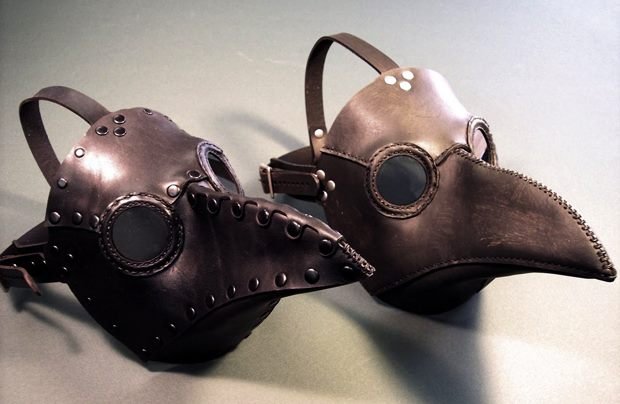
Plague doctors' masks
Poland and Western Ukraine
A legend retold by Poles speaks of the patronage of the Virgin Mary, who warded off the pestilence, but historians say otherwise: the Polish King Casimir III declared a national quarantine, ordering the complete closure of the borders of the kingdom — and Poland avoided the first, most severe wave of the pandemic.
In the chronicle we find the following: "In the year 1347. Casimir, the Polish king, intended to annex the remnants of the Ruthenian state, the land, to Poland, namely Lutsk, Belz, Kholm, Olesko, Volodymyr, which land the Lithuanian princes had held for 14 years. He gathered a large Polish army, marched first to Belz, which surrendered to him..."
Whether success came to Casimir because of the dying out of the inhabitants of Ruthenia, or vice versa — by annexing the lands of Western Ukraine to the Polish Kingdom, and thus to the quarantine zone, the crown saved hundreds of thousands of lives, it is difficult to judge — too little information about this is provided by the few chroniclers of that era. However, history put an end to the existence of the Galicia-Volhynia Principality in the 14th century.
East Again
The pestilence moved across Europe in a circle, in the epicenter of which, as if in the eye of a typhoon, Poland remained safe, continuously: from Crimea and Byzantium to Italy, further to France, Spain, by land to Germany, and by sea to Britain, further to Scandinavia. In 1352, the pestilence closed this black circle: "There was a severe plague in Pskov."
And from there, through Pskov and Novgorod, cities that had, in modern terms, a "visa-free regime" and a "free trade zone" and therefore were in close contact with Europe, the plague went in the fifties to Moscow, Ryazan, and Suzdal. After that, the epidemic spread to the territory of modern Ukraine: Chernihiv, Hlukhiv, Kyiv. As recorded in the chronicles: "In Hlukhiv, then, not a single person remained — all died..."
In 1353, Grand Duke Simeon the Proud and the "Moscow" Metropolitan of Kyiv died of the plague in Moscow (in those days, almost like today, there were two metropolitans of Kyiv — one in the Grand Duchy of Lithuania, the other in the Grand Duchy of Moscow). It can be said that the plague finished off the remnants of Kyivan Rus. But it is clear that the "cleared" expanses of the fertile steppe could not remain empty. And they began to fill with people from the regions that were not so heavily affected by the pestilence.
But the pestilence caused the most devastating consequences for Dasht-i Kipchak. The fragment of the empire founded by Genghis Khan seemed unshakable, but the blow of the plague was the beginning of the end. Having barely recovered, the Grand Duchy of Lithuania defeated the Horde in the Battle of Blue Waters, reached the Black Sea itself with its southern borders, and later extended its influence to Crimea.
Thus, the Black Death changed the course of European history, including that of Ukraine and Crimea. Actually, the word "Ukraine" as the name of an "administrative-territorial unit" of the Grand Duchy of Lithuania was first mentioned in 1395.
Consequences of the Pestilence
The first count of the number of victims of the Black Death was carried out by order of Pope Clement VI and gave a bitter total of 23,840 thousand people — a third of the population of Europe.
Most historians agree that 30–50% of the entire population died in Europe and the Middle East, up to a half in China, and generally a quarter worldwide, which amounted to over seventy million people.
The culture of Europeans underwent changes; they began to pay more attention to hygiene. The medieval notion of cleanliness as an excessive luxury died along with the victims of the pandemic. The attitude towards the lower social strata in the social pyramid changed because it was mostly peasants and the urban poor who died out, so there was a shortage of labor. This destroyed the feudal system of serfdom, caused an increase in the cost of labor of wage earners, and therefore forced the beginning of significant social changes.
Kivrin's Prayer
"— Did God send this on us? — asked Roche. — No, — Kivrin replied, — no. — Then is it the Devil? It was most convenient to agree. All of Europe placed responsibility for the Black Death on Satan. And they searched for the devil's servants, tortured Jews and lepers, stoned old women, and burned young girls. — No, no one sent it. It's just a disease. No one is to blame. God would have helped us if He could, but... What 'but'? He does not hear us? Has He gone somewhere? Does He not exist? — He cannot come, — she finally said unconvincingly." Connie Willis, "Doomsday Book"
Eyewitnesses (for example, Giovanni Boccaccio) wrote about the Black Death, and many times this topic has forced modern writers to take up the pen. One of the most striking works is "Doomsday Book" — a science fiction novel by the American writer Connie Willis, written in 1993. Thanks to the time machine, historians of the future have the opportunity to be present in the midst of events of past eras, but none of them had yet dared to travel to the Middle Ages.
And so, an energetic, enthusiastic, and curious heroine named Kivrin sets off for the 14th century. Due to a glitch, she ends up in the wrong year... namely, on the eve of Christmas in the vicinity of Oxford. She is vaccinated against the plague, but, finding herself in the very hell of the epidemic, she does not remain an outside observer, but seeks to fix the inevitable, to save at least someone.
In fact, this is impossible — all the people who lived in the small village of forty houses died long before Kivrin set off to them from her 21st century.
No one manages to escape. Only the priest remains, Father Roche, who shrived the dying parishioners and tolled the bells for them. He dies of the plague last, having fully fulfilled his duty as a pastor when there is no one to shrive him and toll for the rest of his soul. No one but Kivrin, lost in past time.
"Roche turned to her. — Tell me, is this the last days and the end of the world that the apostles of God predicted? 'Yes,' Kivrin thought. — No, — she replied. — No, it's just a bad time. A terrible time, but not all people will die. And then wonderful times will come. Renaissance, social reforms, music. A wonderful era. It will have new medicines, and people will not die of plague, smallpox, or pneumonia. And there will be enough food for everyone, and homes will be warm even in winter. — She remembered Oxford decorated for Christmas, the streets and lit shop windows. — There will be plenty of light everywhere, and there will even be bells that ring on their own, you won't have to toll them."