The Sea People
Dolphins are the main inhabitants of the Black Sea.
Valeriy Verkhovskyi. "Krymska Svitlytsia" Newspaper, 2017, Issue No. 42
In antiquity, dolphins were called the "sea people." We have searched for brothers in intelligence in the black infinity of the Universe, but it is possible that intelligent beings have been near us all along — in the seas and oceans of the planet we call Earth, and they probably call Water...
Dolphins and the Harbour Porpoise
Three species of cetaceans inhabit the Ukrainian seas.
The bottlenose dolphin is the largest (body length can reach three meters and weighs on average 120 kg). The upper part of the body is black with a blue tint, the lower part is white, the snout resembles a blunt beak, and there are dark rings around the eyes, resembling spectacle frames. Exhaling, bottlenose dolphins blow out small fountains.
The common dolphin is smaller, up to 60 kg and up to 2.8 meters in length. The snout of the common dolphin is more elongated. The upper part of the body is dark, the sides are light gray, and the lower part is white with dark stripes.
The bottlenose dolphin and the common dolphin belong to the dolphin family (Delphinidae), but the harbour porpoise (or Azov dolphin) is classified in a different family, the porpoise family (Phocoenidae). These are the smallest (up to 1.9 meters and 50 kg) Black Sea cetaceans; unlike dolphins, they do not have a beak-like snout, the upper part of the body is dark gray, almost black, and the lower part is white or light blue. Harbour porpoises do not have the habit, like dolphins, of leaping out of the water.
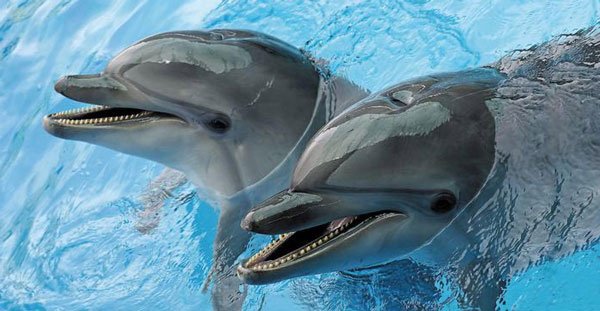
Bottlenose dolphin
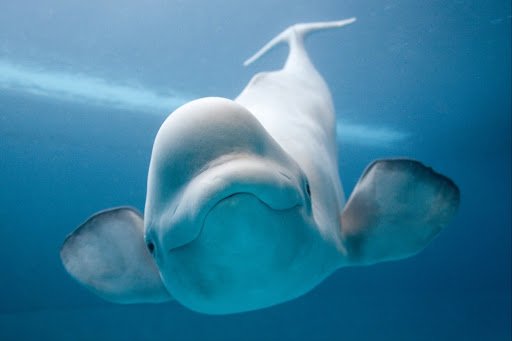
Beluga whale
In the first half of the 20th century, there were up to a million dolphins in the Black Sea, but later, due to their intensive harvesting, the population shrank to a few hundred thousand. As wild as it sounds now, dolphins were caught, slaughtered, and used for food, and bone meal was also produced for cattle feed, and lard and glue were rendered.
Dolphin meat and fat, however, as special studies show, contain large amounts of mercury and cadmium, and because of this, consuming them is not healthy at all. In East Asian countries, where dolphin meat is still eaten, doctors categorically forbid children and pregnant women from eating it.
Only in 1966 was the commercial harvesting of dolphins in the USSR banned for 20 years, and later this moratorium was extended. All Black Sea countries acted similarly, with the exception of Turkey.
"Delfin" Hunts a Whale
Whales — toothed or baleen — do not live here. The Black Sea is too cold for whales to breed, although they can live and feed here. Individual representatives of these largest animals on the planet have swum into the Black Sea at least twice, these cases are recorded, and it is known that they were minke whales. The smallest among the baleen whales (up to ten meters long and 5–10 tons in weight), they have no equals among the fauna of the Black Sea.
One whale beached on April 18, 1880, near Batumi in Georgia, and shortly after, another whale was spotted near the Caucasian coast heading north towards Crimea. The skeleton of the first whale has been preserved. And in 1926, also in the eastern part of the Black Sea, a whale was spotted, and a vessel with the symbolic name "Delfin" was dispatched from Novorossiysk to hunt it.
But recently, one species of whale entered the Black Sea waters.
The beluga whale — a toothed whale of the monodontid family — has never lived in the Black Sea. Its usual habitat, to the conditions of which it is best adapted, is the Arctic, the Barents and Okhotsk seas, and only rarely the Baltic. They are six and a half meters long and weigh under two tons.
The reasons for the beluga's appearance became clear when it was noticed that they were cared for by... people in military uniform. Journalist Volodymyr Tsekava of "Kubanskie Novosti" wrote: "Apparently, experiments on the combat use of dolphins and whales in the Russian Navy continue today. And, as can be assumed, now belugas are trained not to kill enemy scuba divers, but to notify about the approach of divers or large underwater objects to a protected ship or structure."
It is unknown what changes in the Black Sea ecosystem the uncontrolled increase in the population of this small whale will lead to, because its usual diet is the same as that of Black Sea dolphins, and in nature, as we know, the stronger wins in the struggle for survival...
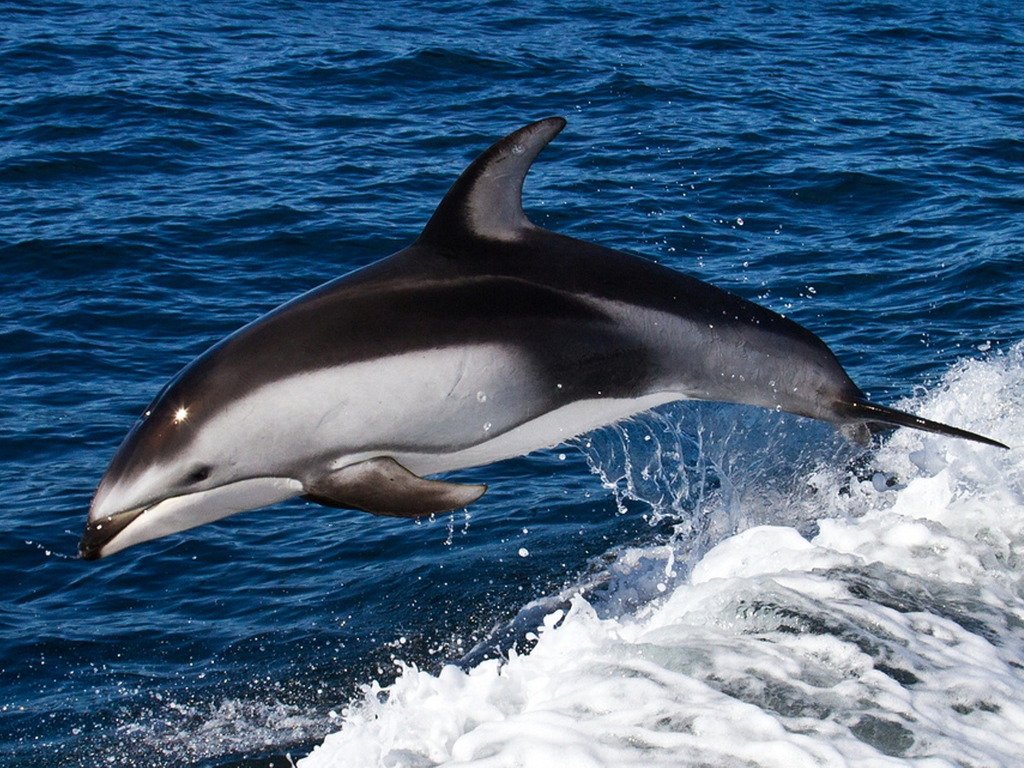
Common dolphin
On the Verge of Sci-Fi
The military has long been interested in cetaceans. In 1965, a secret decree of the Soviet government and a directive of the Commander-in-Chief of the USSR Navy were approved to establish the 184th Research Base in Sevastopol — military unit 13132-K — under the leadership of Captain First Rank Viktor Kalganov to "study the physiological, hydrodynamic, and hydroacoustic characteristics of Black Sea dolphins." Officially, this was explained by the needs of designing naval and aviation military equipment. What was later called bionics.
But the cognitive abilities and natural adaptability of dolphins to the water element prompted the development of this topic, and in a few years this base began studying the possibility of using bottlenose dolphins (as the largest and strongest species of Black Sea dolphins) for underwater search, mine clearance, and defense of naval bases against hostile combat divers. Military-clerical terminology was supplemented by the strange phrase "biotechnical system."
From 1975, dolphins prepared for military tasks entered combat duty in the Sevastopol Bay.
Later, dolphins trained by the military for combat needs also served in peaceful activities, helping archaeologists search for ancient artifacts on the seabed.
Brothers in Intelligence?
"We have long understood that dolphins are among the most intelligent mammals and that they are capable of doing what anthropoid apes can do, for example, they are able to recognize themselves in a mirror, communicate, are capable of imitation, and they have cultural inheritance" (Michael McGowen).
Of all "our lesser brothers," dolphins are closest to humans in cognitive abilities. The brain weight of a dolphin is 1.7 kg (in humans, it is on average 1.4 kg), and it has twice as many convolutions as a human brain. The language of dolphins has up to 14 thousand sound signals, which allow them to communicate with each other. Unlike humans, they are capable of ultrasonic echolocation. Dolphins are social creatures, they help calves and the sick, pushing them upwards, and, as is well known, they also prevent people who find themselves in tragic circumstances in disasters at sea from drowning.
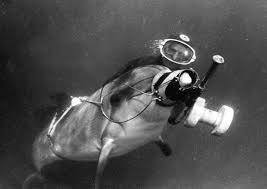
A dolphin in combat gear