«Новый Крым с русским укладом»: deportation of the ancient peoples of the peninsula
The illegal deportation of the nationalities of the Crimean peninsula.
Ihor Svitlychanin. "Krymska Svitlytsia" Newspaper, 2017, Issue No. 26
"Already in the railway carriage, I finally realized that we no longer had a home, that I would no longer see the street where I lived, my friends..."
(Vagarshak Mazlumyan, author of the book "Crimean Prisoner")
June 27, 1944 is one of the most tragic dates in the history of Crimea. On this day, Decree No. 5984 of the State Defense Committee (GKO) of the USSR, signed by Stalin on June 2, was executed: "In addition to the eviction of Crimean Tatars under GKO Decree No. 5859ss of May 11, 1944, evict from the territory of the Crimean ASSR 37 thousand people of German accomplices from among Bulgarians, Greeks, and Armenians." Having overfulfilled the Kremlin's instructions out of habit, the "organs" deported almost 37.5 thousand representatives of these peoples from the peninsula to the Urals, Siberia, and Kazakhstan. At dawn, people were woken up from their beds and, having read the decree in a hurry, ordered to pack for the journey. They could give as much time for packing as they pleased — not forgetting to seal the doors.
For some Christian peoples of Crimea, in particular Greeks and Armenians, this was the second eviction from the peninsula. The first took place back during the reign of Catherine II: then the military commander Pyotr Rumyantsev-Zadunaisky believed that this step, given the political and economic realities of the time, would be very beneficial for the Russian Empire. At that time, the reasons for resettlement were formulated as follows: 1) the need to develop the lands that the Russian Empire received under the terms of the Treaty of Küçük Kaynarca; 2) the desire to weaken the economy of the Crimean Khanate and gradually prepare for its annexation; 3) the "rescue of Christians from oppression by Muslims and possible revenge for helping Russia in the past war."
The last circumstance was supposed to guarantee the assertion of Moscow as the "Third Rome." In June 1778, representatives of Crimean Christians signed a resolution on "voluntary" resettlement to the Azov region, tempted by the 30 desiatynas of land promised to each male family member. Having sold off their property, under the supervision of troops commanded by Alexander Suvorov, Crimean Christians left Crimea by various routes with their belongings. In late 1779, the settlers founded the city of Mariupol at the mouth of the Kalmius and almost two dozen villages in its vicinity, which received Crimean names — Yalta, Laspi, Mangush, Staryi Krym, etc.
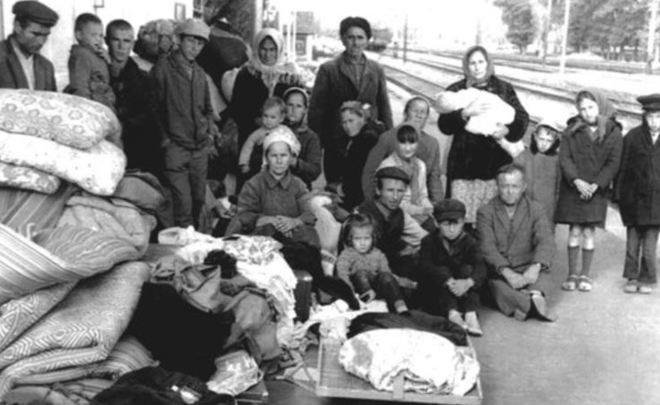
The second eviction took place during the Second World War. Before that, for the purpose of the gradual eviction of the remaining national minorities from Crimea, a census was conducted on the peninsula. In late May 1944, Deputy Chairman of the GKO Lavrentiy Beria in his report to Stalin claimed: the Bulgarian, Greek, and Armenian population of Crimea are "accomplices of the occupiers."
Unfounded accusations against representatives of these peoples were aimed not only at all ethnic communities from old to young, but also at those who were to be born after the war. On July 5, 1944, Beria reported to the "Leader of Peoples": "From April to July 1944, the territory of Crimea was cleared of anti-Soviet spy elements, and Crimean Tatars, Bulgarians, Greeks, Armenians, and persons of foreign nationality were evicted to the eastern regions of the Soviet Union."
Speaking of the Soviet accusations of entire peoples of "betrayal," Ivan Dzhukha, a well-known Russian researcher of Greek origin born in Ukraine, ironically notes: "During the occupation of Crimea, even a child could not avoid cooperation with the fascists: on Fritz's orders, they could run with a pot to the field kitchen and bring him lunch, they could clean the boots of a Wehrmacht officer, they could even accept a chocolate bar from the enemy and eat it. By the first two actions, the child strengthened the power of the German army, by the third — decomposed the morale of the Soviet people in the face of the enemy." The historian rightly notes that the entire population could not go to the partisans, so some had to survive under occupation — including engaging in trade, working to feed themselves and their families.
The evictees were sent to rural areas. Detention outside the designated place of residence was considered an escape — with corresponding consequences. Men discharged from the Soviet Army under special orders were sent to their evicted families. For this, there was even an NKVD directive with the hypocritical name — "On the reunion of separated families of Crimean Bulgarians, Greeks, and Armenians."
Not everyone could take even the permitted property with them (15–20 kilograms of things and food): it was especially hard for those who had children, the sick, and the elderly on their hands. "What you managed to take in your hands, you carried," recalled the evictees. Instead of the handed-over property, the evictees received receipts and cynical promises of new housing and property in place of the lost. Those arriving at the special settlement were housed in unrepaired, abandoned premises and basements; several families could be placed in one room. Due to the change of climate and the lack of proper medical care, mass illnesses began.
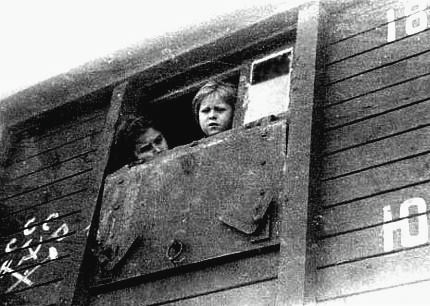
As a result of the war, occupation, and deportation, the population of Crimea was reduced threefold: in the autumn of 1944, there were 379 thousand people in Crimea — compared to 1,126,426 in 1939. Some areas were practically depopulated. Despite an active campaign to settle Crimea with residents of Russia and Ukraine, the peninsula's economy was able to recover only by the 1960s — already after "the traitor Khrushchev gifted the historically Russian Crimea to the Ukrainians."
However, it is not common to mention that in 1945 and 1948 this notorious "historically Russian character" was consolidated by decrees under which settlements with Crimean Tatar, German, Greek, and Armenian names were renamed — in total over 90% of the towns and villages of the peninsula. The main goal of the ethnic cleansing of Crimea was also unambiguously stated in the report of the first secretary of the Crimean regional committee of the VKP(b), Tyulyayev, on November 27, 1944: "We have been set the task of making Crimea a new one, with a Russian way of life."
Some evictees managed to return to Crimea in the period from the mid-1950s to the late 1980s. Most of those who arrived found themselves torn apart from each other in their homeland and lived as separate families throughout Crimea. Those who managed to obtain a residence permit semi-legally recalled what misunderstanding and humiliation they had to go through.