The Day the Sky Wept
The deportation of the Crimean Tatars
Tetyana Bykova, Candidate of Historical Sciences, Researcher at the Institute of History of Ukraine of the National Academy of Sciences of Ukraine. "Krymska Svitlytsia" Newspaper, 2018, Issue No. 20
18 May we remember one of the gravest crimes committed by the Bolshevik government — the deportation of Crimean Tatars in 1944. According to the Resolution of the Verkhovna Rada of Ukraine No. 792-VIII of 12.11.2015, the deportation of Crimean Tatars in 1944 was recognized as genocide, and 18 May is commemorated in Ukraine as the Day of Remembrance of the Victims of the Genocide of the Crimean Tatar People. After all, it was on this day that a kind of watershed occurred in the life of the entire ethnic group, which divided the history of the Crimean Tatar people into two parts: "before" and "after" the deportation.
It is common knowledge that the formal reason for the deportation of the indigenous people of Crimea (which was hidden under the term "eviction" in government documents) was the accusation of "total collaboration." GKO Decree No. GOKO-5859 of 11.05.1944 on the eviction of Crimean Tatars from their historical homeland claimed that many of them betrayed the Soviet Union, defected to the enemy, and even joined German punitive detachments. Moreover, the document claimed that "the Crimean Tatars particularly distinguished themselves by the most brutal massacres of Soviet partisans and helped the German invaders in the forced deportation of Soviet citizens into German slavery."
Later, in the works of Soviet historians, fantastic figures were cited: allegedly about 20 thousand Crimean Tatar deserters went over to the side of the Nazi troops. In the post-Soviet period, Ukrainian scientists proved that the official figure was intentionally exaggerated by the authorities several times, and the actual number of deserters among the Crimean Tatars was comparable to the number of defectors of other nationalities. Of course, there were collaborators among the Crimean Tatars, but they were also among other peoples. Therefore, the facts of collaboration can in no way justify the deportation. In addition, according to Article 50 of the 1907 Hague Convention "On the Laws and Customs of War on Land," collective punishment was strictly prohibited.
On April 13, 1944, the NKVD and NKGB of the USSR adopted a joint resolution "On measures to clear the territory of the Crimean ASSR of anti-Soviet elements." Implementing it, by the end of April, about 8.5 thousand people were found and arrested. The culmination of these actions was the decision to deport the entire Crimean Tatar people. Even a letter from the then secretary of the Crimean regional committee of the VKP(b), V. Bulatov, who in vain tried to convince the Moscow authorities that: "Traitors have nothing in common with the Tatar people... The bulk of the Tatar population are honest Soviet people who look forward to the day when the Red Army will come, drive the fascist invaders from Crimea, and re-establish Soviet power here," did not stop its implementation.
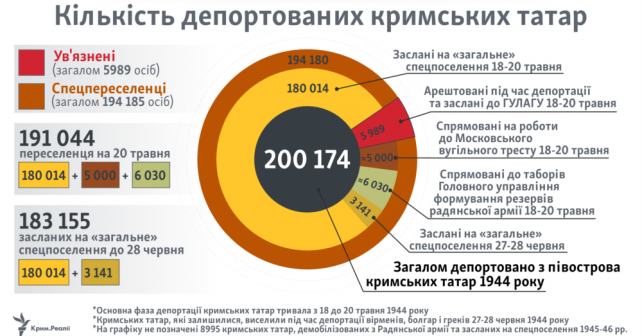
However, all appeals remained in vain, and on May 11, 1944, J. Stalin signed Decree of the State Defense Committee No. 5859ss on the organization of the deportation of Crimean Tatars. The main phase of the special operation began before dawn on May 18 and was completed by the evening of May 20. Those Crimean Tatars who remained were evicted during the subsequent deportation of Armenians, Bulgarians, and Greeks, which took place on June 27–28, 1944.
The deportation was carried out by the forces of the NKVD troops. On average, up to 15 minutes were given for packing. However, in some cities, the military did not give the poor residents even this miserable time. So, for example, in Bakhchysarai, the Tatars were given about five minutes to pack.
Officially, each family was allowed to take up to 500 kg of things and food with them, but in reality everything was limited to hand luggage (and sometimes even without it). Many did not even have time to take their documents. By the way, at one time the Tatars saw how the Nazis did the same in 1941, when local Jews were rounded up, carrying precious bags of clothes and food. "We all thought we would die," recall the survivors after that night. The irony was that this time the armed men were their Soviet compatriots.
The evictees, most of whom were women and old men, were brought by trucks to railway stations, where they were placed in cattle cars. The whole process was fast and efficient: the NKVD troops already had similar experience. The cars into which the Tatars were loaded to be sent to the East had just returned from another mission of transporting people — the recent deportation of the mountain peoples of Chechnya, Ingushetia, and the Kabardino-Balkar Autonomous Republic. As witnesses said, the cars were still soiled with excrement and dried blood of the last contingent of deportees.
During the 2–3 weeks that the trains were on the way, the people locked there suffered from overcrowding, suffocation, poor nutrition, and lack of drinking water (there were also cases when during the entire journey the Tatars received food only once), the cruelty of the guards, and various diseases. There are many testimonies of corpses of the deceased, which the guards threw out along the path of the train without any documentation. The official figure of 191 deceased is clearly underestimated. According to scientists' estimates, about 8 thousand deportees died during the journey to the places of exile.
The rest would rebuild their lives from scratch when they arrived in Central Asia. They would not receive a warm welcome there. Their new neighbors, Soviet Muslim compatriots, believed the stories that the entire Crimean Tatar people were traitors.
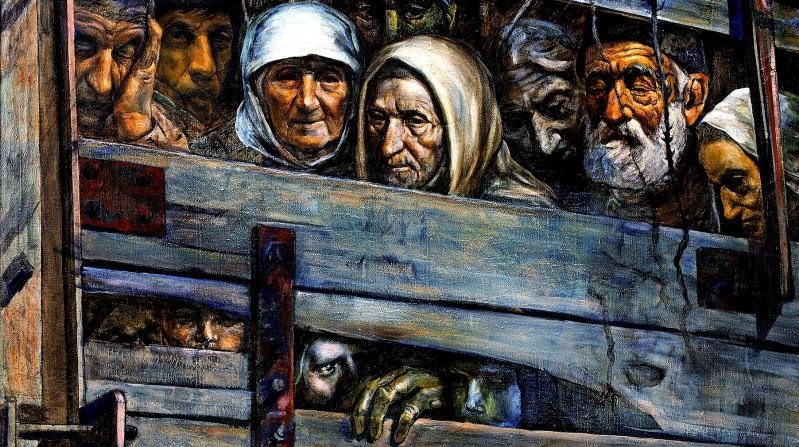
Illustration by the artist Rustem Eminov
The results of the "operation" to deport the Crimean Tatars were summarized at a meeting of the bureau of the Crimean regional committee of the VKP(b) on October 14, 1944. The minutes noted: "Great work has been done regarding special operations. In May 1944, 194,111 Tatars were evicted and at the beginning of the harvest, 33,349 Bulgarians, Greeks, and Armenians were deported."
It should be noted that demobilized Crimean Tatars and those who went into evacuation at the beginning of the war and returned to the peninsula in the spring of 1944 were also deported. Among those deported was a large number of former partisans, including political commissars Akhmetov and Isayev, who were in the 5th partisan detachment and, starting from April 1944, helped the Red Army. At least four Heroes of the Soviet Union, who received awards for the landing in Kerch in November 1943, were also deported.
According to various official estimates, between 20 and 25% of all Crimean Tatars died in special settlements. According to unofficial information (the self-census of the Crimean Tatar national movement), this figure reached 46%. The survivors were considered exiled forever until 1956 and did not have the right to leave their place of residence under threat of 20 years of hard labor. In 1967, the accusations of mass collaboration were lifted from the Crimean Tatars, but they were not allowed to return to the peninsula. Mass repatriation began only in 1989.