An Airship over the Black Sea
In the autumn of 1945, the airship V-12 "Pobeda" ("Victory") arrived in Sevastopol. On that day, unique research and practical tests of the capabilities of the airship took place.
Valeriy Verkhovskyi. "Krymska Svitlytsia" Newspaper, 2018, Issue No. 29
In the autumn of 1945, the airship V-12 "Pobeda" ("Victory") arrived in Sevastopol. Unique research and practical tests of the capabilities of the airship took place here: the main task of the aeronaut crew under the command of Captain Roshchyn was the search for sea mines, torpedoes, and sunken submarines...
This was not the first appearance of airships in the Crimean sky: during the First World War, an aeronautical detachment was also created here, in Sevastopol. In 1916, the Black Sea Fleet of the empire created a detachment of four airships, delivered disassembled from Britain. However, everything went poorly: the first airship fell into the sea, the second crashed, the third was destroyed by an explosion, and the fourth was decided not to be put into operation to keep out of trouble.
The V-12 airship was built in a short time, in six months in 1944. The available airships did not participate directly in combat operations, but were used for military needs: training paratroopers and transporting hydrogen for barrage balloons used in air defense.
A new task for the airship crews after the war was the use of the airship in conditions over the sea.
The giant aircraft was stationed in the Kilen-balka on the outskirts of the city for the duration of this business trip. Despite fears, the airship was not torn from its moorings or damaged by the strong Black Sea winds at this time of year.
The commander of the aircraft, Captain Roshchyn, reported: "We carried out a large program of research work, flew several times for mine reconnaissance. Storms tore them from their steel cables. Drifting in the sea, they threatened merchant and passenger vessels. We found mines and reported this to the commanders of trawler vessels, and they destroyed them. It happened that we descended over the sea to 5 meters and communicated freely with the commanders of boats, pointing out the location of the mines."
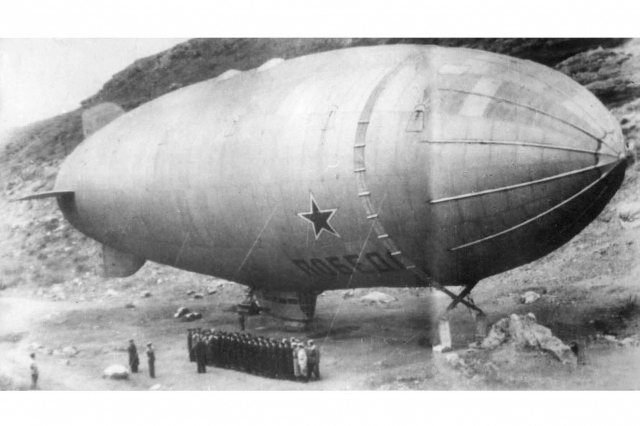
The first flight on September 26 was introductory, but it turned out to be productive — at the exit from Sevastopol Bay, the aeronauts noticed a sea mine at a shallow depth. With the help of radio communication, the airship crew guided the minesweeper to the right place, and it defused the mine.
For the first time in history, reconnaissance of fish schools was carried out from the air — what has become commonplace in our time seemed like a miracle then; fishing vessels then for the first time carried out fish trawling not at random, but on instructions from above.
But the V-12 airship was destined to fly for only two years after its return. On January 29, 1947, during a low-altitude flight, the ship caught on a power line. The crew, dropping the emergency ballast, managed to tear the airship out of the trap... however, the sharp ascent became fatal — the envelope could not stand it. The "Twelfth" partially released hydrogen from the envelope and crashed into the ground, taking the lives of all three crew members.
Already the following year, the helicopters of Mil, Yakovlev, and Kamov made their first, but confident steps into the air. The era of airships was coming to an end.