The Road to the Sea
The history of the construction of the Crimean trolleybus route.
Petro Volvach, Full Member of the Shevchenko Scientific Society, Member of the National Writers' Union of Ukraine, Honored Worker of Science and Technology of the AR of Crimea, a Crimean with 60 years of experience. "Krymska Svitlytsia" Newspaper, 2018, Issue No. 9
The connection between central Crimea and the South Coast has always been one of the most painful economic and household problems of the peninsula. It was the inaccessibility of the South Coast for numerous conquerors and its protection by the high ridge of the Crimean Mountains from the north that largely ensured its political and economic independence and autonomy. And the natural and climatic features of this unique zone formed not only a way of management, its agriculture, economy, and way of life different from the steppe and foothill regions, but also a separate ethnotype of its inhabitants.
All this diversity and difference was preserved by more than one generation for several centuries. However, they underwent a fundamental transformation after the capture of the peninsula and the liquidation of the Crimean Khanate by the Russian Empire in 1783. If before this the connection between these regions was made through narrow natural roads and human paths using donkeys, horses, and small carts, the occupiers, for the sake of settlement, economic, and military development of the peninsula, were forced to take care of some roads.
In 1824, the tsarist administration decided to connect the provincial city of Simferopol with the small coastal village of Yalta by road. Several regiments stationed in Simferopol and Sevastopol were thrown into the construction of the road. After two years of hard labor by several thousand conscripted soldiers, a poorly maintained road connected Simferopol with Alushta. The road from Alushta to Yalta was built only in 1887. It took almost ten years to build the south coast road from Yalta to Sevastopol.
A small modernization of the mountain roads was carried out in 1860. During 1923–1933, asphalt paving was tested for the first time on some sections of the mountain road network. And in 1935–1940, another regular modernization was carried out: widening the roadbed, straightening sharp bends, constructing retaining walls, and eliminating landslides. Because of the war, no work, not even repairs, was carried out on the roads. During the 10 post-war years, the Russian Federation did not make significant changes in road construction, did not expand the road network, and did not reconstruct the roads.
General Secretary of the CPSU Central Committee Nikita Khrushchev loved to vacation in Crimea the most. Therefore, shortly after Stalin's death, the mountain road network in Crimea was capitally reconstructed. Already after the Crimean Oblast entered Ukraine, the builders performed a colossal volume of engineering and mountain work: they eliminated dozens of sharp bends, reliably secured large sections of side slopes, planted them with anti-erosion plants, tamed soil landslides, and built retaining walls. In fact, since the mid-1950s, Ukraine rebuilt Crimean roads anew.
And it was no coincidence that on October 27, 1958, the Council of Ministers of the Ukrainian SSR adopted Resolution No. 1340-R "On the construction of a trolleybus mountain line from Simferopol to Yalta." The narrow road with a serpentine of sharp bends turned into one of the best mountain highways in the country. By the way, the design and estimate documentation for the construction of the first mountain trolleybus line in the country and the longest in Europe was developed by Ukrainian specialists with the participation of the Georgian branch of the All-Union Institute for Road Construction Design and Management of Southern Highways.
The working design group was headed by Ukrainian Viktor Denysenko. It also included several specialists from Kyiv and Georgia. The directorates responsible for the construction of the mountain route were also headed by Ukrainian specialists Borovsky and Sushchenko. In the summer of 1959, the Crimean Trolleybus Administration was established in Simferopol, and in the spring of the same year, the Crimean Trolleybus Depot appeared, which was also headed by Ukrainian Vasylenko. The depot consisted of 40 domestic trolleybuses and 8 Czech-made vehicles.
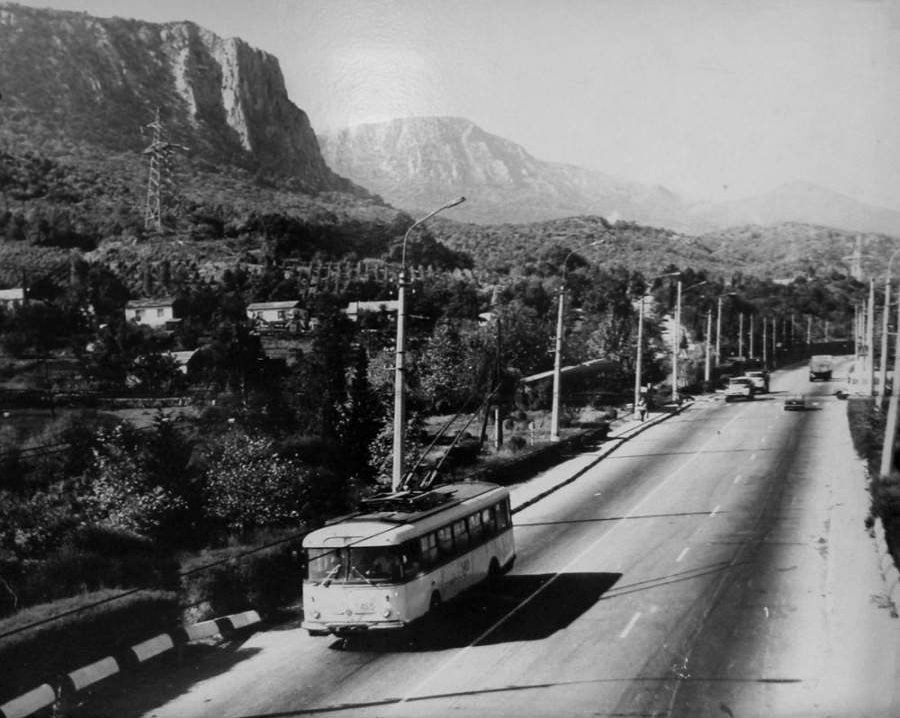
The construction of the trolleybus route began from the railway station and was carried out in two directions: to the settlement of Maryine near Simferopol and to the airport. In Simferopol itself, the builders had to widen and straighten city streets, choosing the most optimal routes.
The first line of the trolleybus route from Simferopol to Alushta was built in a fantastically short time, in just 11 months. The line was opened on November 6, 1959, in honor of the 42nd anniversary of the Bolshevik coup in Petrograd. The authorities politicized this event and conducted it with great pomp. Flower-decorated trolleybuses were dispatched from Alushta and Simferopol to meet each other. The vehicles heading from Simferopol were decorated with portraits of Vladimir Lenin, and those heading from Alushta — of Nikita Khrushchev.
The volume of work performed for the construction of only the first stage of the trolleybus route was colossal. It was necessary to excavate and move over 1 million cubic meters of soil, install about 6 thousand poles, build 16 traction substations, run over 200 km of contact wires, and open two trolleybus depots.
An equally large volume of work was performed during the construction of the second stage of the trolleybus line from Alushta to Yalta. The implementation of this project proved to be even more difficult and expensive. Over 80 enterprises from 10 cities of Ukraine (Kyiv, Kharkiv, Dnipropetrovsk, Zaporizhzhia, Kherson, Sevastopol, etc.) were involved in the construction of the mountain trolleybus route. The opening of the second stage and the commissioning of the entire mountain trolleybus route in the summer of 1961 also took place with great celebrations. This event was timed to coincide with the opening of the 22nd Congress of the CPSU.
It should be noted that only republican budget funds were attracted for the construction of this major mountain trolleybus highway. Thus, it can be quite reasonably argued that the longest mountain trolleybus route in Europe was built at the expense of Ukraine, designed by Ukrainian engineers, and implemented by the hardworking hands of Ukrainian workers. Specialists and construction organizations from almost all cities of Ukraine participated in the implementation of this huge project. According to statistics, over 118 million rubles were spent on the construction of the highway. The trolleybus route breathed life into the south coast sanatoriums, holiday homes, and children's health resorts, stimulated resort construction, contributed to the creation of new jobs on the South Coast, and revived trade.
According to incomplete data, by 1990, Crimean trolleybuses carried over 9 million passengers. Thus, the trolleybus route, like the revived horticulture and viticulture, is the greatest achievement of the first decade of Crimea's presence in Ukraine.