Energy Sources of the Peninsula
Electrification of the peninsula as the main component of the Crimean energy sector.
Petro Volvach, Full Member of the Shevchenko Scientific Society, Member of the National Writers' Union of Ukraine, Honored Worker of Science and Technology of the AR of Crimea, a Crimean with 60 years of experience. "Krymska Svitlytsia" Newspaper, 2017, Issue No. 23
From the first years of the electrification of the peninsula, the power plant was the main component of the Crimean energy sector. After all, the oil and gas sector of energy in Crimea began to develop only in the 1970s of the last century. It is known that the first Crimean natural gas field was discovered in November 1960, and the preparation of the Hlibovske gas condensate field for operation was carried out in 1966. Commercial gas production in Crimea began in the 1970s of the last century.
So, electric energy, which was produced at local thermal power plants, was the main source of development of the Crimean economy and the functioning of the entire economic complex before the war. Therefore, power supply in Crimea has always been the most painful problem.
It is known that the first Crimean power plant, which was built in Simferopol in 1896, could provide lighting only for the local theater and several adjacent central streets. By the beginning of 1911, there were 25 industrial enterprises in Simferopol, according to the factory inspection (5 canneries, a mechanical plant, 4 tobacco and 2 joinery factories, 4 mills, 6 printing houses, craft workshops, several bakeries, and a laundry). Their work was provided by two small power plants. They were built not without the participation of foreign investors.
For almost 30 years, the Simferopol administration carried on fruitless and unsuccessful conversations about the construction of a tramway network in the city. It, like in Sevastopol, was to be powered by a local power plant. After all, whole herds of horse carriers scuttled along Simferopol streets, most of which were unpaved. In summer, horse-drawn carriages (there were almost 500 of them in the provincial city) with dashing drivers raised clouds of dust and pungent dust. And in bad weather, the streets of the provincial city of S. turned into solid mud and impassable swamp. Getting from the station or the city outskirts to the city center was quite problematic. So the city suffered from lack of roads and reliable transport connection. Belgian investor-concessionaires ventured to bring transport order to the provincial center.
They first laid one tram track from the station to the city center. The rapid development of industrial enterprises in Simferopol by the early 30s and the increase in the urban population prompted the authorities to lay two more tram tracks from the railway station to the outskirts and the center. And this in turn increased the demand for electricity. The capacity of the local power plant was not enough, and this forced the installation of a high-voltage power transmission line from the Sevastopol State District Power Plant (DRES). Back in the late 19th century, the situation with electrification of the "city of Russian glory" Sevastopol by municipal transport was catastrophic.
The entire infrastructure of the Black Sea Fleet also required electrification. The Russian Empire, which spent huge amounts of money on the maintenance of the world's largest aggressive army, proved unable to electrify Sevastopol, equip city streets, and provide the city with at least some transport.
Historical documents show that the first power plant in Sevastopol was built only in 1897–1899. At the same time, the first tram track appeared in the city. After the end of the civil war in 1921, the city power plant and the power plant of the Marine Plant started working. In July 1922, Balaklava began providing current, and in September 1923, the Northern Power Plant was put into operation. The presence of several power plants in the city allowed the creation in 1923 of the municipal trust "Electrotrans", which was later transformed into "Krymenergo".
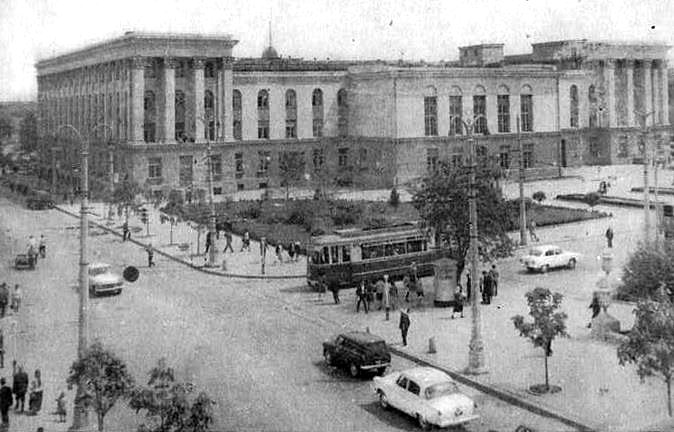
A tram at the intersection of Kirov Avenue and Gogol Street in Simferopol
Back in the early 20th century, Yalta was lit by kerosene lamps and used a water pipeline built back in the Middle Ages. The construction of a more powerful water pipeline was completed in 1898, and the sewerage in Yalta was partially equipped in 1886. A small municipal power plant was built only in 1904. The power of its engines was 700 horsepower. Alushta and most of the south coast villages were also lit by kerosene lamps until 1914. The capacity of the local Yalta power plant was not enough even to light the entire city.
To improve the energy supply of the South Coast, primarily Yalta, already in the first year of the transfer of the Crimean Oblast to Ukraine, the Ukrainian authorities raised the issue with the "Crimean" authorities of building two substations with a voltage of 36 kW in Gurzuf and Alushta. Feodosia was supplied with electricity by Kerch power plants. To improve the energy supply of the Crimean Oblast, the draft resolution of the Council of Ministers of the USSR and the Central Committee of the CPSU "On measures for the further development of agriculture, cities, and resorts of the Crimean Oblast of the Ukrainian SSR," prepared shortly after the entry of the Crimean Oblast into Ukraine, provided for:
– increasing the construction of the Novo-Krymska DRES (presumably in Simferopol) with a capacity of up to 100 thousand kW, with the commissioning of the first stage in 1956;
– completing the expansion of DRES No. 1 and putting into operation boiler No. 4 in the first quarter, generator No. 3 and boilers No. 5, 6 in the IV quarter of 1955.
In addition, the union government obliged the Ministry of Power Plants and Electrical Industry to design and put into operation the Kerch – Feodosia power line in 1956 and Simferopol – Feodosia in 1957.
In subsequent years, Ukraine significantly improved the power supply of the peninsula. Thus, with the completion of the construction of the Kakhovka HPP in 1962, the 220 kW Kahovka – Dzhankoy Oru line of the Simferopol DRES was put into operation. It connected the Crimean energy system with the unified energy system of the south of the country.
Almost at that time (1962–1965), i.e., in the first years of Crimea's presence in Ukraine, the following were put into operation: the 220 kW Dzhankoy – Feodosia transmission line, the 110 kW Saki – Yevpatoria transmission line, Staryi Krym – Sudak, Staryi Krym – Planerske, the 220 kW Dzhankoy substation, and the 110 kW substations — Moynaky, Donuzlav. During 2003–2011, the Simferopol – Sevastopol transmission line was upgraded from 220 kW to 330 kW.
Before the seizure of Crimea by the Russian Federation in February 2014, over 6.3 billion kWh of electricity was transmitted to the Crimean power grid, of which over 5.0 billion came from mainland Ukraine. The main volumes of electricity consumed were covered by transfers (from the Zaporizhzhia TPP, the Zaporizhzhia NPP, and from the energy system of Mykolaiv Oblast) via four high-voltage power transmission lines.
Thus, the economy of the Crimean peninsula can fully function only with electrical supply from mainland Ukraine. Only the de-occupation of Crimea can once and for all solve the two most painful problems of the peninsula — providing it with water and electricity.