The Ethnogenesis of the Crimean Tatars
From the history of the Crimean Tatar nation, which was formed over millennia on the territory of the Crimean peninsula.
Khalise Zinedin. "Krymska Svitlytsia" Newspaper, 2016, Issue No. 48
The Crimean Tatar nation was formed over millennia on the territory of the Crimean peninsula, and therefore, on a par with the Karaites and Krymchaks, the Crimean Tatars are autochthonous. Tauri, Cimmerians, Scythians, partly Hellenes from Miletus, Sarmatians, Bulgars, Goths, Huns, Khazars, Pechenegs, Kipchaks (Cumans), Italians, Horde members, Seljuk Turks, and Adyghes (Circassians) participated in their ethnogenesis. Over the centuries, peoples came to Crimea and assimilated with the local population.
The origin of the Crimean Tatars is the subject of endless arguments and discussions. In the minds of many learned men, a firm conviction has taken root that the Crimean Tatars are descendants of the Golden Horde members who settled on the peninsula in the first half of the 13th century. This myth appeared immediately after the annexation of Crimea by Russia in 1783, and since then it has firmly entered official Russian and then Soviet historiography and still continues to be replicated in scientific literature. Falsifiers took the events associated with the Horde period, which is in fact only a stage of a centuries-long, complex historical process, as the starting point of the origin of the Crimean Tatars.
It was the Tauri, who are known from the 10th century BC, that became one of the main components of this indigenous people of Crimea. The Cimmerians, known from the 10th to the 7th century BC, share common ancestral roots with the Tauri.
In the 7th century BC, the most famous tribal union in ancient history — the Scythians — appeared in Crimea. Unlike the Tauri and Cimmerians, the homeland of the Scythians was the Altai — the cradle of the Turkic peoples. An active process of inter-ethnic interaction took place. Further, the Hellenes from Miletus, Sarmatians, Bulgars, even Roman legionnaires, Goths, Huns, Khazars, Pechenegs, all of them, wave after wave, came to the peninsula at different times and took an active part in integration processes. They mutually enriched each other, while preserving the features of their individuality. Thus, the Goths brought Arian Christianity to Crimea, and with the appearance of the Huns, the faith and cult of the god Tengri spread on the peninsula. The blood of all peoples harmoniously poured into the Crimean "melting pot," which for millennia formed the Crimean Tatar ethnos.
But still, the Kipchaks — one of the numerous Turkic tribes — deserve special attention.
According to written sources, the Kipchaks were mostly light-haired and blue-eyed people. A strange feature of the Kipchaks is that they did not assimilate, but rather assimilated others into themselves. That is, they were the core to which, like a magnet, the remnants of the Pecheneg, Bulgar, Alan, and other tribes were attracted, adopting their culture.
From 1299, the peninsula became part of the Ulus of Jochi of the Great Horde. After that, both the conquerors and the conquered lived peacefully on the Crimean land, gradually getting used to each other.
Thus, from the 13th century, almost all ethnic components, all ingredients, in other words, the forefathers, from whom only a few centuries later a new nation — the Crimean Tatars — would be formed, were already present on the peninsula.
It is noteworthy that even before the emergence of the Ottoman state, immigrants from Asia Minor appeared on the peninsula. These were representatives of the Turkic Seljuk tribe, who left traces of their presence in Crimea.
Speaking of the ethnic composition of Crimea, it is difficult to bypass the Italians. Or, to be more precise, the Venetians and Genoese. Many of them took root here and over time completely dissolved in the Crimean Tatars.
Thus, the ethnogenesis of the modern Crimean Tatars, in which non-Turkic and Turkic ancestors participated, developed in a quite complex way over the centuries.
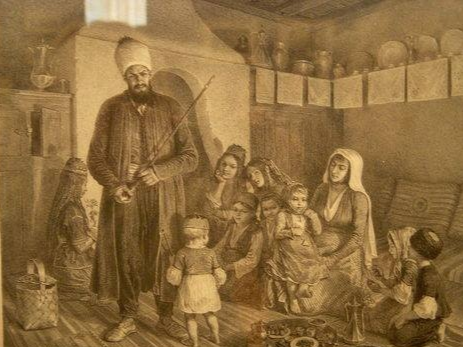
Modern Crimean Tatars consist of three main sub-ethnic groups: coastal (Yalıboyu), mountain/foothill (Tats), and steppe (Noğays). As for the ethnonym "Crimean Tatars," or rather "Tatars," it appeared in Crimea only with the arrival of the Horde, that is, when Crimea became part of the Ulus of Jochi of the Great Horde. By this time, a new nation had already almost formed. It was from then on that the inhabitants of Crimea began to be called Tatars. But this in no way means that the Crimean Tatars are descendants of the Golden Horde. Today, the process of ethnogenesis of the Crimean Tatars is still not completed.