Ukrainian Philology at Taurida University
The career of talented Ukrainian teachers in Crimean educational institutions.
Petro Volvach. "Krymska Svitlytsia" Newspaper, 2018, Issue No. 45
Kyiv communist party officials began to speak about the need to train teachers of Ukrainian language and literature in the 100% Russified Crimean State Pedagogical Institute (the successor of Taurida University) only after the entry of the Crimean Oblast into Ukraine.
As evidenced by archival document No. 66 of September 13, 1954 (Note of the Crimean Regional Committee of the CPU), already in 1955, there were to be over 600 teachers of Ukrainian language and literature in Crimean schools. (Crimea in the Conditions of Socio-Political Transformations (1940–2015). Collection of Documents and Materials. – Kyiv, "Klio Publishing House" LLC, 2016. – P. 331–332). In subsequent years, their number was to increase manifold.
Undoubtedly, it was difficult to attract such a number of qualified teachers from other regions of Ukraine. In Kyiv, it was well understood that the issue of teachers of Ukrainian language and literature could be fundamentally resolved by their well-organized training in the local Crimean Pedagogical Institute. Responding to the aforementioned report of the Crimean Regional Committee of the CPU, the Minister of Education of the Ukrainian SSR on October 14, 1954, under No. 471, issued an order "On the organization of the department of Ukrainian language and literature and the introduction of teaching the Ukrainian language at the Crimean Pedagogical Institute named after M. V. Frunze" (Order No. 11). (Collection: Faculty of Ukrainian Philology and Ukrainian Studies of Taurida National University named after V. I. Vernadsky, Simferopol, Tavriya, 2000. – P. 11).
Already in the autumn of 1954, the first academic group for the study of the Ukrainian language was created in the pedagogical institute from among the philology students. Due to a lack of local specialists, an experienced teacher, Antonina Yova (Smyrnova), was invited to Simferopol from the Kryvyi Rih State Pedagogical Institute. It is completely justified that graduate Ukrainian philologists of all generations called her the mother of Ukrainian teachers of Crimea. For several decades, this heroic woman and highly gifted teacher-scientist laid the foundation stone for Ukrainian pedagogical education and science in Crimea. For almost 32 years, A. Yova worked as a lecturer and associate professor of the department of Ukrainian language created by her at the Crimean Pedagogical Institute and Simferopol State University.
The department of Ukrainian language and literature at the Crimean Pedagogical Institute was opened on August 26, 1955. To head it, a former front-line soldier, Candidate of Philological Sciences, Associate Professor Petro Kyrychok, was invited from the Kryvyi Rih Pedagogical Institute. He took a direct part in creating a full-fledged department of Ukrainian philology at the Faculty of History and Philology and formed a capable team of highly respected teachers and scientists.
At his invitation, talented teachers and scientists began their work in the department of Ukrainian literature: Volia Zakhanevych, Mariia Dotsenko (Zirchenko), and Heorhiy Nedilko. Among the teachers of the department of Ukrainian literature was also the well-known literary critic and literary scholar Musiy Bohutskyi. He and the writer Ivan Nekhoda, on a government assignment, created the Crimean branch of the Writers' Union of Ukraine.
Petro Kyrychok, as head of the department of Ukrainian language and literature, actually performed the role of director of the Ukrainian branch of the Faculty of History and Philology. The development and strengthening of the department took place with his active participation. He worked in this position from 1955 to 1977, combining pedagogical activity with scientific research. In the summer of 1977, Petro Kyrychok was the first in the history of Simferopol State University to defend a dissertation for the degree of Doctor of Philological Sciences in the specialty "Ukrainian Literature."
By the mid-1970s, the Ukrainian branch of the Faculty of History and Philology had strengthened in terms of staff and material resources to such an extent that in June 1975, two full-fledged departments were created — of Ukrainian language and of Ukrainian literature. During 1987–1998, the department of Ukrainian literature was headed by a graduate of the university, Kateryna Pokotylo, and from 1998 to 2003 — by Candidate of Philological Sciences Viktor Humeniuk.
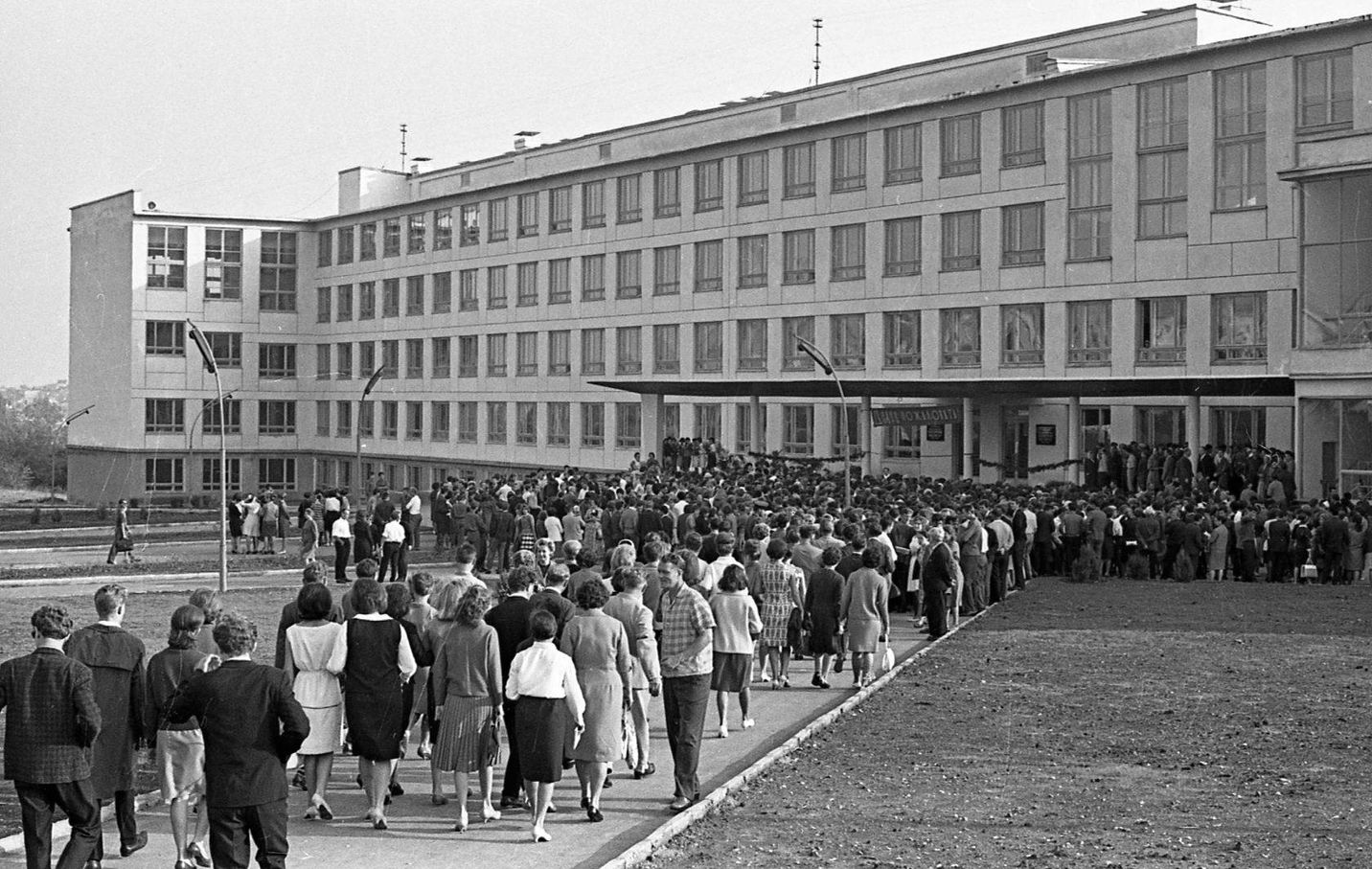
The new main academic building of the Crimean Pedagogical Institute (TNU), 1965
A real ornament and pride not only of the department of Ukrainian literature of the Philological Faculty but of the entire university was Candidate of Philological Sciences, Professor Oleksandr Hubar. The scientist initiated the study of Ukrainian-international cultural relations in the department and the university. He is the author of original works on Ukrainian-Russian, Ukrainian-Belarusian, Ukrainian-Armenian, and Ukrainian-Italian cultural ties.
Oleksandr Hubar published two books popular among Crimean teachers — textbooks about Ukrainian writers of Crimea of the second half of the 20th century: "The Black Sea Wave" and "Modern Ukrainian Writers of Crimea."
Associate Professor Mykhailo Vyshniak was a very colorful scientific and pedagogical figure in this department. During 2003–2005, he headed the department. Several collections of poetry also belong to his pen. He is a member of the National Writers' Union of Ukraine and for a long time headed the Ukrainian branch of the Crimean Writers' Organization.
In the mid-1975, a well-known scientist, Candidate of Philological Sciences, Professor Yevhen Rehushevskyi, was invited to head the department of Ukrainian linguistics. With his arrival, the scientific work of the department became significantly more active. As a result, during the entire existence of the department of Ukrainian language (linguistics), 1 doctoral and 20 candidate dissertations were defended in the specialty "Ukrainian Language."
Thanks to the activities of two Ukrainian studies departments — language and literature — the Ukrainian branch became so powerful that on January 19, 2005, a rector's order was issued "On the creation of the Faculty of Ukrainian Philology and Ukrainian Studies" on the basis of these two departments. Before the occupation of Crimea by the Russian Federation, four departments operated within this faculty: Ukrainian linguistics, theory and history of Ukrainian literature, Ukrainian studies, and culture of the Ukrainian language.
Two of the four departments had a university-wide status. The department of culture of the Ukrainian language provided teaching of the Ukrainian language for professional purposes, and the department of Ukrainian studies — of the history of Ukraine at all other fifteen faculties of Taurida University. Computer and multimedia classrooms equipped with the latest technology were created at the faculty. The pride of the faculty was the specialized classrooms "Ukrainian House," the classroom named after O. I. Hubar, "Museum of the Ukrainian Towel," and "Exhibition Hall 'Ukraine through the Ages'." This complex formed a real Center of Ukrainian Studies. As of 2010, 6 Doctors of Sciences, professors, and 26 Candidates of Sciences worked at the faculty.
Over its long history, the Faculty of Ukrainian Philology has trained thousands of teachers of Ukrainian language and literature not only for Crimea but also for the south of Ukraine, and most of them justified the high and responsible title of Ukrainian people's teacher.
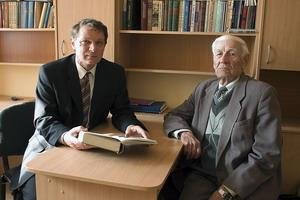
Viktor Humeniuk and Petro Kyrychok
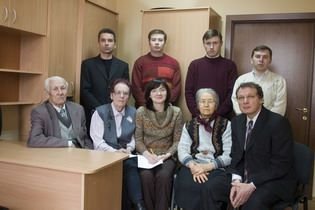
Department of Theory and History of Ukrainian Literature