One builds, another destroys... On the current state of the Genoese Fortress
The complex of fortifications in Sudak has repeatedly suffered destruction, changed names, and was restored, rising from the ruins.
Valeriy Verkhovskyi. "Krymska Svitlytsia" Newspaper, 2019, Issues No. 41-42
The complex of fortifications in Sudak, known in our time as the Genoese Fortress, has repeatedly suffered destruction, changed names and affiliation, and was restored, rising from the ruins.
As far as historians can tell, the building of walls here in Surozh (or Soldaia) began in the third century of the new era. Khazars, Goths, Byzantines, Venetians, Genoese, Ottomans... The fortress suffered a new invasion in 2014 — and, as has most often been the case in its history, the horde came from the East again.
The conquerors of the past did not care about the artistic or historical value of the fortress — for them it was a structure of military purpose, not a monument of Byzantine, Gothic, or Italian history. The Ottomans rebuilt the Catholic church into the Padishah Cami mosque, and the Russians, starting from 1771, stationed their Kirillovsky regiment in the fortress, built barracks for it, and converted the mosque into an Orthodox church.
Since 2001, a festival of medieval martial arts "Genoese Helmet" (Genoeskiy shlem) has been held annually in Sudak, namely in the Genoese Fortress; members of historical reconstruction clubs gather here, arrange mock battles, imitating those conquerors who once destroyed this fortress. Horsemen gallop, costumed fighters fire ancient small arms and artillery, "mock" team battles-bohurts take place...
Everything is not so apolitical, because war (even a battle of reconstructors) always remains a continuation of politics. At the first post-occupation festival in 2014, the organizers, "to avoid trouble," banned four Ukrainian "knightly" reconstruction clubs that had performed successfully and without any "unsportsmanlike" conflicts here in previous years. Political bias did not spare this event either, which is far from the vanity of modern times.
A very interesting event, and, of course, it is better to hold such a festival in a city actually related to medieval Europe, rather than somewhere in a semi-Asian hinterland with completely different traditions.
Everything is not as free as it seems at first glance. What contribution is made by the participants remains behind the scenes, and for the audience a ticket to the festival costs 600 rubles (whereas visiting the Genoese Fortress at another time is only 200 rubles). The organizers of the festival promote the exoticism of the fortress walls, the romance of the sea and natural landscapes, and the rich history of the ancient city, which together create ideal conditions for holding a medieval festival. Of course, exoticism, romance, rich history — that is why Crimea was needed, because Russia has nothing to brag about, with the exception of the Kremlin, built according to an Italian design.
The mandatory element of the program — shooting from artillery — also raises questions. Although it is carried out, one must think, not for real, but with blanks, a certain risk of damage to the fortress remains.
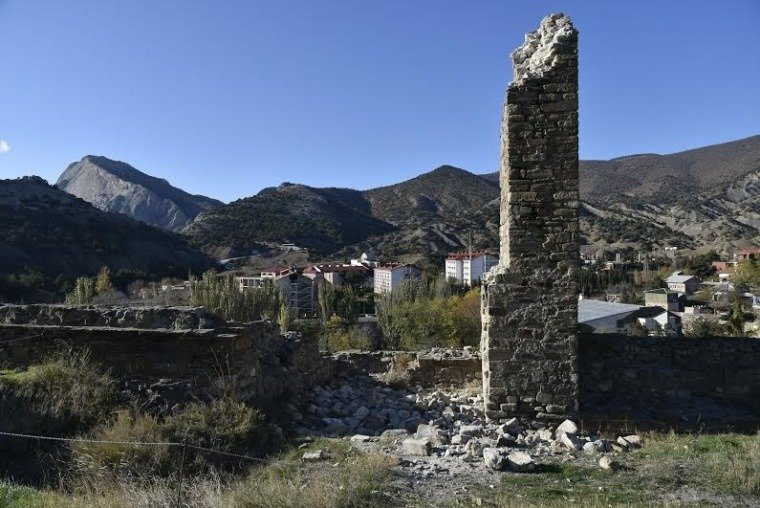
Part of the ancient tower in the Sudak fortress that fell.
Since 1958, the Genoese Fortress has been a branch of the National Sanctuary "Sophia of Kyiv." Back in 2007, Ukraine submitted this monument as a candidate for inclusion in the UNESCO World Heritage List (St. Sophia Cathedral itself has been in this registry since 1990). Unfortunately, the consideration of the application has been suspended due to circumstances infinitely far from culture. Having separated it from "Sophia of Kyiv," the Russian invaders created the so-called "State Budgetary Institution of the Republic of Crimea Museum-Reserve Sudak Fortress." Even under current circumstances, two hundred thousand tourists visit the museum-fortress annually. A ticket costs 150-200 rubles. This is a quite profitable business; no wonder the "museum" dealers who seized control of this object seek to create even more comfortable conditions for visitors.
History can be ignored — they even began to build hotel premises and additional toilets on the territory. As a result, the irreparable happened: on the night of November 16–17, 2015, one of the fortress towers collapsed. A little more than a year was enough for the occupiers and their local lackeys to destroy a structure that had stood for centuries. And the so-called management of the newly created museum SBI RC "Sudak Fortress," instead of properly restoring the monument, decided to quickly "fix the irreparable," showing criminal negligence.
They carried out a hasty "restoration" — builders without experience in restoring historical sites, especially ones as ancient as this, were hired; they simply made a concrete foundation and built a replica of that tower from authentic stones using modern cement mortar.
Nelya Kukovalska, Director General of the "Sophia of Kyiv" Museum-Reserve, says: "They did the same with the walls nearby. And these are terrible things, unacceptable in restoration. They are a barbaric interference in the body of the monument. This situation demonstrates the inability of the so-called management of the 'Sudak Fortress' museum-reserve and the occupying authorities of Crimea to determine priorities in work and testifies to criminal negligence in matters of cultural heritage protection."
The fact that the collapse of the tower in the Genoese Fortress is a crime is clear, but the principle of "hush-hush" in Russia, which now rules in Crimea, has not been abolished by anyone. And impunity allowed the construction work to continue, and immediately in the following year, 2016, they began digging a foundation pit for construction directly under the walls of the fortress. The soil was taken away by trucks, although under such conditions, the disturbance of the delicate balance could lead to the complete destruction of the priceless monument on any day.
Moreover, two landslide tongues hang over the fortress, which at any moment can destroy a part of the wall. Nelya Kukovalska says that she monitors what is happening to the "calling card" of Sudak, although she does not have direct access to the object, which is still de jure subordinate to the institution she heads. According to Ms. Kukovalska: "After the annexation of the peninsula, illegal and unprofessional work is being carried out on the site, and no one is dealing with the development of the landslide situation. The fact is that we observe an increase in seismic activity there, and there is a threat that these two landslide tongues will advance towards the western wall of the fortress."
Unfortunately, as long as the occupation continues, there are no levers of influence on those who lead this structure to destruction through negligence and incompetence.
"We are concerned about the fate of the Genoese Fortress, because the specialists of the National Sanctuary 'Sophia of Kyiv' devoted a lot of their time and effort to it. Since 2006–2008, an activation of landslide processes has been noticed, that is, seismic activity has increased, — says Nelya Kukovalska. — To act proactively, we set up a monitoring system and put markers. In 2012, during the annual check of the technical condition of monuments, the appearance of a vertical longitudinal crack with the opening of the masonry body was recorded, about which a corresponding act was drawn up. And already when Crimea became annexed, one of the towers, as is known, collapsed."
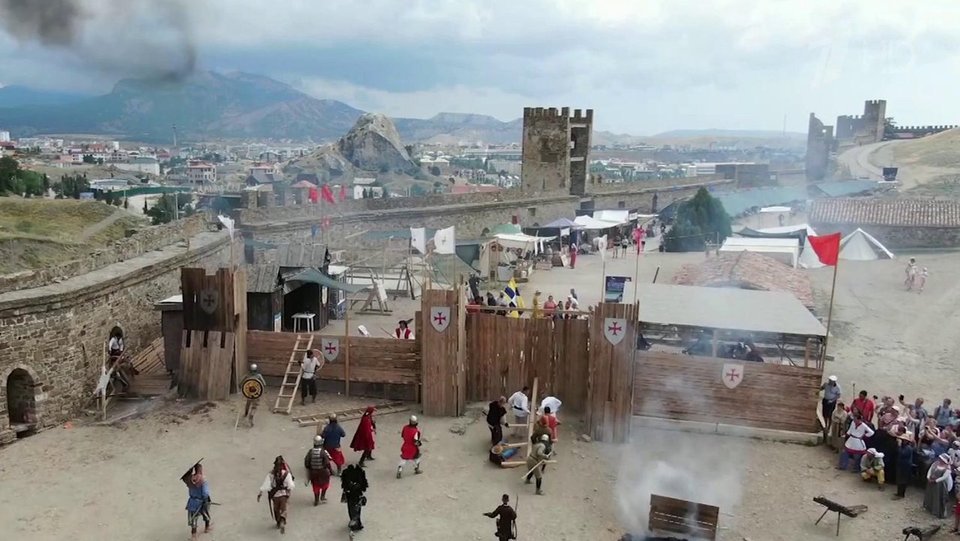
Since 2001, a festival of medieval martial arts "Genoese Helmet" has been held annually in the Genoese Fortress
Since last year, the restoration of this unique monument of medieval fortification art was entrusted to the notorious company "Meandr" from St. Petersburg, which simultaneously conducts work on a dozen architectural monuments of the peninsula: the Bakhchysarai Palace, the Mithridates Stairs in Kerch, the Vorontsov Palace-Museum in Alupka, the Surb Khach Monastery in Staryi Krym, the Pallas Manor in Simferopol, the Chekhov House in Yalta, the Swallow's Nest, etc.
"Ukraine continues to promote the Sudak Fortress as a cultural heritage monument to the UNESCO lists, but without allowing international experts to the temporarily occupied territory and ensuring their safety, the completion of the project becomes problematic," emphasized Nelya Kukovalska.
In exchange for recognition of the result of the aggression, Russia, of course, would be ready to admit UNESCO experts and ensure for them not only safety, but also the most comfortable conditions, but if the annexation is not recognized, then everything can be done as they please.
What, besides, of course, a bad memory, will remain after they leave? Only decorations and ruins, ruins and decorations will remain. Such European ancient structures are a rarity in Russia; on the territory of Russia proper, they do not exist at all — everything is only on the western and southwestern outskirts annexed by force. So it is not surprising that films are shot in the Genoese Fortress. Unfortunately, filmmakers do not always "clean up" after themselves. In the photos received in August of this year, we see decorations built for the shooting of some Russian movie, which have been standing here clearly not for the first year. How much longer will they stand? And if the gray board shed only irritates with its untidy appearance against the backdrop of the fairy-tale landscape, the additional arch very badly spoils the entire panorama.
The invader always sees in the captured territory something foreign and hostile, not theirs. They are proud that they annexed this land and everything on it, as if it were a war trophy, like deer antlers on a hunter's wall. Therefore, the history of the conquered territory begins from the moment of conquest, the previous population remains foreigners, their history and culture — foreign and hostile, everything that was before the conquest has no great value, and therefore, one should not hope for an improvement in the attitude towards the historical monument.
And millions of rubles allocated from the "sovereign treasury" for restoration and reconstruction will not save it, nor will the search for the guilty in the event of the worst development of events save it (and in the search for the guilty the Kremlin has always been unsurpassed). Moreover, rebuilding the monument from handy materials using modern cement will not save it — this will already be an attraction instead of history and a reconstruction instead of the spirit of chivalry.
Supported by the Ukrainian Cultural Foundation