On Serpents: Marine, Terrestrial, and those of Propaganda
Legends and myths of Karadag.
Ihor Svitlychanin. "Krymska Svitlytsia" Newspaper, 2018, Issue No. 7
Recently, the Internet simply exploded with a "sensation" that it was in Crimea, on Karadag, that St. George defeated the dragon. Karadag, translated as "Black Mountain," is a mountain range on the southeastern coast of the peninsula, almost midway between Sudak and Feodosia. Karadag is the remains of an ancient volcano that arose, erupted, eventually became extinct, and was destroyed by waves, earthquakes, and winds. And this process lasted a hundred million years. Now it is one of the extraordinary pearls of the Crimean coast, a geological, avian, and plant paradise for scientists, as well as artists, poets, and simply all lovers of the beauty of Crimean nature.
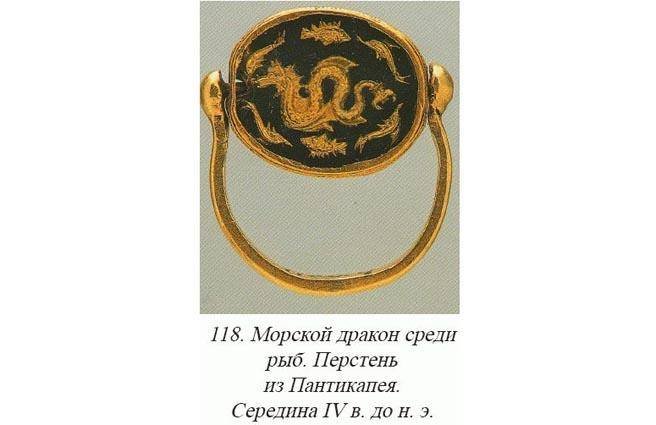
Of course, such an outstanding place has its own legends and tales. We will get to the legends later, but it is told that a large sea serpent lives under the Golden Gate of Karadag. At least the artist Maximilian Voloshin, who was in love with Karadag, left evidence of this. The devil nudged him to inform Mikhail Bulgakov about the Karadag serpent in correspondence, and the latter sketched the film script "The Fatal Eggs." And although they saw the monster in Crimea from Azov to Tarkhankut, the beast's lair was localized in the underwater caves of Karadag — they say they are there.
The serpent was also seen there by naturalists — people who are not prone to excessive fantasizing, for example, the geologist Promtov in Serdolikova (Carnelian) Bay in 1952. And what does Saint George the Great Martyr have to do with this? The Russian Wikipedia claims: "Karadag can be recognized as one of the places where Saint George defeated the dragon." Great... But this is indicated in the section called "Interesting Facts"! We emphasize — facts!
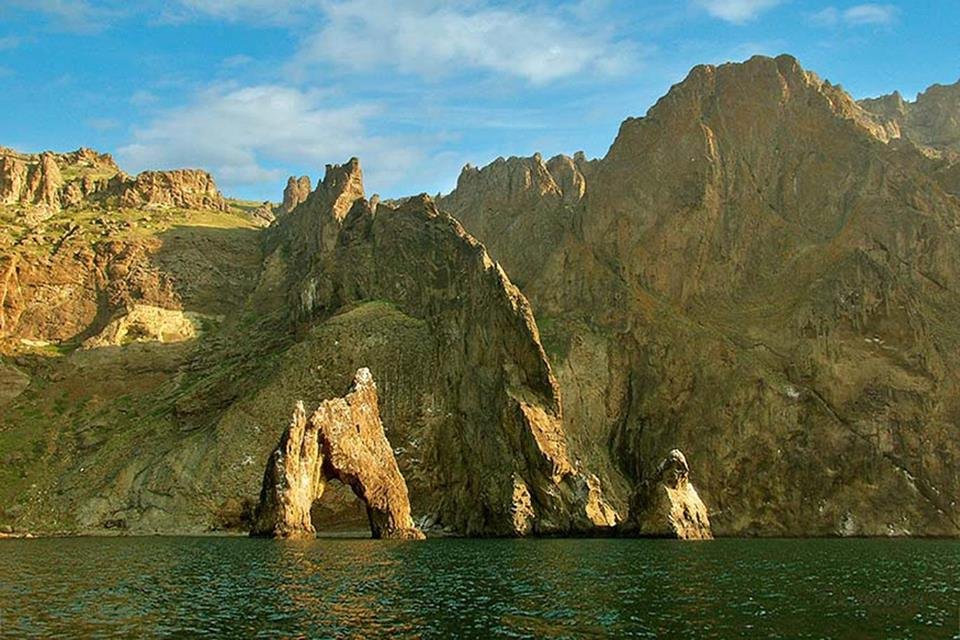
Karadag
It is strange, but it is since the time of the occupation of Crimea that this myth has actively begun to spread in the information space. Who benefits from this? Of course, the imperial propaganda, which operates with false claims: "Crimea is a sacred Russian territory," "the baptism of the Russian Prince Vladimir," "historically Russian land," "free expression of the will of Crimeans," "city of Russian glory," "Kyiv junta," "Banderites and fascists," and so on and so forth.
But in all these manipulations one can notice the main goal — to shamelessly steal from others and attribute what is foreign to oneself, and with the help of propagandist myths to create the illusion of eternal belonging of the stolen. Culture and religion become an effective tool in this process. A striking proof of this is Pushkin, the "Great Russian word," regular Russian imperial sabbaths in Ukrainian Crimea under the guise of purely cultural events, the appropriation of Voloshin, and now a brazen attempt to consolidate Saint George the Dragonslayer, the patron saint of Moscow, in the "great Russian world." Thus, we have yet another, but already historically "spiritual/staple" (skrepny) "proof" of both the sacredness of Crimea and such an "unobtrusive" integration of the peninsula into the Kremlin model of the state.