Crimea in Works of Foreign Literature: Returning from Crimea Alive
Memories of Crimea in the works of the prominent German writer Heinrich Böll.
Valeriy Verkhovskyi. "Krymska Svitlytsia" newspaper, 2017, issue No. 50
Heinrich Böll was a prominent German writer of the 20th century, a Nobel Prize laureate in literature, and a member and president of the PEN Club (both German and international). He visited Ukraine, including Crimea, but not of his own free will, but under circumstances that were difficult for him to remember, speak, or write about. But perhaps Crimea is endowed with such a karma that it is never bypassed by wars, and a large portion of literature about this sunny peninsula consists of military memoirs. Corporal Böll fought in Crimea.
Heinrich Böll was born on December 21, 1917, in Cologne to a Catholic family. His inclination toward literary writing manifested itself in childhood. Similarly, other traits appeared while he was still at school—for instance, he showed no desire to join the Hitler Youth, unlike most of his classmates. Later in an interview, Heinrich Böll would regretfully say, "We Germans are an obedient people." He was not obedient, but when he, by then already a student at the University of Cologne, was conscripted into the Wehrmacht, no one asked whether he had a desire to go to war. Since 1939, Heinrich Böll had been a soldier of World War II.
Writers fought in it... Somewhere Antoine de Saint-Exupéry and Hal Clement flew their planes into battle, the tank crewman Günter Grass went into combat, Aleksandr Solzhenitsyn commanded an artillery battery, the sailor L. Ron Hubbard fought in the Pacific, Ernest Hemingway hunted submarines in the Caribbean, and Kurt Vonnegut sat in a prisoner-of-war camp. These are only those who returned from the war.
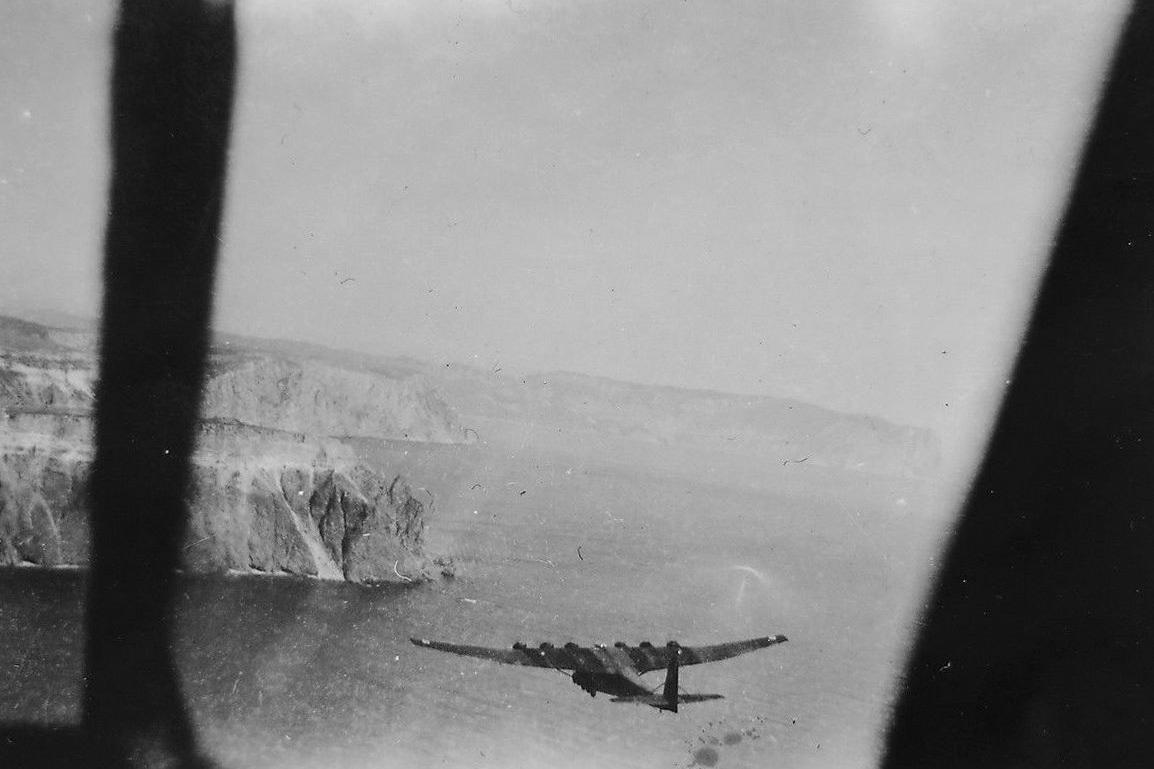
German military transport aircraft over the Black Sea
Böll had to fight in France, and later on the Eastern Front. In 1942, he married Annemarie Cech, and immediately after the wedding, he went back to the front. His soldier's path now lay across Ukraine: "Lviv is beautiful... The streets here are like those in the big cities of the world. Wide, elegant, gently sloping streets with pale-yellow houses that seem dead, yet the streets are full of people," the writer recalled. Böll did not stay long in Lviv. The Wehrmacht armies were advancing south toward the Black Sea, and so he ended up in Odesa, from where they were to be sent to Crimea.
"The only thing we wanted was to get out of those big, black, dirty walls, but now that we were already standing in the street, it seemed to us that it would have been better to return to the barracks. Only two months had passed since we were drafted into the army. We were very afraid and at the same time understood that if we went back, we would definitely want to leave again, but by then we wouldn't be able to; and it was still only four o'clock, and we were kept awake by lice and singing in the barracks; besides, we were afraid and at the same time hoped that the next morning there would be flying weather and we would be transported to Crimea, where we would perish. We did not want to die, and we did not want to go to Crimea..." ("Back Then in Odesa").
In Heinrich Böll's writings, you will not find descriptions of beautiful Crimean landscapes or the wonderful nature of the region where fields and mountains are magical and the sun and sea are healing... No, if you are on the Eastern Front, your Crimea is leaden clouds, a black-blue sky, a harsh Black Sea. It is a field of withered sunflowers where the future Nobel laureate hides from the fire of enemy rifles. It is hell...
"War is vile, ruthless, and anti-human; I simply cannot find the right words for it, maybe later I will tell you about it. I have already got used to saying when passing by a dead man: 'God save your soul!'—regardless of whether he is German or Russian." (From Corporal Böll's letter to his wife. Crimea, November 21, 1943).
When you lie on the front line in the middle of Crimea in a sunflower field in November, you pray only that the shelling will end quickly. Chauvinistic propaganda and cheerful marches are left for the rear-guard rats. You plead that the bullet bypasses you, even though you know that by bypassing you, it will hit someone else... War will take its toll.
"Where the Black Sea was, which is not visible from here, the sky had an even darker, almost blue-black coloring; it seemed that twilight and night were advancing from the east. Somewhere deep in the airfield, near the gloomy hangars, the tanks of the winged monsters were filled to the brim with fuel, after which the monsters moved back and, with malevolent hospitality, opened their bellies, which were filled with people—gray, exhausted, and despondent soldiers; nothing could be seen in their eyes but fear: Crimea had long been surrounded..." ("To Bind Brooms").
He was lucky to escape from Crimea alive. He ended up on the Western Front, was captured by the Americans, and returned home. To live with his beloved wife and father two children. To work as a minor clerk in a statistical bureau and write his stories, and soon join the ranks of the most famous German writers. To always tell the truth, because he knew the bloody cost of lies. To condemn the repressions against Mustafa Dzhemilev, to host Aleksandr Solzhenitsyn at his home during his transit from the Soviet Union to America—a man who had gone through the same war, only on the opposite side of the front.
To write about what a terrible thing war is; about how all wars end sooner or later, that the only true victory can only be peace; that flowers will eventually grow on the battlefield, but the dead can never be brought back...