Gogol as Our Everything
Reflections on the creative activity of Nikolai Gogol.
Valeriy Verkhovskyi. "Krymska Svitlytsia" newspaper, 2017, issue No. 35
"An unheard-of wonder appeared beyond Kyiv. All the pans and hetmans gathered to marvel at this wonder: suddenly it became possible to see far to all the ends of the earth. In the distance, the Liman turned blue, and beyond the Liman, the Black Sea spread out. Experienced people recognized Crimea, rising like a mountain from the sea, and the swampy Syvash. On the left hand, the Galician land was visible.
— And what is that? — the gathered people questioned the old folks, pointing to the gray and white peaks looming far away in the sky, looking more like clouds.
— Those are the Carpathian Mountains! — said the old folks, — among them there are some from which the snow never melts, and clouds cling and spend the night there..." Nikolai Gogol, "A Terrible Vengeance"
Kyiv, the Liman, the Black Sea, Crimea, and the Carpathians, the land beyond the Carpathians—this is the world in which Gogol existed. He precisely outlined the borders of Ukraine; on his map, there is no Siberia, no Kremlin, nor even Belarus, but there is Crimea, the swampy Syvash, and the Carpathians. Mykola Vasylovych, undoubtedly, belonged to this land and no other, yet he wrote in the Russian language and no other... So, is he a Russian writer or an Ukrainian one?
"Cursed Katsaps" "I must tell you that I had a cockroach in my left ear. In Russian huts, the cursed katsaps have bred cockroaches everywhere." "Ivan Fyodorovich Shponka and His Aunt".
When Taras Bulba cried out at the end of Gogol's novella about the "Russian land" (zemlya russkaya), what was it: a conformist bending or the sacred conviction of an ideologically driven writer? Or perhaps it was simply a brilliant truth, artistic and historical? The desire to rewrite the classic or to dig up something in his work that wasn't there looks very naive. To throw out words that became irrelevant three centuries later? Just like trying to drag Taras Bulba into the national idea?
Gogol possesses what makes him a great writer—a great truth. Taras Bulba belonged to the 17th century, and back then in Ukraine, the "Russian land" referred to territories inhabited by Ukrainians and Belarusians, as well as the Novgorod and Pskov lands; Moscow and Muscovites did not fall under this definition. Gogol's Russian language is not Muscovite or St. Petersburg-like at all, and the inclusions of Ukrainianisms in his novellas are placed so accurately that one can only envy them. "He is still a young child (moloda dytyna),—she usually said, despite the fact that Ivan Fyodorovich was almost forty years old,—how should he know everything!"—reflects (in Russian!) about Ivan Shponka "your dearly loving aunt Vasilisa Tsupchevska."
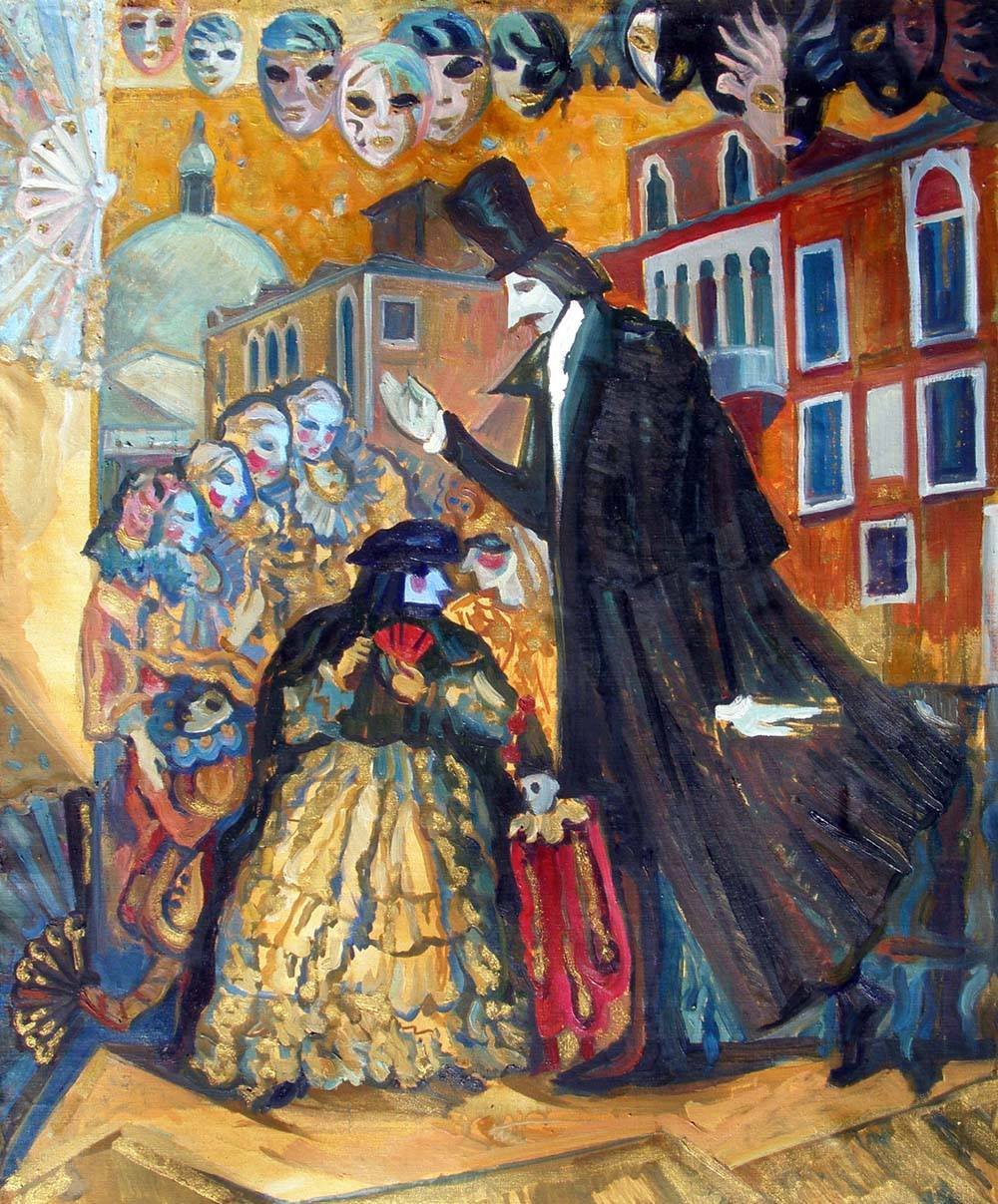
I. Levytska "N. Gogol in Venice", 1996, oil on canvas
The Ashes of Taras Beat in My Heart
Gogol resembles Charles De Coster, who scattered Flemish words throughout his French-language novel about Eulenspiegel. Is De Coster a French writer or a Dutch one? Such a framing of the question is meaningless, for he is a Belgian and only a Belgian writer.
It is equally absurd to ask questions about Gogol based on modern realities. Gogol was a Little Russian writer. And of all the paths Ukraine could have taken, history granted us precisely the one we trod. The "Ostroh" Volhynian-Calvinist project remained an unrealized exotic plan; the Greek Catholic path was almost realized, though limited to the western region, but history does not know the word "almost." The Union of Lublin of 1569, unfortunately, put an end to another possible path of development, removing Ukrainian lands from the jurisdiction of the Grand Duchy of Lithuania and drawing the line that is now the border between Ukraine and Belarus. Little Russia won, but in the historical perspective, it lost.
"I Begot You, and I Will Kill You!" Gogol's stories are not just called "Little Russian Novellas"; they should be viewed as a single hypertextual construct, although each individual story is an independent work. They are indeed Little Russian literature, but these two books are a verdict: "...to those low Little Russians who claw their way up from tar-distillers and shopkeepers, fill government chambers and offices like locusts, rip the last penny from their own countrymen, flood St. Petersburg with petty litigants, finally acquire capital and solemnly add the syllable -v to their surname ending in -o."
The heroes of "Taras Bulba" fight valiantly for the "Russian land."
And the direct grandson of Taras Bulba is Vakula the blacksmith, who at the crucial moment when the Empress decided to reformat the Cossacks into carabineers is concerned only with the question of shoes for his Oksana, who, however, is already "willing even without the slippers." And the direct descendant of the "bogatyrs of the Russian land" is Ivan Fyodorovich Shponka, who at "almost forty years of age" retired from military service in the rank of lieutenant, and who saw marriage in his worst nightmares.
And the "nobleman and robber" Ivan Ivanovich Pererepenko and the "nobleman" Ivan Nikiforovich Dovgochkhun are also descendants of the "bogatyrs"; only these "noblemen" are no longer Cossacks who would take up sabers over a "mortal insult."
These are old-world landowners, kind but passive people, with whom the family line ended, and their estate—read: the whole of Ukraine—crumbled to nothing, falling to newcomers with reformist inclinations.
"Soon there arrived, from nobody knew where, a distant relative, the heir to the estate, who had previously served as a lieutenant, I don't remember in which regiment, a terrible reformer. He immediately saw the greatest disorder and neglect in the management of the estate; he resolved to eradicate all this, correct it, and introduce order in everything. He bought six excellent English sickles, nailed a special number to each hut, and finally managed things so well that within six months the estate was placed under trusteeship. The wise trusteeship (consisting of a former assessor and a certain staff captain in a faded uniform) in a short time cleared out all the chickens and all the eggs. The huts, which lay almost completely on the ground, collapsed entirely; the peasants took to heavy drinking and for the most part were listed as runaways." ("Old World Landowners").
Therefore, the most important phrase, which cannot be thrown out of "Taras Bulba", is "I begot you, and I will kill you!" Perhaps this was the creed of the writer who did not sin against the truth when he remained to die with Little Russia, upon which he himself had pronounced the verdict.
A writer is not a judge—he is only a court clerk.