The Grail—a Legend Leading to Crimea
What is the Grail, and how is it connected to Crimea?
Oleksandr Dziuba. "Krymska Svitlytsia" newspaper, 2016, issue No. 50
The search for the Grail has for many centuries captured the imagination of generations of poets, dreamers, and even politicians fascinated by mystical ideas. What is the Grail, and how is it connected to Crimea?
"Grail" is an Old French word used to refer to a large platter or tray. This is exactly how the Grail is depicted in the oldest surviving document about this relic today—the 1182 romance by the Provençal troubadour poet Chrétien de Troyes, "Perceval, the Story of the Grail." However, in other works, this relic appears as a cup, a goblet, or even a stone.
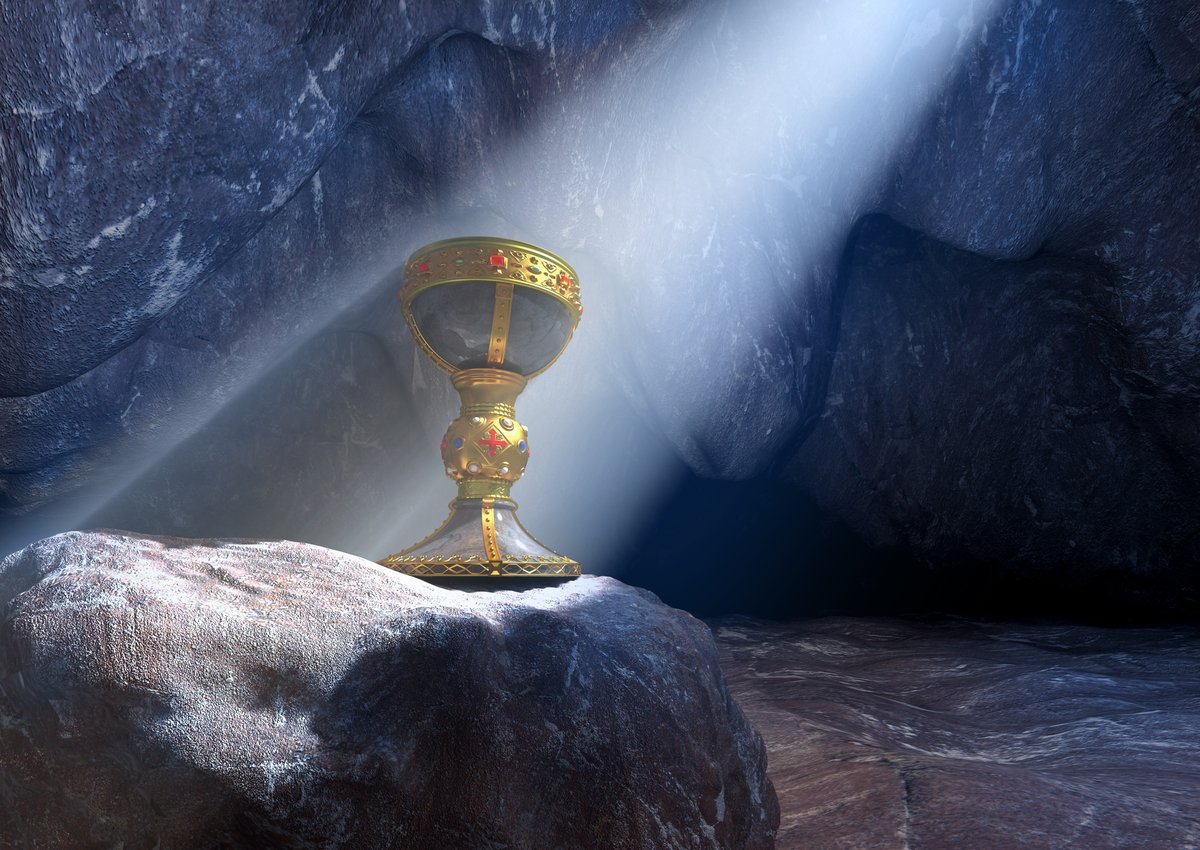
The most widespread version is that of the Grail as the cup used by Jesus Christ's disciples to commune at the Last Supper, and in which the blood of Jesus, crucified on the cross, was later collected. This cup was envisioned as a goblet carved from olive wood, 12 centimeters high and 6 centimeters in diameter.
According to Byzantine tradition, as early as 394, the cup was kept in Jerusalem, in the Church of Zion, built on the site where the Last Supper took place. Among the feasts of the Byzantine Church was the feast of the finding of the Holy Cup of the Lord, celebrated on July 3. Perhaps later it was transported to the capital of the Byzantine Empire, Constantinople, and kept there in one of the Orthodox churches. What happened next to the relic is unknown: in 1204, as a result of the Fourth Crusade, Constantinople was captured and looted by Western European knights.
Mentions of the cup reaching Western Europe border on information that it was hidden in a castle in the East, and one version of the Grail's subsequent fate leads us to the Crimean Mountains, where it supposedly ended up during the slow destruction of Byzantium. The further fate of the Grail is woven into the context of the medieval history of southern Crimea. In the 12th–15th centuries, a small principality of Theodoro, friendly to Byzantium, existed in the mountainous and foothill parts of Crimea, with its capital in the city of Mangup-Kale; its territory stretched in a strip from Yamboli (modern Balaklava) to Aluston (modern Alushta).
This country was ruled by the Gavras dynasty of tsars, who were of Armenian origin. The ethnic composition of the population was quite diverse: Crimean Goths, Alans, and Greeks lived there, united by their common Orthodox religion.
The position of the small state was extremely insecure. The legend tells of a war between the Theodorites and the Genoese, who owned colonies in the southern coastal part of the Crimean peninsula (and we know from history that such wars between the principality and the Genoese occurred quite often). During this war, the Genoese set a condition for the rulers of Theodoro: to hand over some golden cradle to them, after which the war would end.
The situation was so threatening that the prince and his family hid in one of the caves of Mount Basman, where he concealed the mysterious golden cradle. Afterwards, an earthquake and a landslide occurred in the mountains, and the golden cradle was reliably hidden from people. Interestingly, this legend is partially confirmed by archaeological research. Scientists established that a settlement once existed on Mount Basman, which was destroyed by a powerful earthquake in the 14th or 15th century. And inside one of the mountain caves, the skeleton of a person crushed by a fallen boulder was found.
Various assumptions have been made about what exactly the mysterious Mangup golden cradle could be. Some believe it refers to a golden font presented to Prince Isaac of Theodoro by the Moscow Tsar Ivan III. Others saw a certain similarity with the equally legendary cradle of Genghis Khan. And the most attentive Crimean researchers noticed an important detail in the frescoes of the temples that remained from the times of this small state's existence. They often feature the motif of a cradle-cup with a child. In the Christian tradition, a child in a cup symbolizes Christ.
In the 20th century, the secret services of two powerful states, which were also at war with each other, including in the Crimean Mountains, showed great interest in these Crimean legends. By a strange coincidence, or perhaps not by chance at all, the competing sides in the race for the Grail were those who considered themselves descendants of Western European knights, and those who considered themselves heirs to the imperial traditions of the Byzantine Empire.
In 1926–1927, a group of employees of the special cryptography department of the NKVD of the USSR, led by Aleksandr Barchenko, began operating in Crimea. However, they preferred not to speak of the Grail unnecessarily; according to the official version, the group was generally researching the cave cities of Crimea. But the team included the astrophysicist Aleksandr Kondiayn, who spoke of another, unpublicized goal of the Cheka expedition, namely: the search for a stone of extraterrestrial origin that had fallen to Earth thousands of years ago from the constellation of Orion.
Interestingly, in Wolfram von Eschenbach's 13th-century poem "Parzival", the Grail is presented as a stone that fell to Earth from Lucifer's crown, from which the allegorical name of the Grail—"the stone from Orion"—originates. The end of the search was tragic: in 1941, just before the outbreak of the war with Germany, the expedition leader Aleksandr Barchenko was shot.
Some believe it refers to a golden font presented to Prince Isaac of Theodoro by the Moscow Tsar Ivan III. Others saw a certain similarity with the equally legendary cradle of Genghis Khan. And the most attentive Crimean researchers noticed an important detail in the frescoes of the temples that remained from the times of this small state's existence. They often feature the motif of a cradle-cup with a child. In the Christian tradition, a child in a cup symbolizes Christ.
No small interest in these searches was shown by the competitors of the Land of Soviets' secret services from National Socialist Germany. The Grail cup became desired by such a well-known mystic as Adolf Hitler. At the height of the Second World War, he ordered this shrine to be found. The Nazi leader obviously wanted to acquire the ancient relic, known for its wondrous properties, for himself as well. It would significantly complement his collection of artifacts. In the Hofburg Museum in Vienna, his subordinates had by then already found the spear of the Roman centurion Longinus, with which Jesus's body was allegedly pierced.
In this spear, the Nazi mystics also envisioned a source of magical power, and Hitler hoped the spear would help him win a victory over his fierce enemies—America and Great Britain.
Ever since the Germans set foot on the land of Crimea, like their red-starred predecessors, they began searching for the Grail in the Crimean Mountains. They searched in the most attractive places for solving mysteries: in the fortress of Chufut-Kale, where the Karaite kenesas, the mausoleum of Khan Tokhtamysh's daughter Dzhanike-Khanym, and numerous caves were carefully inspected. They searched in Tatar mosques, in the remains of old temples, and in the ruins of the Kermenchik fortress.
Ever since the Germans set foot on the land of Crimea, like their red-starred predecessors, they began searching for the Grail in the Crimean Mountains. Otto Ohlendorf, whose pseudonym was "Graalritter"—the Knight of the Grail—was appointed project manager; the knight was not alone, "Einsatzgruppe D" was under his command, so he had no shortage of assistants in mystical research. They searched in the most attractive places for solving mysteries: in the fortress of Chufut-Kale, where the Karaite kenesas, the mausoleum of Khan Tokhtamysh's daughter Dzhanike-Khanym, and numerous caves were carefully inspected. They searched in Tatar mosques, in the remains of old temples, and in the ruins of the Kermenchik fortress.
However, neither the Bolsheviks nor the Nazis were destined to find the Grail in Crimea. But the history of the search for the mysterious artifact may well have its continuation, as the new invaders of Crimea call it a sacred peninsula for a reason.