Ukrainians in Egypt
Hryts Bozhok. "Krymska Svitlytsia" newspaper, 2020, issue No. 1
Hryts Bozhok. "Krymska Svitlytsia" newspaper, 2020, issue No. 1
The author of the memoirs "Ukrainians in Egypt," Hryts Bozhok, was born in 1890 in the village of Kholopkiv in the Hlukhiv region. He was a Second Lieutenant of the UNR Army, chemical engineer, singer, teacher, commander of a platoon (pivsotnia) of the Carpathian Sich in March 1939, political prisoner, priest, publicist, philanthropist, and knight of the Cross of Symon Petliura and the Military Cross. The following excerpts contain his recollections of escaping from Crimea (and then Turkey and Egypt, where he organized interned Ukrainians in a camp) with the Denikinites. In 1922, he moved to Czechia. In the 1930s, he worked in Transcarpathia, briefly performed at the "Nova Stsena" (New Stage) theater in Khust, and was arrested by the Hungarians in 1939.
Until 1944, he taught at an agricultural secondary school in the Lemko region; from 1945, he taught at the Ukrainian Technical and Husbandry Institute in Regensburg. In 1948, he emigrated to Australia, lived in Adelaide, where he died in 1993. He was a member of the Shevchenko Scientific Society (NTSh) in Australia.
Fierce frosts raged. Train after train of half-alive soldiers of the Denikin army arrived in Yevpatoria. All buildings suitable for a hospital were filled with the sick. In the second half of December 1919, at the station, amidst the cracking of a 30-degree frost—unheard of in Crimea until then—the remnants of still living people were unloaded; the "teplushky" (heated boxcars) stood open, for their inhabitants no longer needed warmth... The picture was terrifying, and everyone thought that if not for happy fate, they would have been in their place.
They piled the frozen soldiers onto carts like wood, one on top of another. This affected me so much that I immediately caught a fever and fell ill with typhus. I was tossing and turning, unable to find a place. And then came the turn to unload our boxcar. I thought, how do I get out of this mess? You could sit on a dray cart, but would you be able to get up, and if you did, it would be with frostbitten hands and feet. The self-preservation instinct worked quickly... I decided I would run behind the cart, holding onto it. It was hard, and hope of surviving the difficult road with a fever of nearly 40° was fading.
Multicolored lights flickered in my eyes, my head was heavy with thoughts and burning heat, my legs could barely move; it would have been enough to stumble just a bit somewhere, and I would never have stood up again... Such a thought drives one further and further... Finally, the "Tsar's Dacha"*—the end of the journey. Very good. With relief, I took my bundle and trudged up the stairs to the royal nest. I moved forward cheerfully, but I could no longer climb the stairs to the second floor; my strength failed. The nurse pointed to the second door on the first floor, where I settled. But not for long, because soon I felt the cold enveloping my head so much that I had no strength to endure it.
I looked around on all sides—and saw that everyone was dead, because the wind blew so freely through the room, the window frames without a single pane of glass could not hold it back. Crawling, I got out of this lodging and begged to be put in some place, dragging my linen bedding with me. That is how I saved myself.
Soon they transferred us to the hospital, where the doctor examined us and gave us first aid. I asked the nurse to bring my sheepskin coat as well, because it was very cold under the blanket; she did everything, but it was strange that she often approached me and asked me about something. Later she told me that my condition had been very dangerous and that she was surprised at how I endured it all, but now, she said, everything was fine and one could hope for a good outcome if no complications arose.
Since the sick kept arriving all the time and there was no space for them, all those who required less medical care were sent to the so-called recovery squad, where a doctor checked everyone's health from time to time. But soon this place too was overcrowded, and so even those who still needed care were registered for discharge/separation.
A four-funneled sea giant arrived in Yevpatoria, and anyone who needed 5–6 weeks of rest was registered by the commission on the ship's list. They asked who wished to go. I was registered as wishing to, but "not eligible" (ne podlezhu). Fortunately for me, many "patriots" refused, and therefore my candidacy was also accepted. The military commander issued everyone a pair of Denikin "kolokolchiki" (thousand-ruble notes)**, with which everyone tried to buy a bit of food: canned goods, rolls, etc., and walked onto the deck of the welcome guest with the pleasant thought that they would no longer see the horror created by the multicolored foreigners on our land... Since I was already walking on my own, without anyone's help, I had the opportunity to frequently go out on deck and admire the stormy waves of the restless Cossack sea...
The relatives do not know where Hryts went... They know that he escaped from the cellar and stayed at a German farm near Mykolaiv. But they do not know that he was also held by the Denikinites until a Kuban officer set him free, and then typhus subdued him again and confined him to bed. I recalled the journey from Katerynoslav across the bridge blown up by the Makhnovists to the nearest station, where frozen soldiers sat along the road for the entire way of 4–6 kilometers, like an honor guard for those fortunate ones who could move further. And my legs then already refused to walk any further, but I forced them with my willpower to live—to go further and further. It is hard to leave the family and everyone to an unknown fate, but it happened!.. My thoughts flew back to my homeland, which I was destined never to see again...
In Sevastopol, they filled the ship with more sick people, and a monotonous sea landscape stretched out before us.
...Often I had to witness a sad funeral ceremony: the doctor, acting as a chaplain, read prayers, the dead body was wrapped in a sheet and slid down a board into the water—the water splashed—and the sea hid him forever. No one will place a wreath on his grave, no one will come to the cemetery on Pentecost (Zeleni Sviata) to remember him with a mournful word...
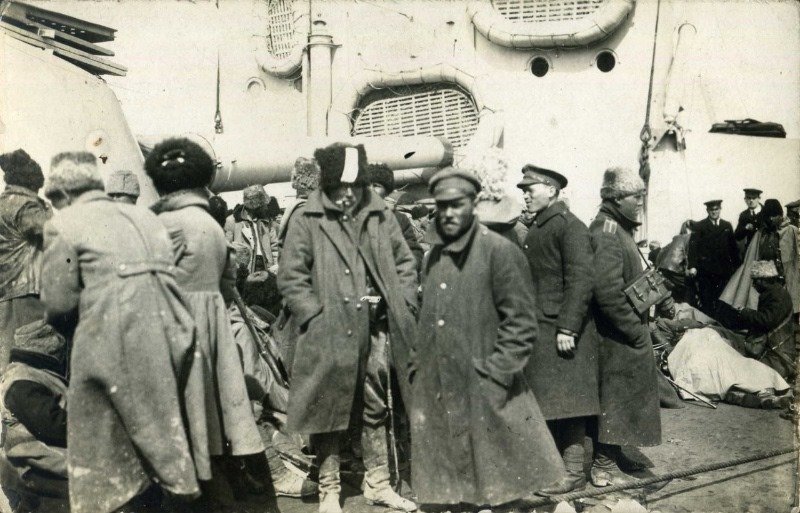
Finally, Alexandria*** loomed in the distance. For us, who had left a harsh winter in Crimea, it was pleasant to meet green palms here and breathe the warm air.
[In Cairo] the tedious life brought the camp inhabitants closer together. Gradually, the Ukrainians got to know each other. And there must have been quite a few of them here, considering that the army's military operations took place on Ukrainian territory, and mobilization was carried out mostly here. Both the army and the recovering soldiers consisted mostly of "inorodtsy" (aliens/non-Russians), primarily Ukrainians. Thus, Ukrainian life began to ferment in the bleak foreign sea. At every step, it was felt that not all of this mass, representing tsarism, agreed with the unbridled "indivisibilism" (nedelimstvo).
A foreign spirit resounded all around, but it was felt that in this large mass, at least 3/4 was of the Ukrainian element, completely hostile to all those Volunteer Army moods. Ukrainian officers were bothered by one thought: how to get rid of the Black Hundred supremacy here in a foreign land. It was strange that the military force of the fat merchant-woman Matryokha, called Tsarist Russia, was built on this diverse element, and we, mostly Ukrainians, represent her here.
It became a bit more comforting in the camp [Tel el-Kebir] when the volunteers left for Crimea. No general epaulets awaited them there—few survived Wrangel's adventure; the rest sleep in the damp earth or, having become crippled, curse their fate.
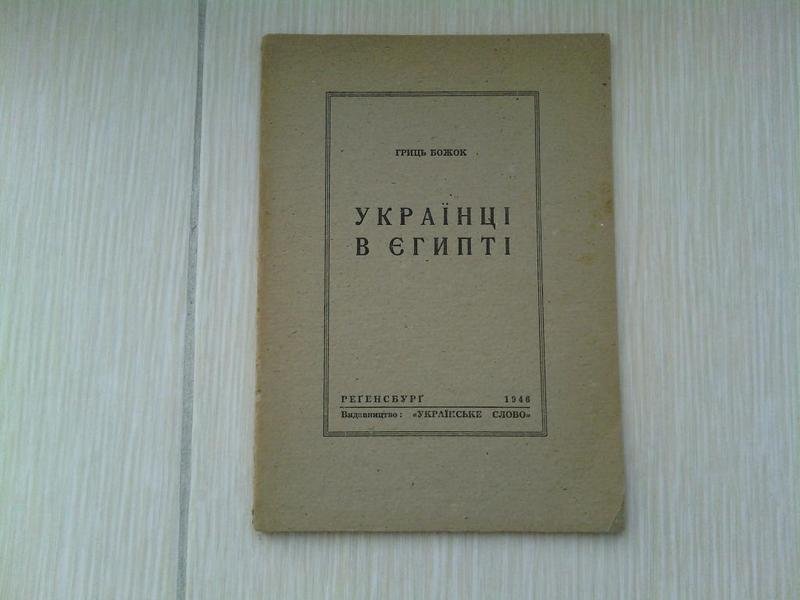
Hryts Bozhok. Ukrainians in Egypt. – Regensburg: "Ukrainske Slovo", 1946.
- The "Tsar's Dacha" sanatorium in Yevpatoria was established at the end of the 18th century by order of Catherine II. In Soviet times, the sanatorium was renamed in honor of May, and in 1960 it received the name "Prymoria." ** The 1000-ruble banknote of the "Armed Forces of South Russia" was called "kolokolchiki" (little bells) because of the depiction of the Kremlin's "Tsar Bell" ("Tsar-kolokol"). In addition to Odesa, Rostov, Novorossiysk, and Katerynodar, banknotes were issued in Simferopol (exclusively the 1000-ruble denomination) and Feodosia. *** Alexandria—the main seaport and second-largest city in Egypt.