Pages of Crimea's History in Georgian Script
The Georgian spirit on the territory of Crimea.
Serhiy Konashevych. "Krymska Svitlytsia" newspaper, 2017, issue No. 18
In mid-March 2017, while preparations were underway in Crimea to celebrate the day of "reunification" with Russia, outrage appeared on one of the Kerch internet resources over the fact that on the eve of the "holiday," not only was the city uncleaned, but even churches were littered with garbage. "Even in Yakutia, they will mark this landmark day with reindeer races, but in Kerch, right in front of the Georgian Church of Saint Nino, piles of junk—boxes, brushwood, and household waste—are piled up. This eloquently speaks to the level of the 'owners' and the city's municipal services," the author of the review noted, attaching the corresponding photographs. The captured scenes are no longer a surprise for Crimea, which for almost three years has been consistently brought to the "high standards" of the Russian hinterland. However, attention was drawn to the small Caucasus-style church itself, which had not been heard of before.
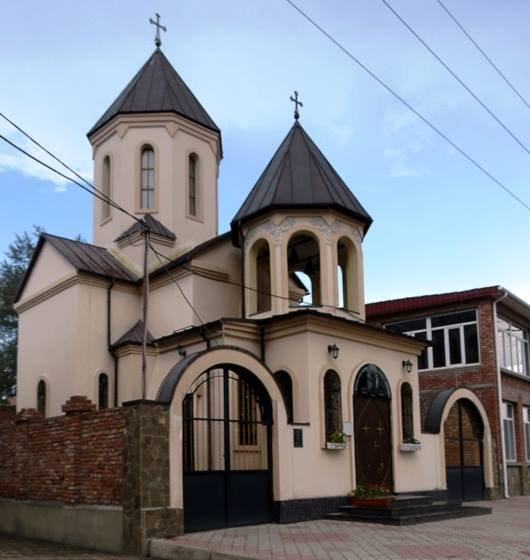
Saint Nino Church in Kerch before the occupation
In Memory of Compatriots
The Kerch church in honor of Saint Nina, the Christian enlightener of Georgia, belongs to the Georgian Orthodox Church (GOC), whose parish in Kerch is apparently the only one on the peninsula. Nearby stands the House of the Georgian Diaspora, built earlier. On May 9, 2012, the church, whose construction was blessed by GOC Patriarch Ilia II, was consecrated by the GOC Metropolitan of Borjomi and Bakuriani, Seraphim (Jojua). The church was built on donations from the Georgian community of Ukraine and, in particular, Crimea, in memory of compatriots who fell during World War II.
Perhaps it is not a random coincidence that the memorial church is located on a street named in honor of Captain Andriy Miroshnyk, a participant in the Kerch-Eltigen operation originally from the Chernihiv region, who died in battle in January 1944 and was buried on the other side of the Kerch Strait.
In the early 1940s, 700,000 people were mobilized from Georgia, half of whom did not return home. In the battles for Kerch, when national military formations were created on the initiative of the supreme command to raise morale among "non-Russian peoples" (precisely this phrasing was used), every third Georgian soldier was either found dead or went missing. According to memoirs from those times, Soviet military leaders sent the fighters to Crimea completely unprepared.
On June 13, 1992, on the memorial day for the slain, a monument to the soldiers of the Georgian division was solemnly unveiled in the village of Hlazivka near Kerch at the burial site of those who died during the war, with a capsule of Georgian soil placed in its foundation. Near Sapun Mountain, not far from Sevastopol, a majestic memorial-necropolis was erected back in 1961 in memory of the heroes of the 414th Georgian Rifle Division who fell while liberating the city in May 1944.
The Kerch memorial was visited a few years before the Russian occupation of Crimea by the famous Georgian artist Vakhtang Kikabidze. It was in those parts in 1942 that his father, Junior Lieutenant Konstantin Kikabidze, a journalist and descendant of a noble family, went missing. "In 2008, Russia decided to award me the Order of Friendship of Peoples. At that time, I saw tanks entering Georgia, simply locked myself away from everyone, and... cried. Of course, I refused the award, saying that my foot would never step in Russia again," recalled the prominent artist, who was honored with the title of People's Artist by Ukraine.
Back then, he canceled concerts in Moscow on the occasion of his 70th anniversary, and he keeps his word to this day. In a 2014 interview, Mr. Kikabidze expressed regret that he could not throw off a few decades to take part in the Revolution of Dignity in Kyiv and the anti-terrorist operation in Donbas—otherwise, he would have definitely supported Ukraine in its struggle for freedom. At the same time, it is impossible not to mention those Crimeans—participants in modern Ukrainian national liberation struggles—who are deprived of the opportunity to visit the graves of their relatives in their homeland, and those who found eternal peace outside their native land.
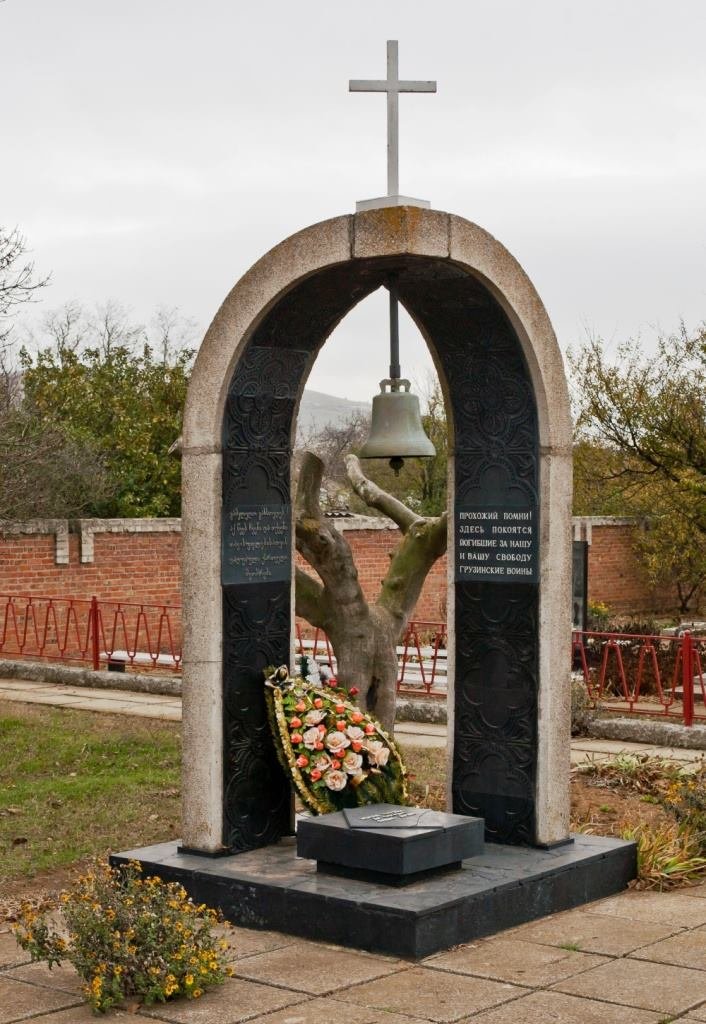
Memorial in Hlazivka near Kerch
Exactly when Georgians first appeared in Crimea is not known for certain. Following the Russian intervention of 2014 in Crimea, Candidate of Historical Sciences, Associate Professor of ONU Oleksandr Muzychko spoke about the history of this people on the peninsula. The specialist notes that the history of Georgians in Crimea is hardly researched, either fragmentarily or comprehensively, and indicates that chronicle and archaeological data show the establishment of relations between Crimea and Georgia since ancient times. In the 18th century, Georgians escaping from Crimean captivity joined the ranks of the Zaporozhian Cossacks. Ethnographer Oleksandr Rybalko notes that Georgians were among the Christian population of Crimea deported in 1778–1780 to the Northern Azov region; according to Oleksandr Muzychko, more than two hundred Georgians were expelled from Crimea at that time.
At various stages of Crimean history, prominent personalities of Georgian origin left their mark on it. In 1833–1850, the governor of Kerch was the military officer Prince Zakhari Herkheulidze. In 1906–1916, the governor of Yalta was Ivan Dumbadze, who became famous as a monarchist, Black Hundred member, and persecutor of the opposition—in modern terms, as a radical Russian nationalist. In the late 19th century, engineer Mikheil Gersevanishvili took an active part in the construction of ports in Kerch, Yalta, and Feodosia.
From 1912 until the Bolshevik conquest of Crimea, the Bishop and later Archbishop of Taurida was Demetrius (born David, in monastic tonsure Anthony) Abashidze, a descendant of a noble Georgian family. In the 1930s, he led the Kyiv group of the Catacomb Church, died during the German occupation of Kyiv, and was buried in the Ukrainian capital. In 2011, he was canonized as a locally venerated saint of the Kyiv Diocese of the UOC-MP. It is also worth mentioning that a participant in the victorious campaign of the UNR Army group in Crimea in April 1918 was the commander of the Zaporozhian Corps, General Zurab Natiyev (Natiev, real surname—Natishvili; in some sources given as Oleksandr), an Adjarian by origin.
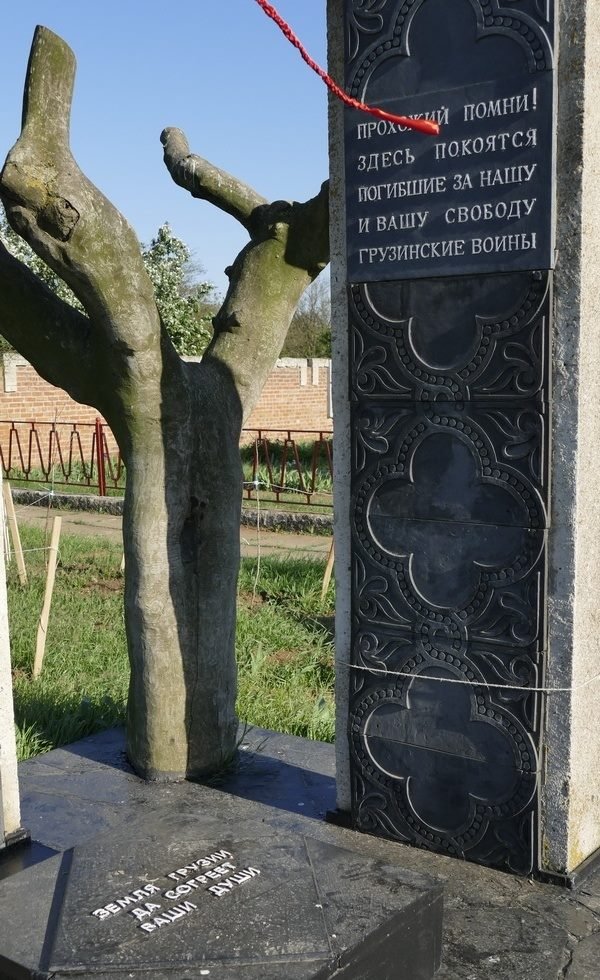
Memorial in Hlazivka
The Crimean Georgian Community
Oleksandr Muzychko provides detailed data on the proportion of Georgians in the demographic picture of Crimea. According to the census materials of the Russian Empire of 1897, 266 Georgians lived in the Taurida Governorate: 125 of them in Sevastopol, 58 in Kerch, and only 11 in Simferopol. In the registries of the Soviet period, Georgians fell into the category of "Other Nationalities." According to the first all-Union census of 1926, 201 Georgians lived in Crimea; in 1939—509, in 1970—1112; according to the All-Ukrainian population census of 2001—about 1800 (O. Muzychko specifies—1774).
During the years of Ukraine's independence, one of the country's four Georgian national-cultural societies operated in Crimea (others were in the Lviv and Odesa regions). From 2002 to 2011, the Honorary Consulate of Georgia operated in Yalta: it was headed by Elguja Kepuladze—an honorary citizen of the Autonomous Republic of Crimea and Yalta, a cultural figure who organized pro-Ukrainian music festivals such as "Lesya's Autumn," "Chariivne Namysto," and cultural events celebrating the 10th anniversary of Ukraine's Independence and the 160th anniversary of the first publication of Shevchenko's "Kobzar."
In 1990–1993, the Crimean Georgian community took shape. By the time of its official registration in early 1993, it numbered 740 people and had branches in Kerch, Feodosia, and other cities of the peninsula. On June 14, 1995, the "Ertoba" ("Unity") organization was registered in Yevpatoria, whose leadership in March 2014 called for a boycott of the "referendum" on the status of the peninsula initiated by Crimean separatists. Georgian children also studied in the Ukrainian Gymnasium in Simferopol alongside Ukrainian, Russian, Crimean Tatar, and Armenian children, recalls its former director Natalya Rudenko.
Following the occupation of Crimea, some Georgians left the peninsula for mainland Ukraine. In October 2014, the Russian census of the population in Crimea registered 1,571 Georgians. Today, news about the life of the Georgian community of Crimea virtually does not reach mainland Ukraine—just as the voices of many other ethnic communities of the peninsula remain unheard.