From Genoa to Kerch
Crimea's national diversity has been formed over centuries. In the list of peoples who traversed the peninsula, leaving a more or less distinct trace, Italians occupy a special place.
Fedir Chuzhanskyi. "Krymska Svitlytsia" newspaper, 2018, issue No. 8
Crimea's national diversity has been formed over centuries. In the list of peoples who traversed the peninsula, leaving a more or less distinct trace, Italians occupy a special place. The Genoese—warriors and merchants, seafarers and builders—left the most glorious memories of themselves in the history of medieval Crimea. And not only in history: in a curious way, the mythical creature, the griffin, is present both on the coats of arms of modern Crimea and its city of Kerch, and on the ancient coat of arms of Genoa.
Italians made their presence felt on the peninsula almost 800 years ago. Italy did not yet exist as a unified state, so these were colonists from the republics of Venice, Pisa, and Genoa. The era of the Crusades was coming to an end, and the weakened Byzantine Empire was bargaining for preferences in exchange for allowing management in its recently controlled territories. The Pisans did not manage to catch hold of any of the Crimean capes; the Venetians resisted—Soldaia was their last stronghold here—but there could only be one winner. And that was Genoa.
For nearly 300 years they ruled the Crimean coast until the Sublime Porte—the Ottoman Empire—put an end to this project. The Turks relocated those who remained to mountain villages, where they persisted as a distinct population for several more generations until they dissolved into the local language and culture. As a legacy, the displaced Italians left Crimea numerous fortresses on its capes.
The history of the World and Europe has preserved a number of their names. Mostly they are carved on stone plaques embedded in the towers of fortresses, and resound primarily from the lips of tour guides: Christoforo di Negro, Guarco Rumbaldo, Corrado Cigala, Antoniotto di Cabella... But there is also at least one globally famous name: Marco Polo. The famous Venetian is celebrated for the book he wrote about his travels to the East, to China, which was then unimaginably distant from Europe. And that journey began in Crimean Soldaia. This is modern Sudak, where Matteo Polo—Marco's uncle, a local merchant—lived at the time.
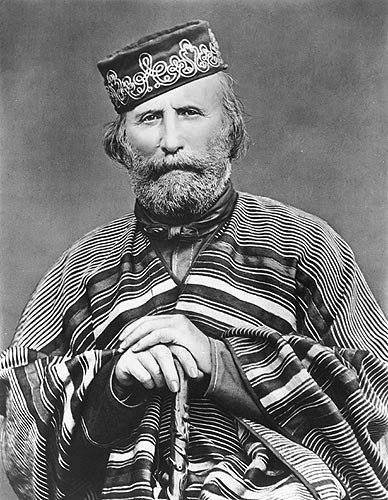
Giuseppe Garibaldi
Another 300 years passed before Italians appeared on the shores of Taurida again. They no longer represented the historical Italian trading republics, but modern Italian principalities and kingdoms: Sardinia, Naples... The coast was already ruled by the Russian Empire, which invited not only Russian landowners to manage it, but also Ukrainian peasants, German farmers, Bulgarian craftsmen, Greek military settlers, and Armenians from Galicia, seekers of land and a better fate from Czechia and Poland, and even Estonian peasants visited Crimea. Naturally, there were also Italians among them, who traded extensively in Tauridian grain through the ports of the northern Black Sea.
But "not by bread alone": people of creative crafts—artists and architects, musicians, and also doctors and teachers—traveled from that sunny peninsula to ours. Their contribution also left material evidence. Thus, the center of Kerch, its plan, the construction of prominent public and religious buildings that still dominate the old town, such as the Mithridates Stairs, is the work of the architect Alessandro Digby. And to connoisseurs, Italianska (Italian) Street in Feodosia recalls the ancient city of Pisa...
Among the names the whole world knows, there is another—both Italian and Crimean. It is Garibaldi. A century and a half ago, this name was so much "in the air," so to speak, that its popularity can easily be compared only to another, no less famous name: Ernesto Che Guevara. Giuseppe Garibaldi was also a revolutionary, a soldier, and, by the way, also made a name for himself in South America in his time—but Garibaldi is famous as the unifier of Italy...
History is a capricious lady: the Garibaldi lineage is Ligurian. And the capital of the Italian region of Liguria... yes, it is Genoa! And once again, just as the uncle of the hero Marco Polo, Matteo, was a merchant of Sudak, so the uncle of the hero Garibaldi, Ambrogio, traded in Feodosia, Taganrog, and Kerch, and was also a consul from the Italian kingdoms. The future hero of Italy, as a merchant navy sailor visiting those ports, naturally stayed with his relatives. There is a fairly probable assumption that the hero took the oath to unify Italy in 1833 in the Ukrainian city of Taganrog.
The Crimean branch of the Garibaldi family took root in Crimean soil, grew, and they possessed and maintained influence in society even during the times when the peninsula became Soviet. This did not escape them—but that is a completely different story.
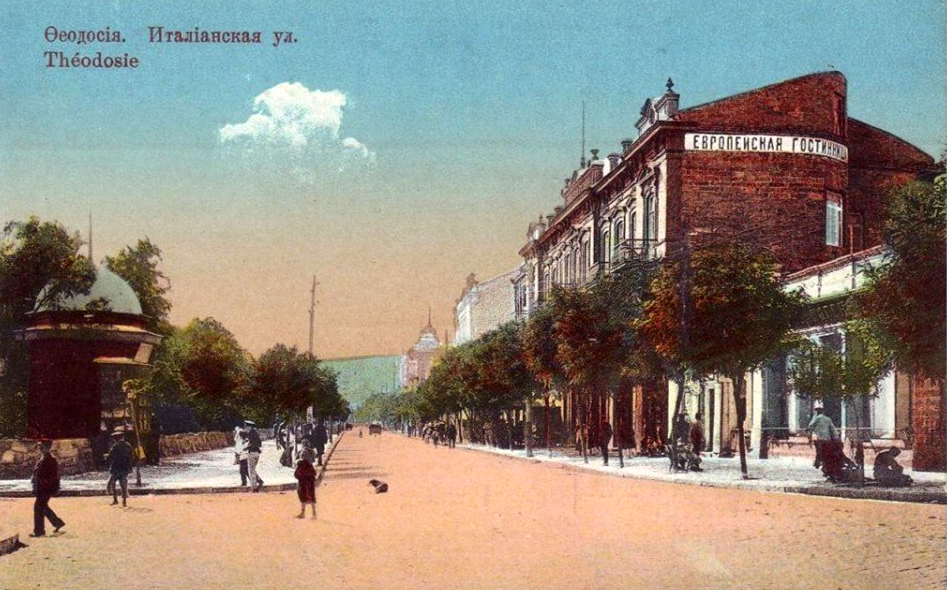
Italianska (Italian) Street in Feodosia
From the Italians in multinational Crimea, the Soviet authorities also organized a national collective farm (kolkhoz), just as they did for Germans, Czechs, Estonians, and Jews. It was named "after Sacco and Vanzetti"—two also world-famous people, Italian workers executed on false charges by a ruling of an American court... The profits of the kolkhoz were used to maintain Italian cultural institutions in Kerch. Unlike the communities of some other nationalities in Crimea, the Italians did not have national village councils, despite the practice of the time.
Mostly residents of Kerch and Feodosia, the Italians were nevertheless not very numerous: according to various estimates, there were from three to five thousand of them—which made up 2% of the population of the Crimean ASSR. To determine more precisely is indeed difficult, because, for example, the same Crimean Garibaldis, due to cross-cultural international marriages, while keeping the surname, were by culture and blood rather already Crimean Germans, and this was clearly not an exception, given the predominantly religious, cultural, social, and other contexts.
But they were not "like everyone else," which attracted the attention of the relevant "organs" with corresponding consequences. Due to Cheka repressions even before the start of World War II, only 1.3% of Italians remained in Crimea; due to the threat of being declared "foreign spies," many left for the homeland of their ancestors as early as the beginning of the 1930s. With the outbreak of the war, Italians, like Germans, were planned to be deported from Crimea. They did not make it in time. However, already in early February 1942, almost immediately after the historical Kerch-Feodosia landing operation, the Italians were deported from the "liberated territory" to Kazakhstan.
Two months of hardships on that journey, hunger, and other "companions" of deportation wiped out half of the deportees. The Italians were allowed to return almost immediately after Stalin's death, but barely half of those who survived in exile returned—and this was slightly more than 300 people. Naturally, their property was not returned to them...
In 1992, the Crimean Italians founded a community that they named with the Italian name of Kerch: "Cerchio". Through this association, they convey requests to the local authorities for assistance in preserving their religious, cultural, and historical identity. However, of the 200 people who were initially involved, less than fifty remain today. The ancient Latin maxim comes to mind: "Sic transit gloria mundi"—"Thus passes the glory of the world...".