River of Life. Part Two: The Flow
Continuation of the history of the North Crimean Canal.
Valeriy Verkhovskyi. "Krymska Svitlytsia" newspaper, 2016, issue No. 42
In 1950, the decision to construct the canal was made at the highest level of Bolshevik power. It was linked to the construction of the Kakhovka Hydroelectric Power Plant, as it was the Kakhovka Reservoir that was supposed to secure the water level to fill at least the South Ukrainian Canal.
Interestingly, the initial project looked substantially different. Specifically, a dam was to be built on the Molochna River near Melitopol, connected to the South Ukrainian hydrosystem. Furthermore, on schemas and drawings from the early 1950s, we see that the canal was supposed to cross the Syvash rather than go through Perekop. In the end, however, everything took the form we know today, as common sense and the need for economy prevailed.
Its construction was declared an all-Union and shock-work project, and a Komsomol one at that. About ten thousand people came here from various corners of the Soviet Union, but primarily from different regions of Ukraine.
This did not simply mean digging a ditch in the ground so that the water would flow in a different direction. Water loss initially amounted to 40%! The concrete could not withstand it, accidents occurred, and the canal bed had to be reinforced by changing the concrete composition because Soviet concrete could not withstand the harsh Crimean winter. Along the entire path through which the water flows in the canal, a network of pumping stations was created. To regulate the water level, a network of drainage stations was built in parallel. After all, when saline waters rose to the surface in the 1960s, orchards and vineyards perished.
A major role in developing the idea and designing the complex node of hydrotechnical structures was played by the Kyiv Institute of Hydrology and Hydrotechnics of the Academy of Sciences of Ukraine, which for a long time in those years was headed by Academician Heorhiy Yosypovych Sukhomel. Specialists for this large-scale project of "transforming nature" were trained by the Kyiv Hydromelioration Institute (which moved to Rivne in 1959). Let us also not forget that until 1954, irrigation with water from the Dnieper affected only the Kherson region. Only as part of Ukraine did Crimea finally receive Dnieper water.
The transfer of the Crimean peninsula to the Ukrainian SSR—or more accurately, its return rather than a "gift"—did not happen out of the blue and was not a unilateral decision of a "voluntarist" general secretary. Factors considered were primarily administrative and economic (which in the Soviet Union were inextricably linked). And the canal became one of those factors.
Who built the canal?
Hundreds of thousands of people were resettled from Ukraine, mainly from Western Ukraine, in what was called "voluntary-compulsory" or sometimes simply compulsory order. It was they, cast onto the gray land of the dry steppe, who managed to take root here, and the foreign land became their home, turning green, blossoming, and resounding with songs.
Oleksandr Dovzhenko's film "Poem of the Sea" is dedicated to the construction of the Kakhovka HPP. Today, this film is no longer perceived as unequivocally as back then... Still, let us remember that people built this "sea" and this canal with hope for a better life.
The Ukrainian SSR of the 1950s–1960s... Looking back at this period, we could fall into the oblivion of renouncing everything, but... Modern Ukraine, which declared Independence in the referendum of December 1, 1991, was formed precisely then. It was during this time that poets who would later become dissidents and heroes of Ukraine wrote verses, and actors and directors who would shoot iconic films in the 1970s studied and took their first steps in cinematography. National identity, even though limited by the dogmatic "Ukraine Our Soviet" (as Petro Shelest titled his book), was forming like never before.
Pride in one's land—from the Carpathians to the Donbas—for its language, culture, traditions, and achievements in science and technology grew and strengthened. All this would eventually lead the people to a confident step forward, to realizing the necessity of an alternative to remaining in a great empire, to independence...
Most Crimeans, to be honest, cared little about this. Ukraine was to them just one of the republics of their Union, and Ukrainian identity was something temporary, incomprehensible, and almost hostile. Crimeans loved to tell horror stories about visiting Lviv, as if it were a different country. Nevertheless, half a million Ukrainians who were not completely Russified and did not remember "Russian" Crimea could not disappear just like that, dissolving into the sea of the Soviet population.
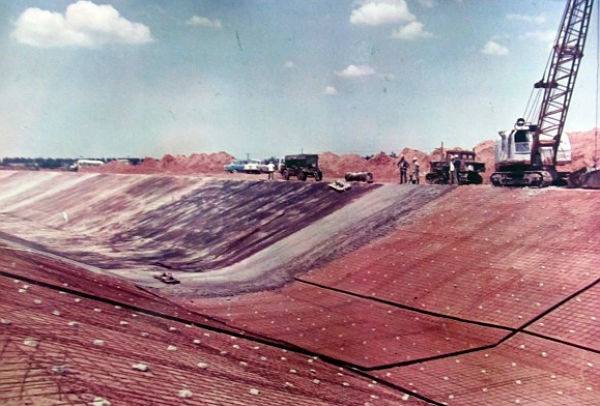
Construction of the North Crimean Canal
What Did the Canal Give to Crimea?
This is the longest canal in Europe. Over four hundred kilometers. Imagine that in recent times, the canal drew a quarter of the Dnieper's water. This is 85% of the water consumed by Crimea's agriculture. The lion's share went to growing rice, which became the second bread for us, the inhabitants of the peninsula. Without irrigation, it was unthinkable to even consider filling the rice paddies (checks) with water. Fish were introduced into the paddies, and every autumn, when the water was drained, another "harvest" was collected—a fish harvest.
The canal changed the way of life in the steppe part of the peninsula. People recall: "Only wormwood and saxaul grew here. But when the canal was built, they started sowing wheat and planting fruit trees."
The General Director of "Krymkanalbud" from 1963 to 1985, Mykhailo Labunets, was originally from the Chernihiv region. The canal became his life's work. In the twilight of his life, he witnessed the decline of his own creation. "Without the North Crimean Canal, there will be no Crimea, no harvests, no normal water supply!" he says.
The canal significantly changed the "face" of the Crimean population, making it less estranged from Ukraine. The Ukrainian language was always heard on the peninsula, even if quietly, occasionally fading almost to nothing. But with the canal, entire Ukrainian-speaking villages emerged. Admittedly, no one intended to introduce Ukrainian education here until the times of Independence. However, Ukrainians in Crimea remained and did not renounce their roots.