A Town Beyond the Kudykyn Mountains
The history of the Crimean town of Kaygador.
Maksym Dubovyaz. "Krymska Svitlytsia" newspaper, 2018, issue No. 37
History is a lady with a good memory.
It is almost impossible to imagine a town on the Crimean coast that doesn't have its own tradition. Kaygador is not like that; it is special. The contrasts of its quiet biography are so stark that it is pointless to try to construct any single line of development; it is rather a dotted line, both in the landscape and in time. Consequently, not even everyone who considers themselves sufficiently knowledgeable about the sunny peninsula knows where it is. Not surprisingly, because it is... beyond the Kudykyn Mountains. Where is that? Somewhere over there, not far.
There, in the arid land between the Country of Blue Peaks (Koktebel) and Kaffa, 1000 or more years ago, there was a spring. Now, only a dry stone structure remains of it, but back then it fed the town and the monastery at the small 11th-century fortress. It is known that it was the monastery of Saint John. But what was the name of the town: Kaygador or Kaydagor? Given the local Italian-Armenian koine of the Middle Ages, the version that this name originates from the name Khachatur does not seem so bizarre. In Armenian, this means "Baptist," which confirms the dedication of the monastery to John the Baptist.
This line of development was interrupted in 1475, when Kaffa fell.
Much has changed on the Crimean shores since then. Unfamiliar toponyms tempt colonizers to adapt incomprehensible names into their own language. Perhaps the names Toply, Saly, Elbuzly, Otuzy... gave rise to that fairy-tale name. The hills between the Biyuk-Yanyshar and Tepe-Oba ridges, which shield the area of Kaygador or Kaydagor from the north, became a "plural" in speech: "Kaydagory" – "Katagory," and eventually—Kudykyn Mountains. Those "mountains" reach just over a hundred meters in height and do not prevent northern winds from dominating the curves of the treeless terrain by the sea.
The Black Sea forms two bays here. The eastern one is Dvoyakirna (Double Anchor) Bay, because due to the winds, a single anchor could not hold a ship at anchor, and both had to be deployed. The western bay is known under the medieval name Provato. Perhaps it was the memory of the ancient name, and not just the steep frenzy of the slopes of the local bare hills, that later prompted the name Provallya (Abyss). On the cape between the bays, a modern settlement has existed for more than a century, which 80 years ago became the town of Ordzhonikidze.
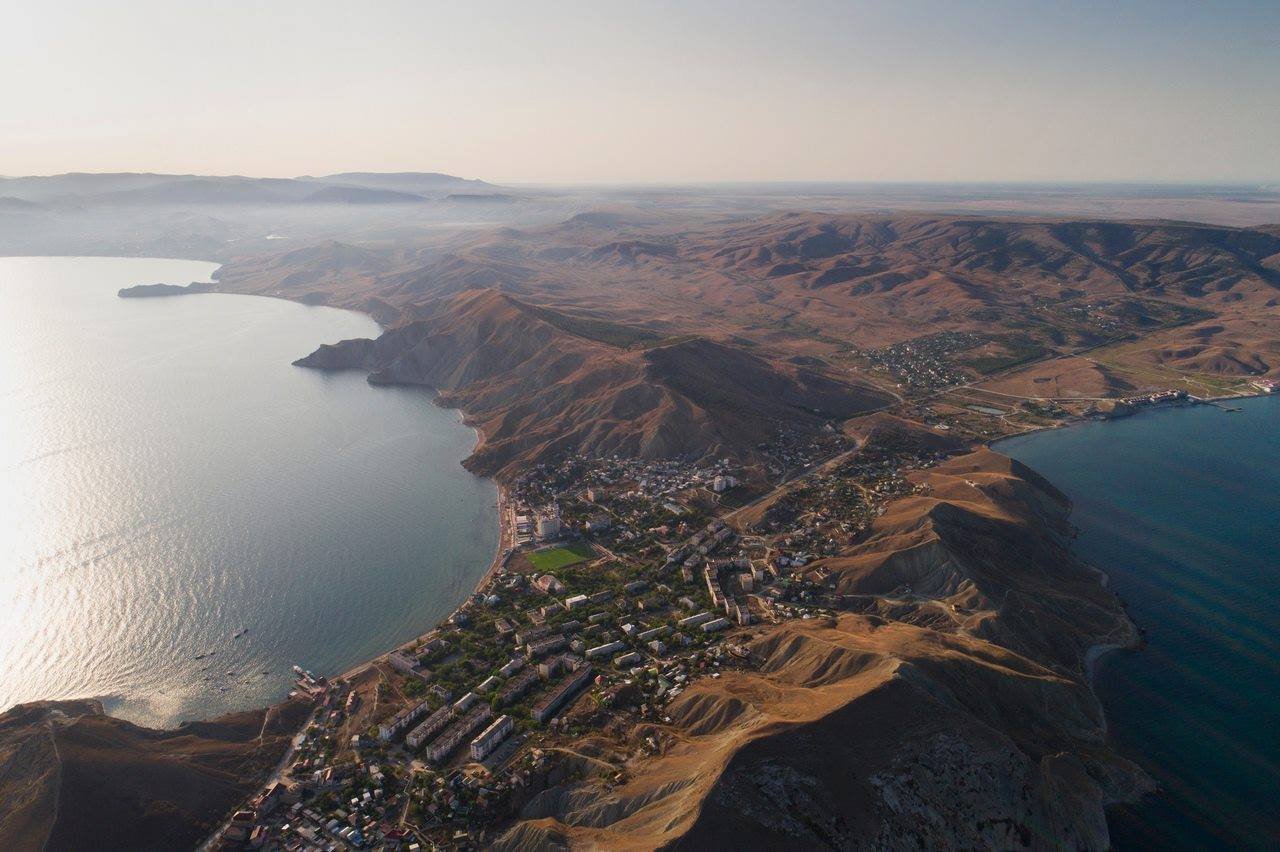
Hardly most of our contemporaries will remember what this word means, and the townspeople themselves call their town simply Ordjo or Orjo. Nearby, there are archaeological finds of human life—with flint tools and piles of oyster and mussel shells eaten 4-5 thousand years ago. One can speak of the beginning of a regular settlement from the 11th century. The monastery dates to 300 years later, and one of Kaffa's city gates, the one leading to the northwest, was long called the Kaygador Gate.
Even today, one can get to Orjo in that direction from Feodosia by city minibus (marshrutka). An experienced Crimean driver can go further through the tangle of remnants of old military highways to Koktebel, which is within sight across the sea bay from the Orjo embankment. However, regular public transport does not take this route: it is easier via Feodosia. The town owes its current existence to Rear Admiral Bubnov of the Imperial Navy. The Admiral established a base here for testing naval weapons before the outbreak of World War I. The year 1917 brought almost everything to naught; however, the factory was soon restored, and connections with Koktebel were established.
During wars, the area between the sea and the Kudykyn Mountains was particularly unlucky with artillery. During the First World War, Kaiser's submarines targeted the coastal guns of the Tsarist army here. During the Second, on the contrary, Red Army calibers poured fire from the air and sea onto the German batteries.
So after World War II, Ordzhonikidze had to be rebuilt from ruins once again. It became a closed town attached to two unique military facilities—"Hydroprilad" and "Hydroaparat"—with a highly specific population of four thousand and supplies for the residents' vital needs coming all the way from Leningrad. It is not surprising that one of the first diving clubs in Crimea was established in Ordjo; sources also point to 1990 as the start of the town's transition into a resort. For some time after the collapse of the USSR, part of the scientific and production base was preserved, but resort trends already dominated.
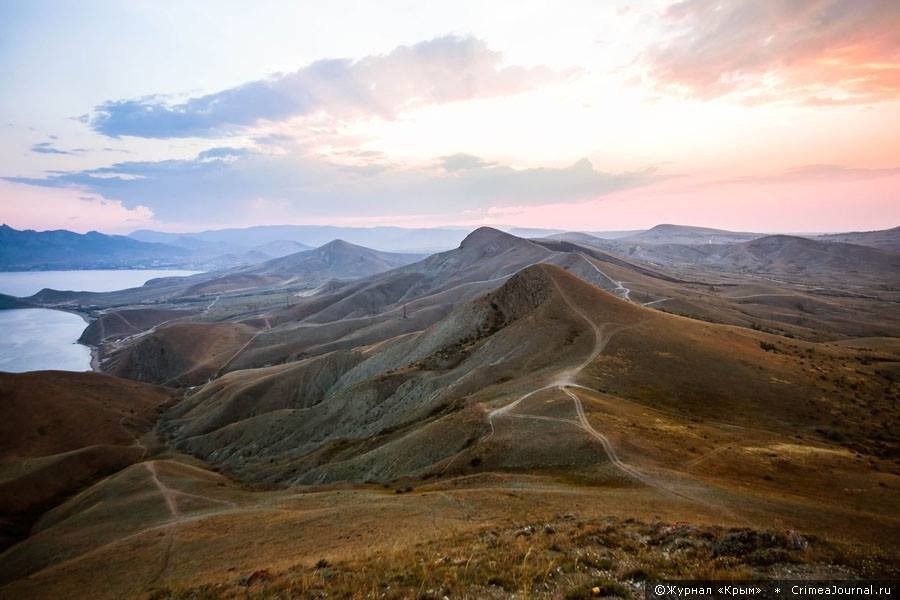
However, one can hardly speak of a "resort Renaissance" of the town on Cape Kyyik-Atlama. The resort infrastructure is limited to a small town beach, and along the shore towards Koktebel, a dotted line of rocky, numbered beaches—from the First to the Fifth—stretches out, becoming wilder the further they go. Meanwhile, Feodosia, with its developed sanatorium infrastructure, is nearby, and on the other side is the popular, bohemian Koktebel, so the quiet recreation of Orjo is not very attractive according to the typical Crimean resort stereotype.
Since the beginning of the 21st century, those who did not leave the town—and its population had shrunk by almost half—sought ways to attract attention to this "intermediate" resort. Its modest resources required a striking feature for development, and in 2007, a logical proposal arose: to change the Soviet name to something bright and romantic. Neighboring Feodosia and nearby Staryi Krym are cities associated with the life and work of the great romantic of the sea, Alexander Grin. Rumors spread about a proposal to give the town a beautiful name from the land of romantics—"Greenland". For example, Gel-Ghew or Zurbagan... However, despite the appeal, it was agreed that this would be too artificial.
So this extraordinary, almost unknown town, hidden behind the forgotten "Kudykyn Mountains" of Crimea, should have its own name—Kaygador.