Kharytyna Pekarchuk: A Crimean Ukrainian in the Ranks of the UNR Army
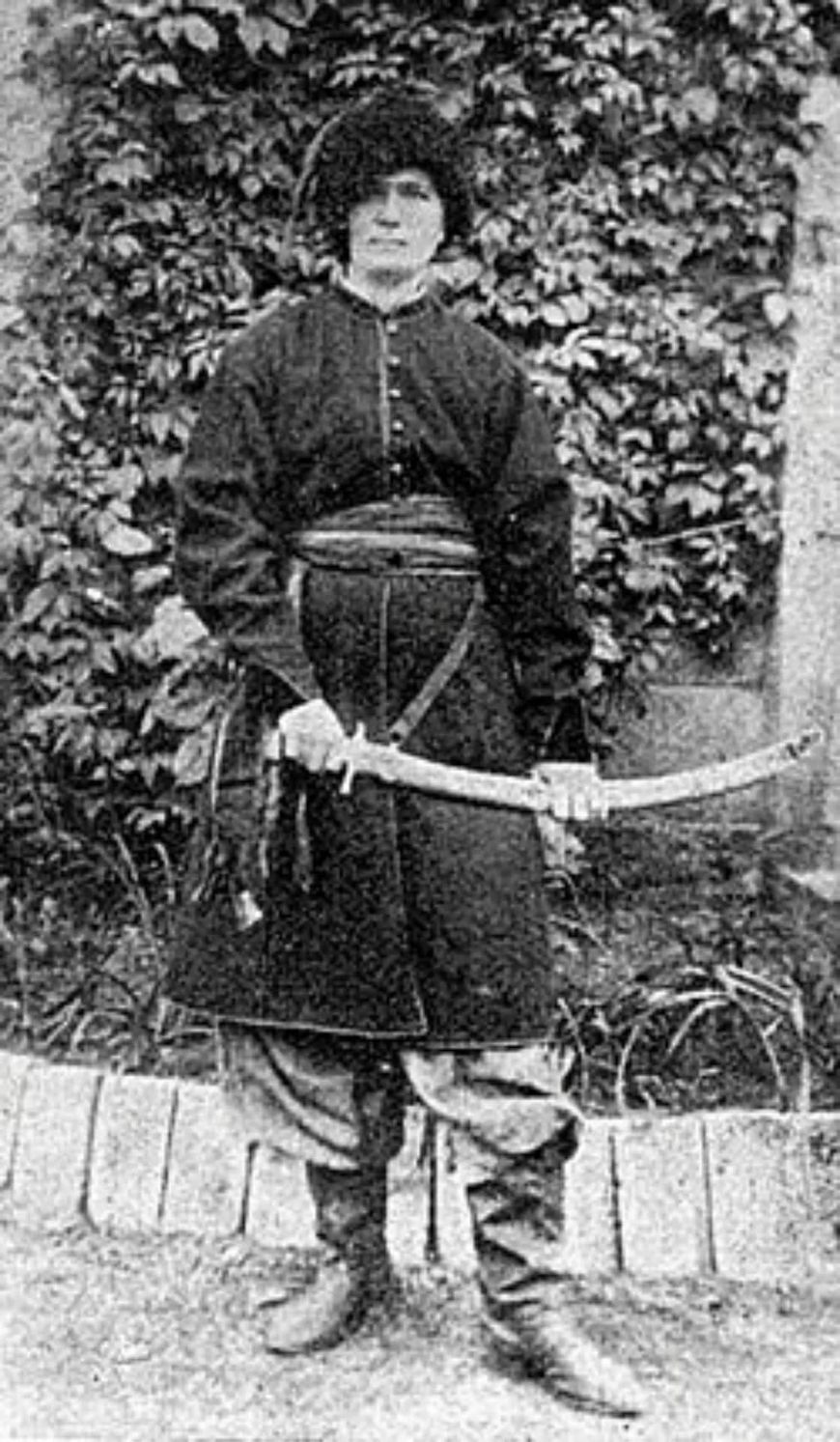
The brave Crimean woman Kharytyna, who participated in the combat actions of the UNR Army.
Serhiy Konashevych. "Krymska Svitlytsia" newspaper, 2016, issue No. 42
"She was born and grew up in sunny Crimea and inspired by its strength..."
Kharytyna Pekarchuk (née Tina Izbytska) was born on October 14, 1894, on the Cossack feast of Pokrova (Protection of the Mother of God), in Simferopol. She came from a Russified Polish family. Her maternal grandfather was a Polish insurgent. Her parents, Anton and Maria, owned huge orchards around Simferopol and considerable land in mainland Ukraine. Her father died early. Her mother hired youth from the Poltava region on long-term contracts; seeking work on landowners' estates, they traveled all the way to the Crimean coast, bringing with them their clothing, language, and songs.
"National consciousness in today's sense was only just budding back then, but the emotional feeling of kinship and belonging in each of them manifested itself with dynamic spontaneity. In our house, they were always welcomed as kin and our own." Tina, observing them, felt herself as a teenager to be a part of the Ukrainian people.
"Our nanny, a Ukrainian peasant woman, was our constant guardian and, to a large extent, educator. The entire staff in our house was always Ukrainian, so the Ukrainian language was equally native to us."
Later, the girl became fascinated by Ukrainian theater, attending performances despite prohibitions by the gymnasium administration. Having received Shevchenko's "Kobzar" from her maternal uncle, Tina not only studied his poems herself but also read them to her friends at school during breaks, which caused problems with her teachers.
"Emotion and spontaneous reaction acted in such a way that we grew up with the feeling that the Ukrainian land is our homeland, and therefore so are its lifestyle and language. The awareness of the wrongs suffered by Ukraine evoked in us a sense of outraged justice, bitterness, and rebellion."
Immediately after the 1917 revolution, Tina and several other people founded a "Prosvita" branch in the city, later organizing a Ukrainian choir and an amateur theatrical group, hosting literary evenings, and running a Ukrainian section in the newspaper. "The public life of Ukrainians in our city was passive then, almost non-existent, despite the fact that there were quite a few Ukrainians in Simferopol. Some had no interest in any forms of social activity. The older intelligentsia, who still remembered the era of persecution and repression, were afraid to reveal themselves so as not to lose their jobs and face punishment."
In 1917, three reserve regiments were stationed in Simferopol, with which the city's Ukrainian community, particularly "Prosvita," actively interacted. On May 17, about 15,000 soldiers from various units marched with Ukrainian flags through the main streets of the city.
"This day should also be considered the beginning of the Ukrainian military formation in Crimea. Yuriy Vorotov-Khvylynsky led the march, and Yuriy Tyutyunnyk took the parade. Both were later destroyed by the Bolsheviks."
When the battalion departed for the mainland, Tina joined it as a private. "This enthusiasm was shared not only by me but caught all the Ukrainian gymnasium and student youth of Simferopol, who were joining the army."
In 1918, Tina was summoned home by telegram due to her mother's serious illness. A Bolshevik coup took place in Simferopol at that time, and she had to flee.
"At the beginning of January 1918, my brother came home. Mother did not rejoice in him for long, because on the night of January 17, the officers stood up against the Bolsheviks in Sevastopol. On the morning of January 18, Sevastopol port workers and a handful of sailors occupied our city. My brother's unit fell into a Bolshevik ambush: only a small handful escaped, including him. Only the Crimean Reserve Regiment, consisting mostly of Tatars, was left to defend our city..."
In Kremenchuk, she fell into the hands of the Bolsheviks: they demanded that she hand over the Ukrainians she knew in Simferopol. After the liberation by German troops, she worked in Yelysavethrad (now Dnipro) as a typist in the district command. She did not want to take the oath of allegiance to Hetman Skoropadsky. In November 1918, she joined the Ivan Bohun Regiment, formed by Galicians and Dnieper Ukrainians. At first she used the pseudonym "Stepan Knyshenko", passing herself off as a boy, and was later called Tina Knyshenko.
After the retreat of Ukrainian troops, she headed a sanitary train she had formed. Taking wounded and typhus patients under her care, she eventually fell ill herself but continued to work. After her illness, in one of the battles, she was lightly wounded in the left leg, and in another—in the abdomen, returning to the regiment in three weeks with an unhealed wound. For her participation in the First Winter Campaign, she was awarded the badge of the Order of the Iron Cross, and later—the Cross of Symon Petliura.
In May 1920, Tina was severely shell-shocked, after which her "service to Ukraine as a soldier ended." In November she was interned, stayed in camps, and engaged in embroidery. At the end of 1921, she fled to the Carpathians to her husband, Ivan Pekarchuk, an officer of the UNR Army, whom she had married in 1919. Due to his illness, she had to work hard to earn a living—she sawed trees in the mountains, clearing a road in the snow in winter. In June 1922, Kharytyna illegally crossed the Czech border. On January 15, 1924, she was enrolled in the Ukrainian Academy of Technology and Husbandry in Podebrady without a scholarship. In 1925, doctors diagnosed her with pulmonary tuberculosis. In 1929, Kharytyna Pekarchuk moved to Poland with her husband, where he obtained an engineering post.
In 1939, the Second World War brought new hardships. In December 1941, Kharytyna moved to Vinnytsia with her husband; two years later, she and her husband were arrested by the Gestapo for connections with partisans, but due to a lack of evidence, they were both released in a few months. Next came flight to the west, wandering from camp to camp. In 1945, they found themselves in the Reinhard camp in Neu-Ulm. Treatment, poverty, no opportunity to leave, her husband's illness, and his death in 1958. Unfortunately, her diary, written in emigration, disappeared along with all the photographs. In the final years of her life, the magazine "Dorohovkaz" in Toronto published her memoirs under the title "My Service to Ukraine as a Soldier."
A Crimean Ukrainian of Polish origin, Kharytyna Pekarchuk passed away at the age of 79 on March 11, 1973, in a nursing home in Dornstadt.
Her creed deserves special attention in her biography: "I was not a heroine; I just did everything that my youthful enthusiasm and love for the Ukrainian people prompted me to do."