Destroyed Temples of Kerch
The tragic history of the destruction of Crimean temples.
Roza Krymska. Newspaper "Krymska Svitlytsia", 2018, Issue No. 47
Every city has its own face. Of course, over time it gets covered with wrinkles or becomes completely unrecognizable: revolutions, wars, changes of government, and its tastes. And while in some cities we can see architectural monuments, in others, unfortunately, this is impossible.
For example, like in Kerch, which has barely preserved the architecture of the 19th – early 20th centuries. This was especially reflected in religious buildings: under Soviet rule, churches were ruthlessly destroyed, and therefore most of the temples in Kerch are modern. But all is not so bad, because pre-revolutionary picture postcards have preserved old Kerch for us.
The beginning of the 20th century is called a real postcard boom. Sending postcards to each other was incredibly fashionable, and having one's own photo studio and printing press was incredibly profitable, so the print runs were fantastic. In Crimea, the most popular were views of the Southern Coast, as well as Bakhchysarai. Kerch is rarer on postcards of that time, although even this material will be enough for us to compare the past and the present.
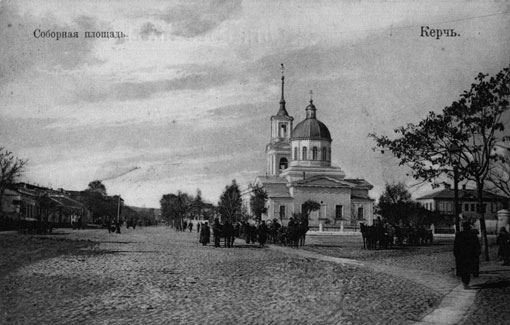
Svyato-Troitskiy (Holy Trinity) Cathedral on Soborna (Cathedral) Square
I will start by saying that Kerch was much more compact than it is today. At the end of the 19th and the beginning of the 20th century, the population of Kerch was no more than thirty thousand people. On the map of the early 20th century, one can see that the entry into the city was near Shlahbaumska (Barrier) Street (by the way, this is one of the few streets that has preserved its historical name). We pass the barrier and find ourselves on Feodosiiska Street (today it is Pyrogov Street). Literally 500 meters—and we are on Soborna Square. We can say this was the center, because here stood the main Orthodox church of Kerch—the Holy Trinity Cathedral, which is depicted on several postcards of that time.
The temple was built in 1832, and in 1845 the bell tower and chapel appeared. On the postcard, one can see that the cathedral was quite large—most of the Kerch residents came here on holidays. Unfortunately, the Soviet government did everything to destroy it: in 1931 it was closed and the cross was thrown down, and during World War II the temple served as a food warehouse. After the liberation of the city, the authorities decided to completely remove the cathedral, although it had not been destroyed by the hostilities. Today, the building of the former branch of the V. I. Vernadsky Taurida National University stands in its place. However, a piece of the cathedral is actually always in Kerch: the Obelisk of Glory on Mount Mithridates is built from the stones remaining from the temple.
The famous obelisk also became the reason to destroy another architectural monument.
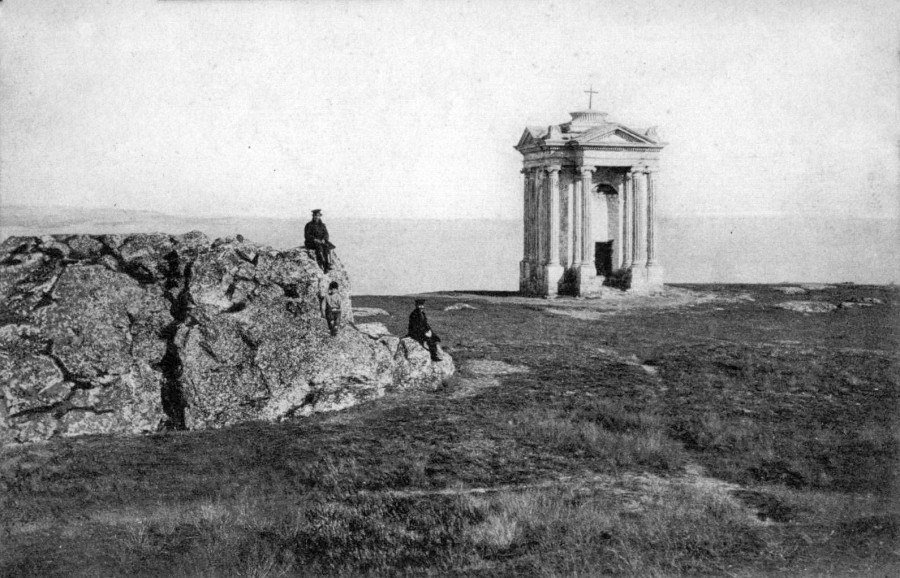
Stempkovsky Chapel on Mount Mithridates
For a long time, the landmark of the city was the Stempkovsky Chapel. The general panorama of the city was incomplete without the chapel on Mount Mithridates. Perhaps this was the favorite view of photographers and publishers, as we encounter it very often on postcards of that time.
The chapel was built in 1830 at the request of the city's governor Ivan Stempkovsky, who wrote a will two years before his death. According to historians, I. Stempkovsky did many good things for Kerch: during his administration, a school, a new pier, the Holy Trinity Cathedral, as well as the Mithridates Stairs, which locals and visitors love to walk on so much, were built in the city. Therefore, the chapel at the highest point of the city became a symbol of gratitude, and later—one of the most recognizable Kerch architectural objects at the turn of the century to appear on postcards.
In 1944, the opening of the obelisk took place on Mount Mithridates, so it was decided to remove the chapel. So now in all views we have the obelisk towering over the city.
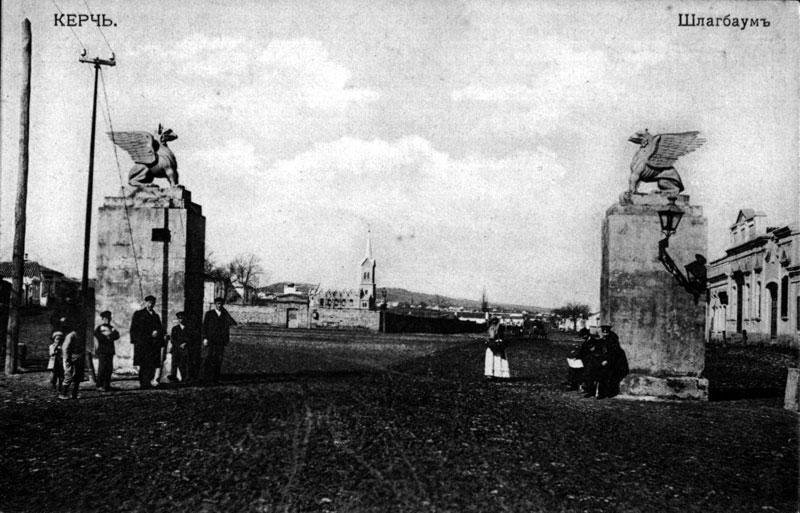
German Lutheran Church (Kirche)
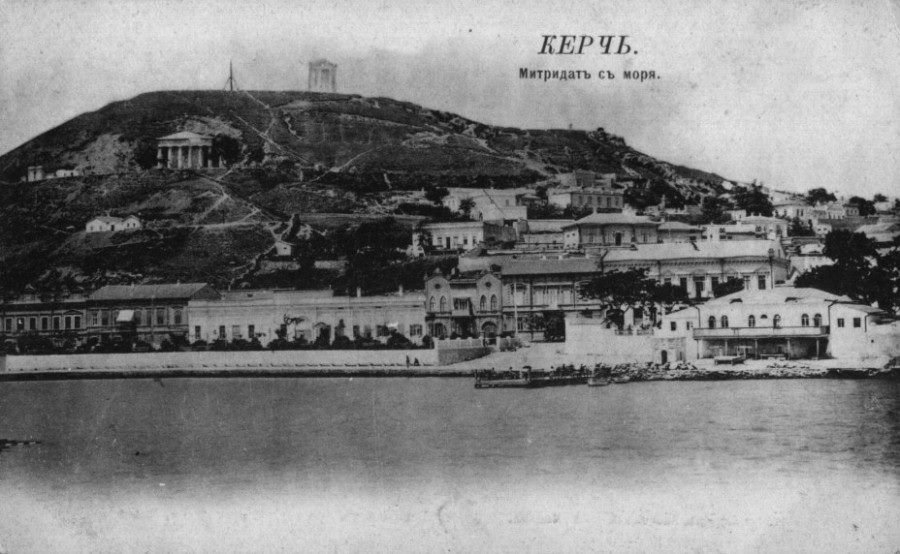
Mount Mithridates
In general, there are not many temples in Kerch, all of them for different denominations. In addition to Orthodox churches, a Roman Catholic church, a mosque, and a synagogue operate in the city today, as well as Armenian and Georgian churches, and a Baptist house of prayer. However, few people know that a German Lutheran Kirche once operated in the city. It can be seen, for example, on a postcard depicting the barrier. Interestingly, the photographer pointed his camera outside the city, because the German colonists lived on the outskirts. The Kirche was built in 1905 by the efforts of the Kerch German community. Its appearance is stunning: gothic spires can be seen from afar, but today a fire station, a passport office, and residential buildings stand in the way of such a view. During the war, the Kirche became the headquarters of the German military commandant's office. In the cemetery around it, fallen German officers and soldiers were buried.
Of course, after the war, the Kirche was adapted to the needs of Soviet citizens: the crosses were dismantled, the spires were removed, and the "Rodina" (Motherland) cinema was opened. In the 90s, "Rodina" was destroyed—everything was carried away for building materials, so today neither the Kirche, the cemetery, nor the cinema can be guessed at this site.
Could it have been otherwise? Probably not, because the Soviets did not aim to preserve history and memory. So postcards are one of the few reliable sources that allow us to peer behind the curtain of time and reconstruct the past.