The King and the Khan
Two historical figures of the late 18th century, the era of the brilliant finale of a great epoch, two monarchs who outlived their monarchies, having surrendered their subjects for gold and privileges.
Valeriy Verkhovskyi. Newspaper "Krymska Svitlytsia", 2018, Issue No. 49
Often the irony of history has a comical tone, but sometimes it is black. Two historical figures of the late 18th century, the era of the brilliant finale of a great epoch, two monarchs who outlived their monarchies, having surrendered their subjects for gold and privileges. They had different religions, their states were historically at war with each other, and now the territories they ruled have become part of Ukraine. The last Polish king and the last Crimean khan—their fates turned out to be surprisingly similar...
Stanisław Poniatowski was born on January 17, 1732, in the Brest region, received a good education, and traveled extensively in Western Europe. At the age of twenty, he spoke in the Sejm, demonstrating significant oratorical skills. While in the diplomatic service in St. Petersburg, at the age of 23, he won the favor of the young Grand Duchess Catherine, who six years later would become Empress Catherine the Second, and became her lover.
"This Crimean dauphin is the most amiable of Tatars; handsome, intelligent, educated in a non-Tatar way, composes verses, strives to see and learn everything. Everyone loved him. He does not miss a single performance," this is how Empress Catherine the Second described the young Kalga Şahin Giray, the future last Crimean khan, in her correspondence with Voltaire.
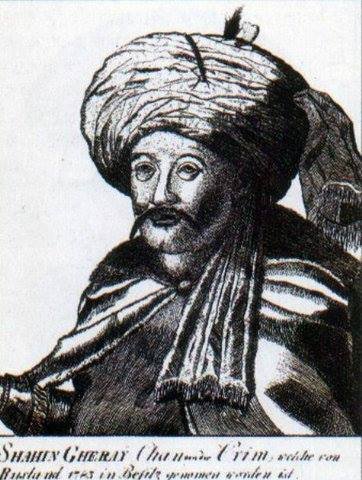
Şahin Giray
Şahin of the Giray dynasty was born in Adrianople (Edirne), visited Europe in his youth, and knew French, Russian, Greek, Italian, and Turkish. After the declaration of the independence of the Crimean Khanate, provided for by the Treaty of Küçük Kaynarca, Devlet Giray became its ruler, and Şahin received the title of Kalga. His stay in St. Petersburg on a diplomatic mission and the favorable attitude of the empire's high officials influenced his worldview, so upon returning home, Şahin became a conduit of Russian influence in Crimea. It was Russia that facilitated his rise in the hierarchy of the khanate, when Şahin managed to lead the Nogais of the Kuban, and later in 1777—to ascend the Bakhchysarai throne.
Whether Poniatowski wanted it or not, he was also destined to receive a monarch's crown. And again, not without the patronage of Catherine the Second: in 1764, the Sejm elected Stanisław August Poniatowski as king of the Polish-Lithuanian Commonwealth. The new king began reforms in all spheres of state life: from military tactics to religious freedoms and the principles of legislative activity. Under his rule, the Commonwealth adopted a Constitution and abolished the death penalty, though much more blood was shed as a result.
Şahin Giray began to reform the Crimean Khanate in the Russian style, which concerned various spheres—from administration to clothing according to the latest St. Petersburg fashions. One of the trends of "Russian fashion" was also the brutal execution of opposition members. As a result, in 1780, the Nogais first refused to obey Şahin Giray, and the following year the Murzas of Crimea even complained directly to St. Petersburg about the cruelty and injustice of the khan, but the complaint was ignored. After this, in 1782, Şahin was overthrown in an uprising, and Bahadur Giray, Şahin's brother, briefly sat on the khan's throne. Even the khan's guard, sent by Şahin to suppress the uprising, went over to the rebels' side. Şahin Giray was forced to flee from Bakhchysarai to Russian-occupied Kerch.
Dissatisfied with the changes, the conservative Polish gentry opposed the pro-Russian king. In particular, they formed the Bar Confederation, which was, in essence, the start of a civil war in the country. This armed rebellion provoked an invasion by Russian troops under the pretext of protecting the Orthodox population and restoring law and order. The confederates suffered a shameful defeat, and the Polish-Lithuanian Commonwealth itself was partitioned among the victorious states.
Bahadur Giray turned to Istanbul for help, and Turkey proclaimed another, "their own" Crimean khan in Kaffa, albeit briefly—Mahmud Giray. Then Şahin turned to Catherine, begging for help, and the Russian Empress, of course, helped the "most amiable of Tatars"—two regiments entered through Perekop without encountering any resistance and took Karasubazar without a single shot, while another regiment moved to the Kuban. Khan Şahin returned to the Bakhchysarai Palace, but not for long—the price turned out to be disproportionately high, as always. Russia took everything away from him the very next year.
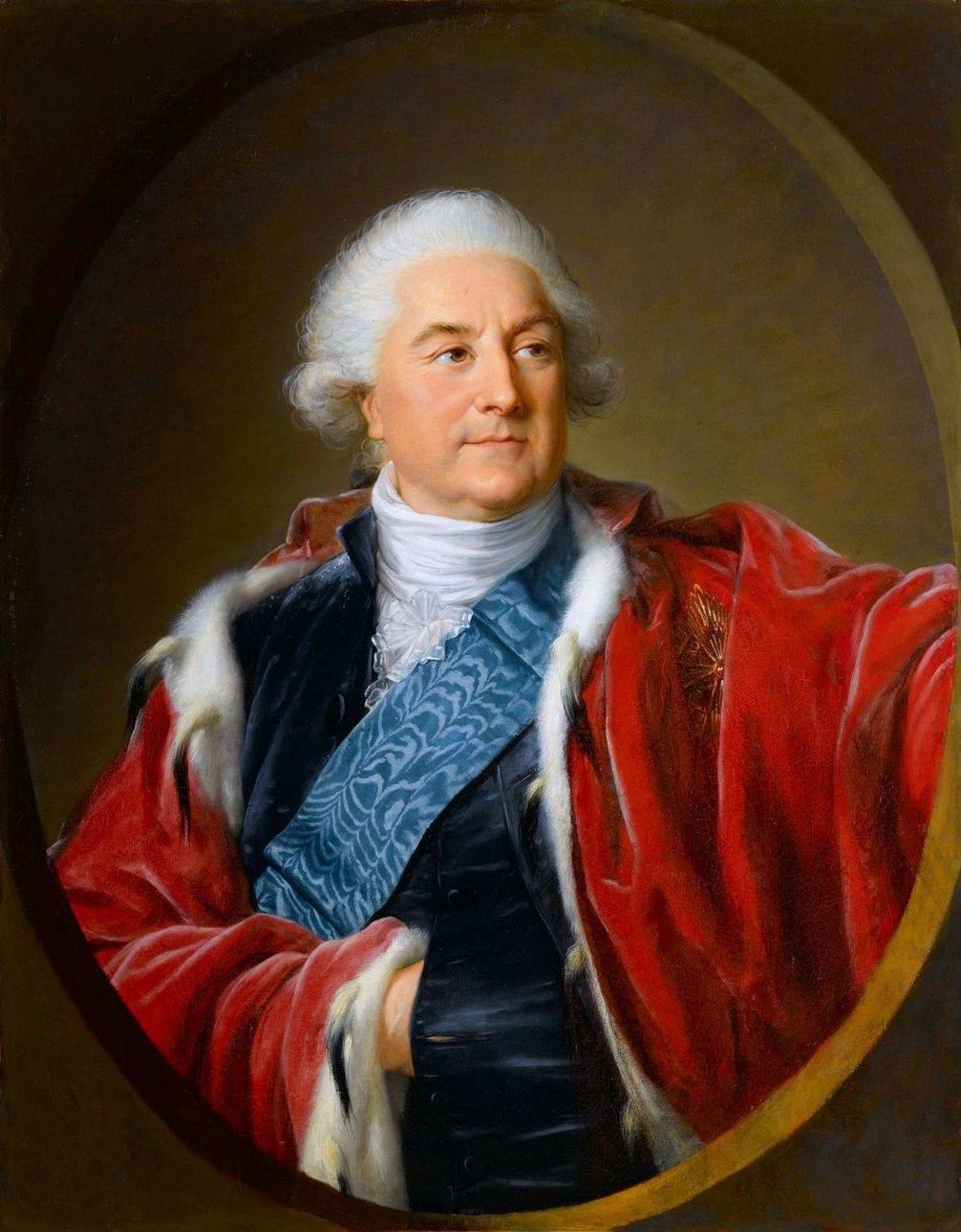
Stanisław Poniatowski
It is not easy to love empresses: the powerful mistress actually deprived Poniatowski of the right to marriage; having a wide arsenal of influence on neighboring states, she made every effort, diplomatic and economic, to keep other candidates away from Poniatowski's heart. He left no legitimate heirs. Catherine was also jealous of Poniatowski regarding Poland—and took his kingdom away, depriving the Polish people of statehood for a long time. The king resigned himself. When his fatherland died, he remained to live out his days in St. Petersburg and died in 1798, being buried there with royal honors.
Şahin Giray abdicated in 1783. The new masters of Crimea strongly advised him to continue living elsewhere in central Russia. The "advice" took the form of a 200,000-ruble annual "pension" or forced exile from Crimea in chains. At first, Şahin lived in Taganrog, Kaluga, and Voronezh, but in 1787 he moved to Turkey. There, he was exiled to the island of Rhodes and was soon executed.
24 years later, the frigate "Şahin Giray" entered service in the Turkish fleet—interestingly, they first killed him and later named a sailing ship after him. In the war of 1806–1812, specifically in 1811, the frigate became a Russian trophy. Even more interesting is that the ship continued its service in the Black Sea Fleet under the exact same name.
During his lifetime, Poniatowski collected a huge library, which after his death was transferred to the Kremenets Lyceum. However, due to the uprising of 1830, the lyceum in Kremenets was closed, and instead, by decision of the imperial authorities, the Kyiv University of St. Vladimir was founded, and the library was moved there. In the early 20th century, the collection of books from the library of the last Polish king became the property of the V. I. Vernadsky National Library.