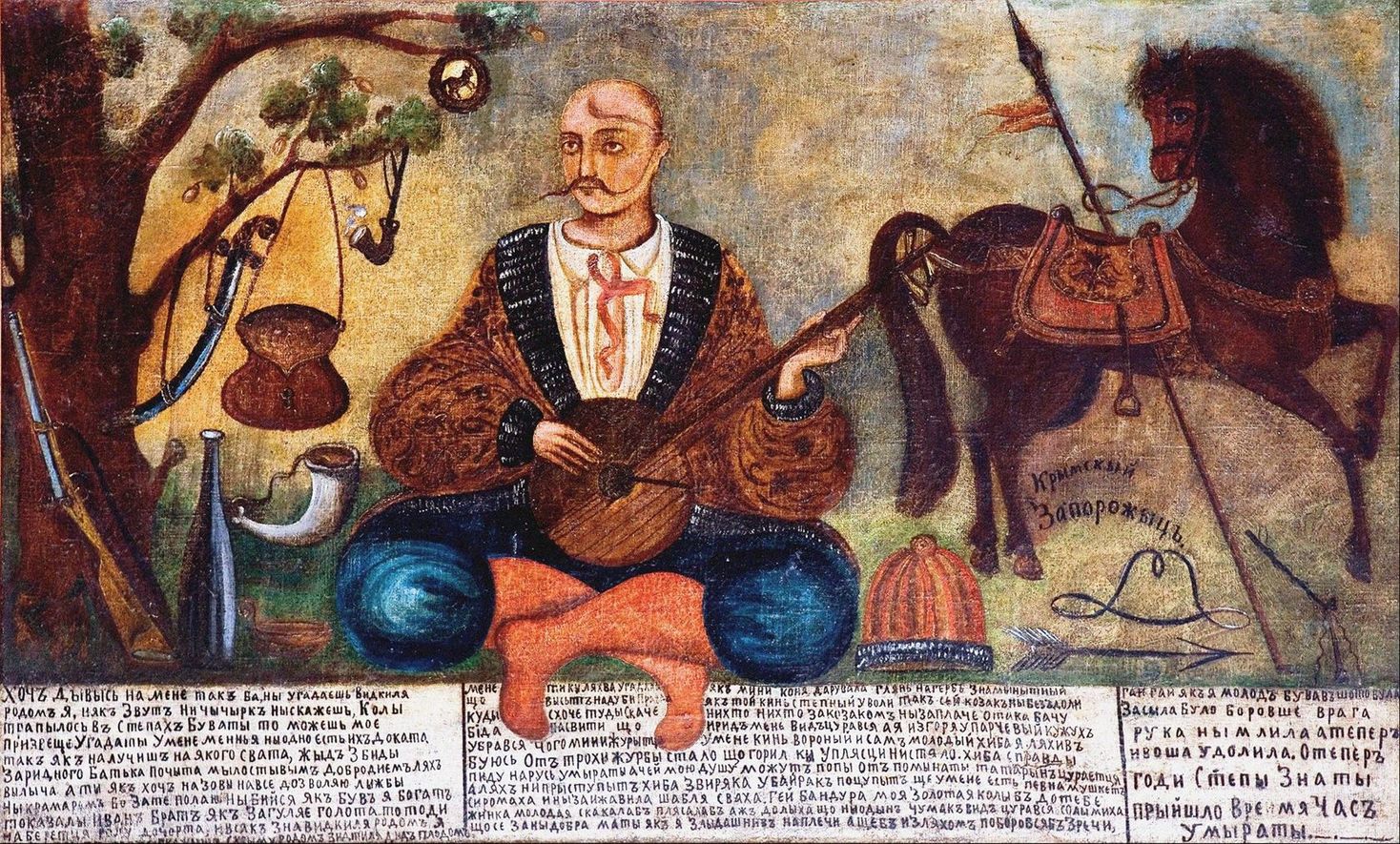
Mamai. The Crimean Zaporozhian
A biography of the legendary Cossack Mamai.
Yevhen Buket. Newspaper "Krymska Svitlytsia", 2016, Issue No. 42
After the Mongol invasion of 1240, Ukrainian lands became part of the Jochid state (the Golden Horde). Tatar princes became hereditary rulers of the Rus' lands, local chieftains ruled under them, and baskaks, on their raids, collected tribute from those chieftains.
One of the most famous military commanders (temniks) of the Golden Horde, of the Cuman clan of Kiyat, was the Crimean emir Mamai (1335–1380). In August 1362, he concluded a military-political alliance with the Grand Duke of Lithuania Algirdas, which allowed the latter to defeat the Horde rulers at the Battle of Blue Waters. Subsequently, Mamai's troops, together with the Lithuanians, fought against the Horde and Muscovites and completely liberated the lands of modern Ukraine from them.
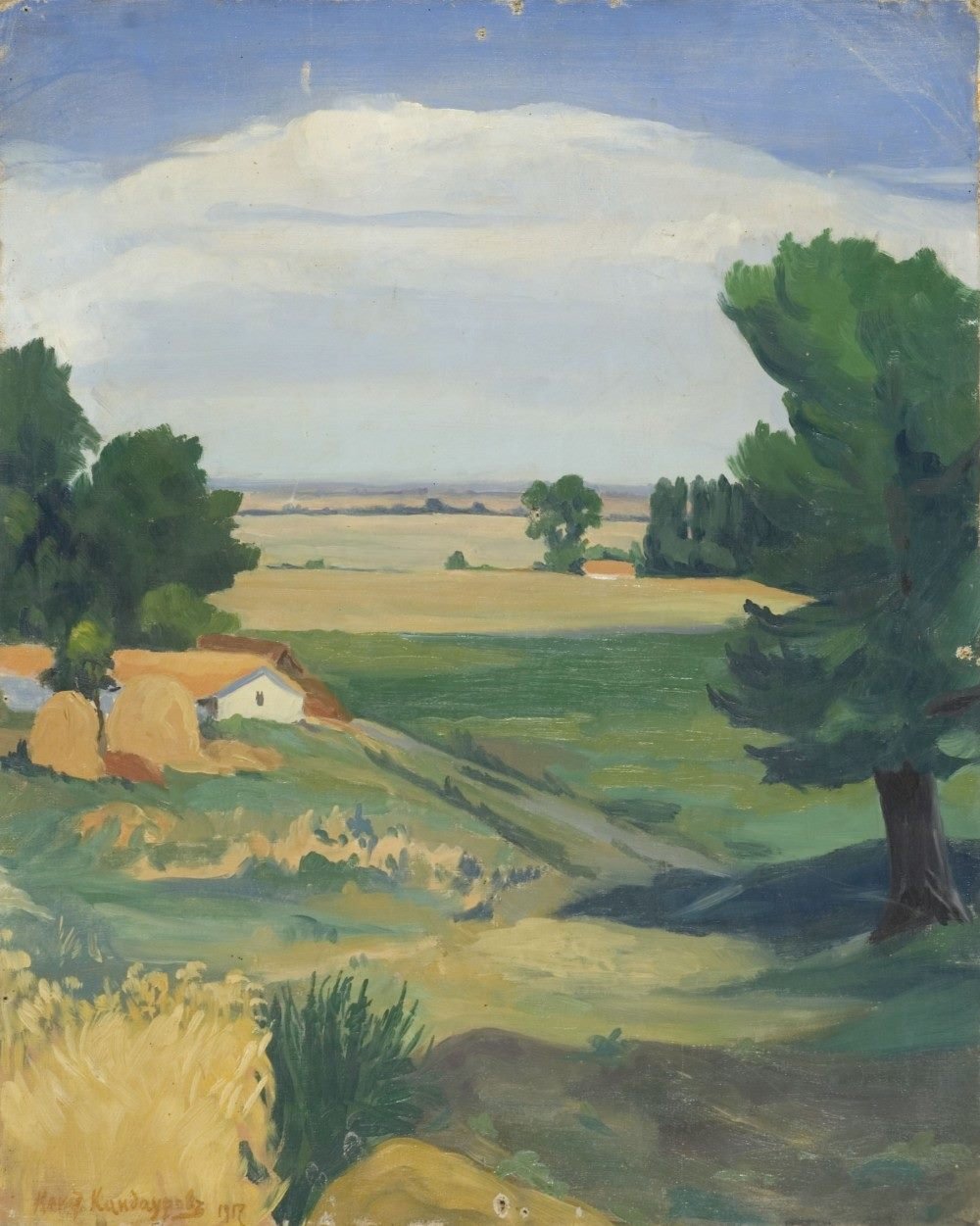
Kondaurov K. V. Landscape. (Steppe Crimea. Sheikh-Mamai). 1917
Historical Figure
Voivode Mamai Kiyat (1335, Solkhat – 1380, Kaffa) was a military commander of the Golden Horde from 1359, a Tatar temnik of Cuman origin.
The lands of the Northern Black Sea region, the Sea of Azov, and Crimea had belonged to the Kiyat clan since the 1220s. Mamai's great-grandfather Tuluk-Temur was the first known ruler of Crimea from this clan. Alibek, Mamai's father, was the ruler of Solkhat (now Staryi Krym) in 1356.
Around this time, the young Mamai became a dignitary at the court of Khan Janibeg. In 1359, the next khan Berdibeg appointed him to the post of beglerbeg—the highest office in the Golden Horde after the khan.
In 1361, Mamai proclaimed himself khan of the Golden Horde, which was not officially recognized, because according to tradition, only a Chinggisid (descendant of Genghis Khan) could bear this title.
Therefore, after an unsuccessful attempt to seize the throne, Mamai raised the inhabitants of the Dnieper region to rebellion. At the end of August 1362, the Lithuanian prince Algirdas and the Crimean emir Mamai concluded a military-political alliance directed against representatives of the Jochid dynasty. It was then that Mamai's army captured Azov, and Algirdas's army defeated the Mongol-Tatar rulers at the Blue Waters. After establishing control over the southern part of the Golden Horde, Mamai marched with all his forces to the Lower Volga, where he again intervened in the struggle for the Horde capital.
In 1380, Mamai concluded a treaty with the Lithuanian prince Jogaila. At this time, the throne in Sarai was occupied by Tokhtamysh, who restored strict order in the Horde within a year and ordered the Moscow prince Dmitry to urgently send him troops, while he himself set off to meet him. On the other side, the allies Mamai and the Grand Duke of Lithuania Jogaila were moving to join forces.
On September 8, 1380, at the Battle of Kulikovo, Mamai met the Moscow prince Dmitry. Hoping to defeat Dmitry's troops on his own, Mamai engaged him in battle. Learning of the rapid approach of Tokhtamysh, in order not to be surrounded, he turned and went into the steppe. Two weeks later, Mamai's army fought a duel with Tokhtamysh on the Kalka River (flowing through the territory of modern Zaporizhzhia and Donetsk Oblasts), was defeated, and fled to Kaffa.
One of the versions of his death states that his ancient allies, the Genoese, did not let Mamai into Kaffa, and on the way to Solkhat (Staryi Krym) he was killed by Tokhtamysh's detachments. According to another version, Mamai was killed in Kaffa, but again by messengers of Tokhtamysh.
The beglerbeg Mamai was buried with honors. So ordered the khan. According to one version, it was in the village of Aivazovske (formerly Sheikh-Mamai) of the Kirovskyi (now Isliamteretskyi) district of the AR of Crimea near Feodosia. The grave (mound) was found by the famous artist Ivan Aivazovsky, who was engaged in archaeology. According to another version, his grave is the Kemal-ata hill next to the town of Staryi Krym.
The Lithuanian prince Jogaila, who was Mamai's ally but did not manage to join him, defeated Dmitry's army returning from Kulikovo, captured the Muscovite baggage trains, and wiped out all the soldiers, including the wounded. Two years after Mamai's death, Tokhtamysh captured and burned Moscow. And on May 20, 1393, he granted a charter to King of Poland Władysław II Jagiełło (Jogaila), according to which the lands of the Rus' principalities he conquered went to Lithuania.
The first Crimean Khan Hacı Giray was also a vassal of the Lithuanians. Around 1440, the Crimean Tatar aristocracy, led by the noble clans of Şirin and Barın, appealed to the new Grand Duke of Lithuania Casimir Jagiellon with a request to release Hacı Giray to Crimea to raise him to the khan's throne. Casimir summoned Hacı Giray from Lida, where he lived in emigration, to Kyiv, where the latter met with the Bey's envoys, and then, accompanied by them, left Kyiv for Crimea.
In addition to the Tatar retinue, Hacı Giray was accompanied by the Lithuanian military commander Radziwiłł. The Crimean Beys and Murzas, led by Tegene Şirin, swore allegiance to Hacı Giray as their ruler, and the Lithuanian marshal Radziwiłł confirmed him on the khan's throne on behalf of the Grand Duke of Lithuania Casimir Jagiellon. However, Hacı Giray's son, Mengli Giray, broke the alliance with the Lithuanians and accepted Ottoman suzerainty in 1478.
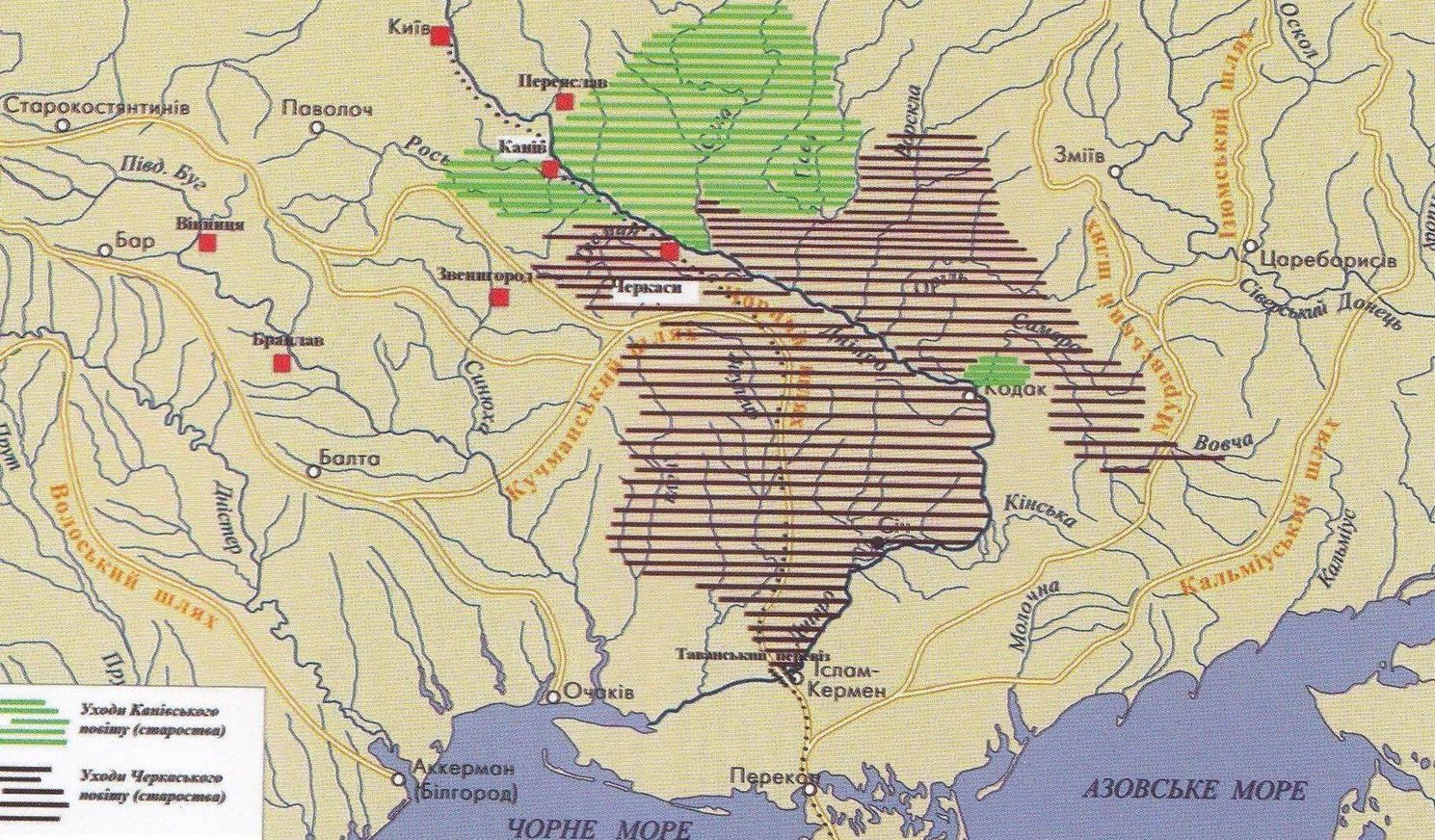
The Mamai-Glinsky Dynasty
Here is how the Lithuanian chronicle describes Mamai's descendants: "And after the Don massacre, Mamai's son Mansur-Kiyat Prince erected three cities: Glinsk, Poltava, and Glechenitsa (Glynitsia); Mansur-Kiyat's children—the younger son Skyder Prince took a herd of horses and camels and wandered to Perekop, and his elder son Oleksa Prince remained in those cities."
The autonomous principality of the Mamai dynasty, created by Mansur-Kiyat, was a formally independent state for 12 years—from 1380 to 1392, while the Grand Duchy of Lithuania and the Golden Horde, led by Tokhtamysh, were at war. The Mamai Principality was a buffer zone between them, although in fact from the very beginning it depended on the Grand Duchy of Lithuania.
In 1390, in Kyiv, Metropolitan Cyprian baptized Oleksa Mamai. He received the name Alexander in baptism and the title of Prince Glinsky. The first in historical sources with the surname Glinsky in 1398 is Oleksa-Alexander's son Ivan Alexandrovich, who was married to Anastasia, daughter of Prince Danylo Ostrozky.
Other relatives of the Horde khans, temniks, centurions, and decurions followed the example of the Mamai-Glinskys. They entered the service of the Grand Dukes of Lithuania. They were granted lands and titles. Thus, the Horde groups settled in the Grand Duchy of Lithuania as boyars and minor gentry.
The defeat of the troops of the Grand Duchy of Lithuania, led by Vytautas, by the army of the Golden Horde on August 12, 1399, in the Battle of the Vorskla River devastated the lands of the Mamai Principality. Only in the 1420s did the Mamai-Glinskys return to their hereditary possessions.
The Glinsky estate at this time retained many features of an independent principality. Oleksa's descendants quickly took control of almost the entire territory of the Vorskla and Sula basins, as well as the territory of the right bank: on the banks of the Tiasmyn River near Chyhyryn, the Tashlyk River near Smila, and the Konylka and Hirskey Tikych rivers near Uman. They became the greatest magnates and occupied key positions in the government administration of these lands.
In the 15th century, the Princes of Mamai were increasingly referred to as Glinsky in official Lithuanian documents. But the center of the Mamai Principality in the 15th century shifted to Cherkasy. Within the Grand Duchy of Lithuania, this territory began to be called the Cherkasy starostwo.
Until the middle of the 16th century, most representatives of the Glinsky family continued to sign their documents with the surname Mamai. Thus, the Kyiv Chronicle mentions that in the first quarter of the 16th century, the voivode of Kyiv was Ivan Lvovich Mamai (of the Glinsky princes). Bohdan Fedorovych Glinsky, voivode of Cherkasy (1488–1495), also used the family surname Mamai. In history, he is known for organizing the first "Cherkasy border troops," which, following the tradition of the ancient Mamai Principality, came to be called Cossack.
Led by Bohdan Mamai-Glinsky, the Cherkasy Cossacks in 1493 made a name for themselves for the first time by capturing Očakiv, which had just been built by the Crimean Tatars. At the same time, the Moscow ambassador Subota, who was traveling to Crimea from Wallachia, was robbed. The Kosh Atamans of this army were descendants or relatives of the Mamais: Vyshnevetsky, Ruzhynsky, Ostrozky, Kosynsky, Dashkevych...
The territory of the Mamai Principality apparently maintained a certain unity until the uprising of 1508, when a group of princes led by Mikhail Glinsky tried to separate their lands into an independent state with the military help of the Grand Duchy of Moscow and the Crimean Khanate. Although many Glinskys did not take part in the uprising, a significant part of the lands was confiscated by the government or fragmented among indirect heirs. Thus, the Mamai Principality, inherited from the first Glinskys, ceased to exist. But it is believed that its political system and self-government were preserved in the Zaporozhian Host.
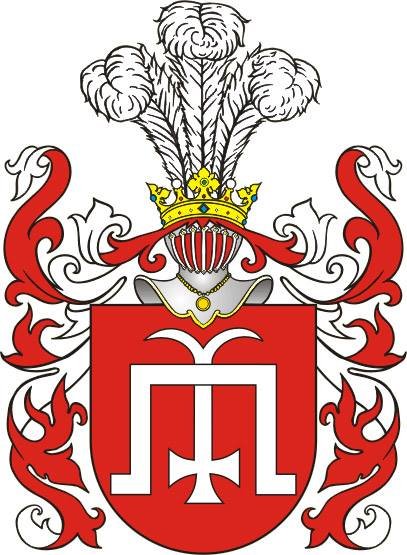
Descendant Coat of Arms of the Glinskys
Cossack Mamai
No one knows for sure where the "Cossack Mamai" painting, popular in the Dnieper region, came from. The warrior-bandurist could have emerged as a collective image of a resident of the border Mamai Principality (the residents of this principality might have been called "Mamais"). But it is more likely that the cult of the ancestor—the founder of the Cossack host, Mamai—was spread in the Northern Black Sea region by his descendants, the Princes Glinsky.
Cossack Mamai became such a symbolic figure for the Ukrainian people that when uprisings broke out, a Mamai was bound to appear. Among the Hajdamaks at different times, there were three atamans who had the surname or pseudonym Mamai. "Ataman Mamai"—Yakiv Shchyrytsia—appeared in the Cherkasy region during the liberation struggle of 1917–1921. And today, in the ranks of the ATO, there are fighters who use this name, sacred to every Ukrainian.
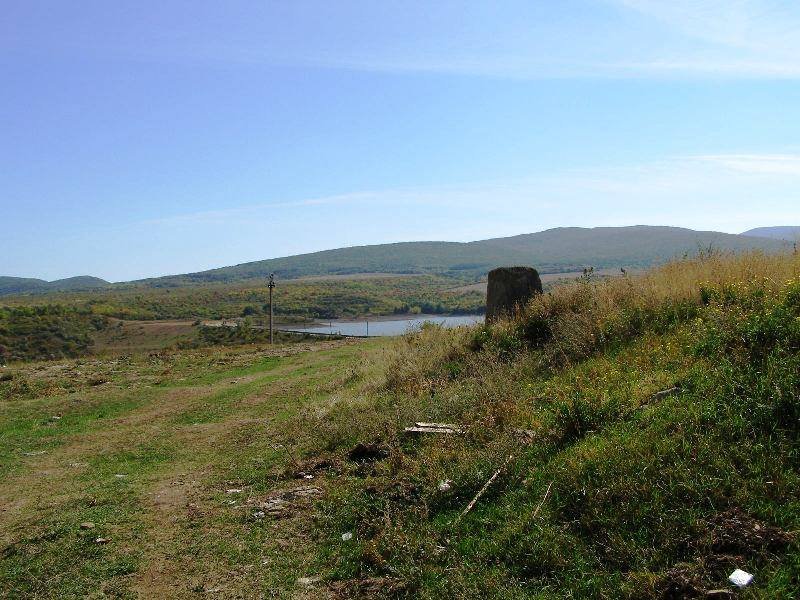
Kemal-ata hill next to the town of Staryi Krym, where according to one version – Mamai's grave is located
According to one version, Mamai was buried in the village of Aivazovske (formerly Sheikh-Mamai) of the Kirovskyi (now Isliamteretskyi) district of the AR of Crimea near Feodosia. The grave (mound) was found by the famous artist Ivan Aivazovsky, who was engaged in archaeology. According to another version, his grave is the Kemal-ata hill next to the town of Staryi Krym.
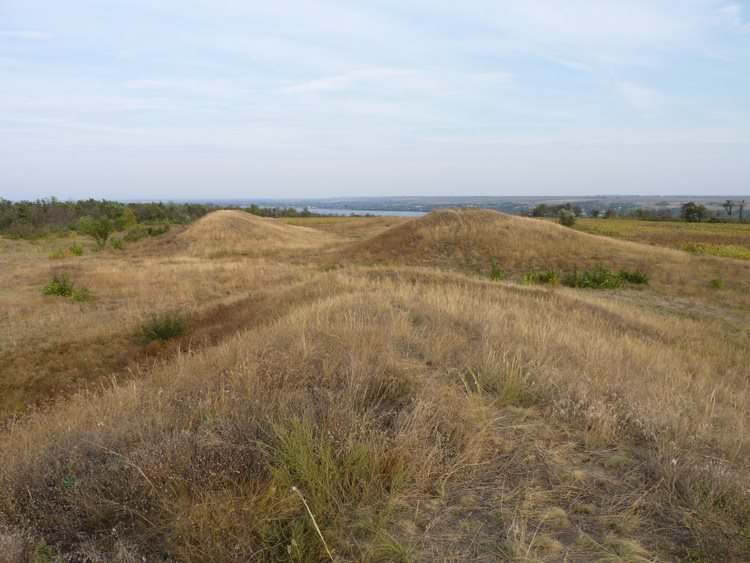
Mamai Burial Mound (Kurgan)
About the Painting
"Cossack Mamai" is a folk painting that is extremely popular among the Ukrainian people. In ancient times, "Mamais" were painted on walls, doors, shutters, frames, chests, beehives, dishes, canvas, wood, and paper. About a hundred such works from the 18th to the first half of the 19th century have survived; the oldest is dated to the beginning of the 18th century, but many researchers believe they existed in the 17th century and earlier.
These paintings preserve a plastic canon, which is that the Cossack sits on the ground with his legs crossed "Eastern-style" ("Turkish-style") in the steppe under an oak tree, on the branches of which ammunition (or lying nearby) is hung—a rifle, a saber, a bow, arrows, a pistol, a powder horn, a bag, dishes; he smokes a pipe and plays a bandura (or kobza); usually dressed in a coat (zhupan) or sheepskin coat, a shirt, wide trousers (sharovary), and saffiano boots; behind is a swift horse tied to a spear thrust into the ground. There are paintings in which the Cossack does not play the bandura but holds his hands on his chest in a characteristic gesture.
Often, folk artists copied old models and, taking them as a basis, introduced new details, which brings the "Cossack Mamai" paintings closer to classical icon painting. The phenomenal popularity of these works throughout the ethnic territory of Ukraine (especially on the lands of the Hetmanate, Zaporozhia, as well as in the Right-bank Kyiv and Cherkasy regions), including among settlers of the Don, Kuban, Siberia, and the Far East, points to coded information important for the Ukrainian soul, transmitted from generation to generation, defining the fundamental traits of the national character.
Sometimes the names of Cossack leaders appear on the paintings—Maksym Zalizniak, Semen Palii, Nechay, Kosh Ataman Kharko, Sava Chalyi; much more often this name acts as a collective, characteristic-typical one: Ivan Vasylovych Kutovyi, Hordiy Velehura, Cossack Bardadym, Cossack Sharpylo, ancient Zaporozhian, Cossack Boniak, Khoma. Even more often, the Cossack is nameless—a Zaporozhian, a Crimean Zaporozhian, a Zaporozhian Kosh Ataman, a Cossack with a true soul, a poor Cossack. On many paintings there are rhymed inscriptions, often significant in volume, in which the Cossack addresses the viewer or ponders on life. In them, serious motifs are whimsically combined with humor or self-irony, significantly complementing the image.
To this day, the origin of the compositional canon of the painting is debated. The sitting posture of the Cossack (with crossed legs) has analogues in the art of the peoples of South, East, and Central Asia (Turkey, Iran, Mongolia, Tibet, India, Japan) practicing Islam, Buddhism, and Hinduism. In our opinion, this composition was not borrowed but has an autochthonous origin. The image of Cossack Mamai is a generalized symbol of Ukrainian history, the image of the legendary ancestor of the Cossacks. In this image, a folk canonization of the Cossack host took place: paintings depicting the Cossack-bandurist hung in homes in the most honorable place, often next to icons.
According to the "Encyclopedia of Modern Ukraine"