Kozu-bash: The Return of the Legend
A unique apple variety — kozu-bash.
Petro Volvach. Newspaper "Krymska Svitlytsia", 2018, Issue No. 7
"There are no apples like the ones here anywhere else in the inhabited quarter. These Sudak apples... smell like musk and amber. These apples, the size of a hand, are packed in white boxes and sent to the Crimean khans, sultans, and viziers. Their beauty and sweetness are not lost over a long time, the color and taste do not change, they are as if just plucked from the tree. In short, there are no apples like those in Sudak in the inhabited quarter..."
Evliya Çelebi. Book of Travels. Crimea and Adjacent Regions. 1678. (Excerpts from the work of the 17th-century Turkish traveler).
Back in the early 90s of the last century, a team of enthusiasts (including myself) centered around the newspaper "Holos Krymu" and the Ismail Gasprinsky Republican Library, together with scientists from the Crimean Horticultural Station, created in a short period of time a collection of indigenous varieties of fruit crops, inventoried the remains of chayir plantings, and began their expeditionary survey.
At that time, we managed to introduce several dozen local ancient varieties of fruit crops, mainly apple and pear trees, to the collection plantings established at the research station of horticulture. The collection was also successfully duplicated in several farms and in the individual gardens of amateur gardeners. We also managed to revive and bring back from oblivion the materials of the Simirenko expedition in Crimean orchards. We published them in the "Tavria" publishing house in 1996 as a separate monographic work, "Local Ancient Fruit Varieties of Crimea."
However, it was repeatedly emphasized that our team, unfortunately, did not manage to find and include one of the most prominent apple varieties, "Kozu-Bash," in the collection of indigenous varieties. As the unsurpassed expert of Crimean horticulture Levko Simirenko noted, this variety began to disappear from commercial orchards as early as the late 19th century. The scientist, given its value for both science and commercial horticulture, expressed concern about losing it.
Unfortunately, these fears came true. During the reconstruction of Crimean commercial orchards, this highly valuable variety was lost. It also disappeared from home gardens. The Moscow occupiers dealt a deadly blow to traditional Crimean horticulture, especially to chayir orchards and local ancient varieties, in the first post-war year after the deportation of the Crimean Tatar people. At that time, not only the rich material, humanitarian, and spiritual culture and science of this people were destroyed, but also their unique and original agricultural culture. In fact, with the deportation of the Crimean Tatars, chayir horticulture, local varieties of fruit crops and grapes, and entire branches of animal husbandry perished.
All our attempts to find the famous Kozu-Bash in Crimean orchards were unsuccessful. We did not find this variety in global collections of fruit crops collected at the All-Union Institute of Plant Industry either, nor in the famous Pomological Collection of Levko Simirenko in the Cherkasy region.
However, the enthusiasts did not lose hope of finding this Crimean horticultural pearl. They constantly appealed through the Crimean media to old-timers, proving the importance of finding this once fairly widespread and popular apple variety as an integral part of the horticultural culture of the Crimean Tatar people.
The greatest New Year's gift for me this year was a message from my horticultural brother A. Server (the surname has been changed—author) that the members of our group had finally managed to find an old tree of the famous Kozu-Bash in the Bilohirsk (Karasubazar) district. A preliminary pomological study showed that the found specimen matched Levko Simirenrenko's highly professional description of Kozu-Bash in almost all parameters.
Taking this opportunity, I want to congratulate my friends on this very important and valuable scientific achievement and wish for the return of this find to Crimean orchards. I hope that in the near future we will establish commercial plantings of this variety in Ukrainian Crimea.
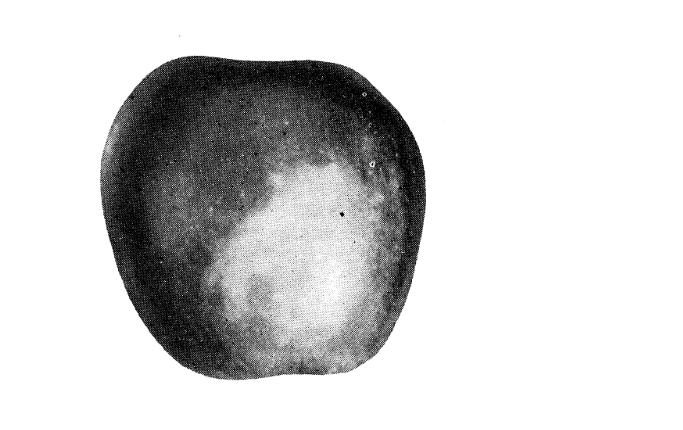
The only illustration of the Kozu-Bash apple that has been preserved in the work "Pomology" by Levko Simirenko
Reference
Kozu-Bash (Lamb's Head)
Kozu-Bash is a showy, large apple. Undoubtedly, it is one of the best Crimean varieties. Translated from Crimean Tatar, it means "lamb's head." However, the characteristics of the fruit show nothing in common with a lamb's head.
Significant groups of Kozu-Bash are found only in the orchards of the Karasubazar district, namely: Azamat, Dzhepar, in the orchards of the Bobovich brothers, Shishman, and others. Solitary Kozu-Bash trees are found in almost every Tatar garden, more often in old plantings, since nowadays no one plants this variety in new orchards. But is such neglect a justification and evidence of progress in Crimean horticulture? Indeed, in its natural (niche) zone, Kozu-Bash is more profitable compared to the demanding Golden Winter Pearmain (Shafran).
It is clear that the most favorable natural conditions and the best lands should be used to grow the best and most valuable varieties. But do we have many such localities? Because of this, the fruits of local Crimean varieties (except perhaps Kandil Sinap) are of lower quality compared to the more refined French variety.
But the former varieties are more adapted and, as a rule, have more robust trees. Their modesty and resilience are qualities of the local Tatar varieties that no one questions. It would be a pity if Kozu-Bash and some other indigenous varieties eventually disappeared from Crimean orchards. Speaking of Kozu-Bash, it is necessary to emphasize the high resistance of its leaves and fruits to the main infectious disease of apple trees—scab. The fruits are never affected by this disease. The Ovak orchard presented a very interesting sight in the summer of 1888.
At that time, the fruits of all Western European varieties were completely affected by this fungal disease and had an ugly appearance, while Kozu-Bash alone amazed everyone with its clean red skin. Similarly, the fruits of this variety are not damaged by the codling moth, so wormy apples are not found among them.
Apparently, there are nearly four variations of this variety in Crimea. Two of them are found in the gardens of O. H. Bangliarov in Ovak. They differ more in the nature of tree growth and yield than in morphological characteristics and the quality of the fruits themselves. The trees of the first have a pyramidal crown, their fruits are large and set singly or in pairs. In others, the crown is spherical, and they are distinguished by a generous yield. However, their fruits are smaller, have a flatter shape, and set in clusters of 3-4 pieces each.
In the garden of A. A. Krim (former p. Khamaryto), two more variations of the variety are found: white Kozu-Bash and striped Kozu-Bash. Its fruits resemble Red Calville in appearance.
Kozu-Bash is willingly exported, and the price for this apple is the same as for Sary Sinap. Due to the large size of the fruits, they are often packed in boxes in no more than three rows. According to the "Summary," 536 Kozu-Bash trees were registered in the gardens of the Simferopol district.
From the book: L. P. Simirenko. – "Local Ancient Varieties of Fruit Crops of Crimea". – Simferopol, "Tavria", 1996, – pp. 83-85. Compiled by Petro Volvach.
Translated from Russian by Petro Volvach.