Coastal Stars of Crimea. Light and Word
Crimean lighthouses guarding peace and tranquility. Continuation.
Maxim Dubov'yaz. Newspaper "Krymska Svitlytsia", 2017, Issue No. 31
Like any element of life that goes beyond the limits of everyday routine, lighthouses attract special attention. Since ancient times, they have influenced local toponymy, and we know in Crimea not only the "red light" Rosofaro from medieval pilot charts of the western coast. There are also those that have survived to our days: Foros and two Lambats—Kuchuk and Buyuk, of which the Lesser is more famous than the Greater, their names having clear Greek roots slightly modified by local pronunciation.
And the cape, which is the easternmost projection of the Crimean land, is named clearly, but somehow mundanely and not romantically: Fonar (Lantern)... Its true local name—in Crimean Tatar—is Fener. If not more romantic, then at least more exotic. However, the meaning is the same, and the cape justifies its "illuminating" name—it is adorned with a lighthouse. This is the Yenikale Lighthouse; its simple round tower was built in 1953 on the site of a temporary wooden structure, which in turn had performed lighthouse functions for seven years instead of the one destroyed in World War II. This lighthouse controls the entrance to the Sea of Azov. It is so important that after the destruction of its tower, the oldest in Crimea, the light equipment was installed on its remains until a temporary wooden one was built, followed by the modern one... Not only the Tarkhankut lighthouse has its own story...
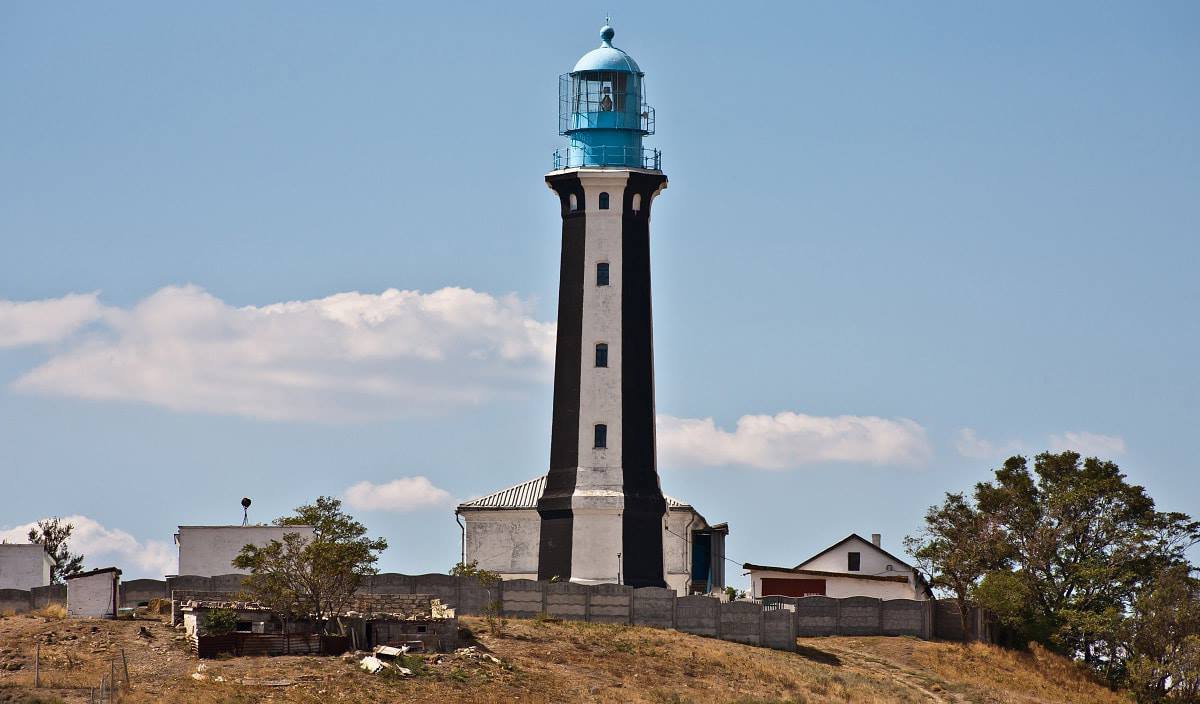
Kyz-Aul Lighthouse
What the old Yenikale lighthouse looked like is known: ancient drawings preserved this memory. The modern one is quite similar to the Illinsky lighthouse, and the original one somewhat resembled the Tarkhankut and Khersones lighthouses built slightly later, which are actually copies of each other. They are also called twins.
The lighthouse near the New Fortress—Yeni-Kale—was built in 1820. However, the first mentions of lighthouse fires on Cape Fonar are found as early as 350 BC, in the periplus of Scylax.
Lighthouses do not just decorate external life—like mountains or foreign palaces. Where lighthouses are surrounded by human settlements, they give names to neighboring objects as the brightest landmark of the area. For example, right under the lighthouse in Yevpatoriya is a health resort which, of course, had no chance of being named anything other than "Mayak" (Lighthouse). And under the unheralded, modest lighthouse in Sudak is a dance floor, witness to thousands of beginnings and endings of resort and local romances... Indeed, it is also called "Mayak". And the root of the name of Pidmayachne (Under-Lighthouse) village, the closest to the former oldest lighthouse in Crimea, is not hard to guess.
The oldest lighthouse in Crimea now remains Ay-Todor, whose low tower already bears clear signs of antiquity, which neither the structural similarity of the buildings nor even tradition can hide.
There are also very unusual-looking lighthouses in Crimea. Some are so unusual that not all sources dare to call the structure with lighthouse functions on Cape Chornyi in Tarkhankut by this name, cautiously calling it a "navigation sign." This is, in fact, the same thing, but with less reference to the stereotype of a "tower" or "mast," or "fire" or "light directed into the distance."
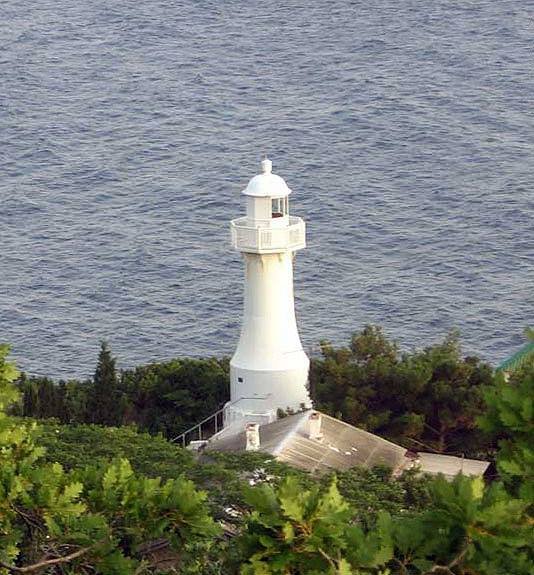
Cape Sarych Lighthouse
The southern cape of the Kerch Peninsula is adorned by a lighthouse called Kyz-Aul, because Kyz-Avul is the real name of the nearby village, which was renamed Yakovenkove. The elegance of the architecture of its blue-and-white tower is emphasized by black stripes; unlike the traditional red horizontal ones, these are vertical. Such "makeup" gives the lighthouse a very stylish look!
It is clear that the urgent need to shine at night in dangerous places is difficult to leave within the limits of everyday use; it actually borders on a real miracle. And so there is a temptation to create such miracles even outside the limits of such acute need. The decorative lighthouse-temple in Kuchuk-Uzen was not a complete precedent. A century earlier, a lighthouse appeared for commemorative purposes, sometimes called the Foros lighthouse, but more often the one on Cape Sarych.
It is said that when the last Russian tsar heard that the cape past which his imperial yacht was just passing was the southernmost point of his European possessions, he wished to make a commemorative sign there. It coincided well that sailors had asked for approximately the same thing: to install a lighthouse on Cape Sarych. This was also proposed (there are completely strange coincidences in life) by an admiral from the famous naval family... of the Sarychev.
This lighthouse is also unusual: a 12-meter cast-iron tower cast in St. Petersburg, resembling a bell rather than a tower, was installed under the light equipment. There was also a real bell, until modern electronic equipment was installed; the voice of the bell spoke from the shore to ship captains in the fog. And again a strange coincidence: when the physical bell was no longer relevant, they remembered that the main, heaviest bell was missing in the Foros Church. Thus, the voice of the lighthouse passed from naval service to divine service...
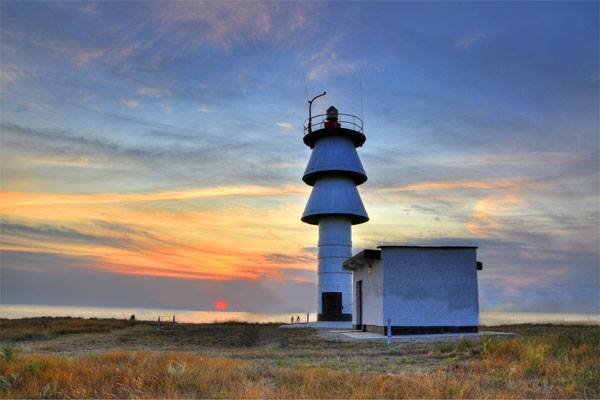
Cape Chornyi Lighthouse
It seems so simple: a shore light. But how many stories are behind each one!
Significantly, two nautical miles south of Cape Opuk, where navigation is secured by a black-striped lighthouse near the Maiden's Village—this is exactly how Kyz-Avul is translated—there are rocks in the sea. There are four of them, and there is a fairy tale legend about these ship-rocks, usually one of the first in the collections of "Legends of Crimea." And there is also a legendary truth. During the Kerch-Feodosia operation, the highest of the rocks, Elchen-Kaya, was to become a lighthouse for just one night in the midst of a formidable winter sea. And this happened on the night of December 28, 1941. And it was done at the cost of their lives by two lieutenants. Their names were Volodymyr Mospan and Demian Vyzhula...
A word about the light of a lighthouse—it often carries a memory of glory. But that is another Story.