River of Life. Part Three: Stones from the Sky
How the North Crimean Canal changed the life of the Crimean Peninsula.
Valeriy Verkhovskyi. Newspaper "Krymska Svitlytsia", 2016, Issue No. 43
At the time of the proclamation of Crimea's autonomous status, and later—the collapse of the Soviet Union and Ukraine's acquisition of Independence—the canal was still being built.
The canal is actually a whole network. ARC—long before the formation of the autonomy, this abbreviation stood for the Azov Rice Canal, which branched off from the main water highway to the northeast of the peninsula, to the villages near the Syvash. To the west, in the direction of Tarkhankut, the canal water went along the Rozdolne canal, and further south—it fed the Saky and Kurman (Krasnohvardiiske), Black Sea, and Connecting canals. Water conduits, branches, a "capillary" system to complement the water "arteries," crossings, reservoirs. All together it amounts to eleven thousand kilometers.
The second stage of the canal was built in the 1980s. The task was to improve the water supply of Simferopol and Southern Crimea. The third stage was started in the 1990s and completed in 1997. The construction of the fourth stage was never started. After 1997, all construction work was stopped altogether. All that remained was to keep what was already there in a usable state.
Almost immediately after the approval of the autonomous status, the leadership of Crimea wanted more. No one especially hid that autonomy was a temporary compromise aimed at separating from Ukraine. And then, in the early 1990s, the canal played its role as a deterrent factor. In response to talks about the "island of Crimea," loud statements about the possibility of transferring to the Kherson Oblast were made in the north of Crimea. Along with many other components, the canal firmly tied the peninsula to the mainland.
The cessation of water supply in the spring of 2014 was a completely logical, though very difficult step.
On the one hand, Ukraine is not obliged to supply resources to the occupied territory, and must not negotiate or engage in business matters of management with the regime that seized power on the peninsula in violation of the law and without asking the consent of the residents of Crimea themselves. On the other side of the scale is the fact that a significant part of the Ukrainian community of the peninsula consists of villagers whose lives directly depend on the canal, on Dnieper water. And the cessation of water supply will hit their lives exactly. In addition, disruption of the established system of nature management can lead to irreversible consequences.
Clashing with the inexorable reality did not help the supporters of separatism in Crimea to come to their senses. Ready to sacrifice anyone and anything, except their mental chains, they will destroy Crimea, because now they have somewhere to retreat—Moscow is ahead.
Loud enthusiasm bordering on common sense was stirred up with the opening of the Novo-Ivanivka hydrosystem in the Nyzhniohirskyi district. The desire to prove at all costs the correctness and irreversibility of the "Russian choice" for Crimea looks increasingly absurd. One of the loyal sentences: "No one would have thought before that the Biyuk-Karasu could flow in the opposite direction"... Natural miracles in Crimea, it seems, are just beginning. And the promised stones from the sky are not far away.
The Biyuk-Karasu River today, it seems, is assigned the role of the main water artery. I grew up on the banks of this river, it is native to me. In summer, it often dried up to a stream that could be stepped over. Of course, there is and can be no concreting comparable to the North Crimean Canal there. Water released from reservoirs along the Biyuk-Karasu will simply not reach the Novo-Ivanivka hydro-structure if there is a drought. And if there is no drought, one could live without irrigation anyway.
However, even before the noise around these "New-Vasyuki" hydro-structures, the head of the Water Resources Committee, Igor Weil himself, could not help but admit in an interview: "Without the canal, finding a source for irrigating 400 thousand hectares of land is unrealistic, and getting rid of the most fertile land is irrational."
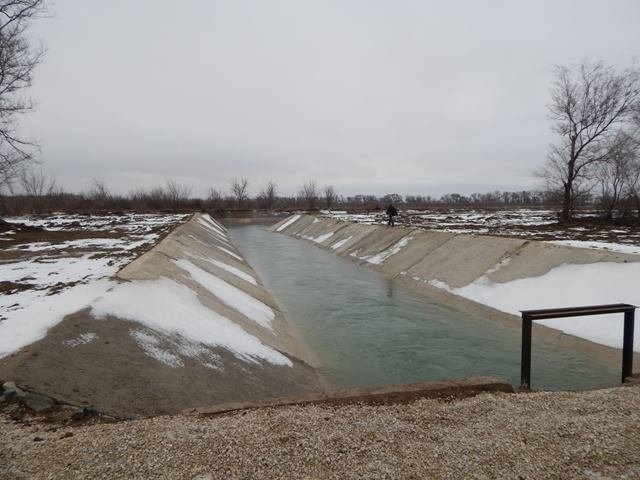
Specialists are concerned about the canal bed remaining in a dry state unnatural for it. Under the conditions of a hot Crimean summer, reinforced concrete will fail much faster than design terms. Georgy Kapshuk, Honorary Meliorator of Ukraine (quoting from the newspaper "Krymskiy Telegraf"): "If the canal is not used for another year—goodbye, North Crimean! This reinforced concrete is like a living organism. In summer, when the ground heats up to 60 degrees, and there is no water, it warps and twists. Eleven thousand kilometers of inter-farm, irrigation canals and pipelines! Like from here to Alaska! It cannot stand without water in summer."
The canal provided a billion cubic meters of water per year—and this is not yet its full capacity. And the pride of the Crimean water management today is the plans to give Crimea at least forty million cubic meters. At the expense of internal resources. What resources? Depleting the already meager flow of steppe Crimean rivers? Pumping artesian waters, whose reserves are far from infinite? Perhaps Stalinist dreams of a water pipeline from the Krasnodar Krai or desalination of sea water will be revived?
The result of the "dehydration of the organism" of the peninsula has already been a sharp reduction in the sown area of rice in Crimea. Instead of it, they suggest growing... sunflower. Needless to say, this very useful agricultural crop requires much less irrigation and is quite profitable, but at the same time, sunflower depletes even the rich chernozems of mainland Ukraine. And what will happen to the Crimean lands in a few years?
In the official documents of the Republican Committee for Water Resources of Crimea, it is frankly stated that there is a catastrophic situation with irrigation in the farms of the steppe part of the peninsula. For example, in June of this year, in the Kurman (Krasnohvardiiske) district, out of forty-seven thousand hectares of irrigated land, less than one and a half thousand were irrigated.
...Meanwhile, the Russian Minister of Natural Resources promises to arrange water supply on the peninsula in sufficient volume by 2019. Well, sitting for three years without water is, of course, not stones from the sky.