Russia's Use of Ukrainian Cultural Heritage in the War Against Ukraine: The Crimean Case
During the period of its rule in the temporarily occupied territory of the AR of Crimea and Sevastopol, Russia has managed to cause great damage to the tangible cultural heritage of Ukraine.
Andrii Ivanets, Candidate of Historical Sciences, Senior Researcher at the Research Institute of Ukrainian Studies. Newspaper "Krymska Svitlytsia", 2019, Issue No. 45-46
Russia's attack on Ukraine in 2014 from the very beginning had the characteristics of a conventional war—the seizure in Crimea by Russian military forces of key civilian objects, including government buildings and ferry crossings, assaults on Ukrainian military units (during one of which a Ukrainian officer was killed in Simferopol), and naval engagement on the western coast of Crimea. Back then, for instance, one of the Ukrainian ships in Donuzlav used hundreds of flashbang grenades to defend against attackers from ships under the St. Andrew's flag.
However, in the public consciousness of Ukraine and the world, Russia's aggression became established as a hybrid war. Indeed, the signs of the latter were also present—a huge role of non-military methods of warfare compared to combat operations using conventional weapons, as well as Russia's desire to conceal the very fact of launching the aggression, presenting itself as some third party in an allegedly "intra-Ukrainian" conflict. The Kremlin has actively and systematically carried out and continues to carry out large-scale informational, economic, and geo-cultural attacks against Ukraine.
Moreover, the economic consequences of Russian aggression for Ukraine are large and painful. Just one aspect of the problem—due to the seizure of Crimea, the Ukrainian side lost access to most of its continental shelf, where it conducted hydrocarbon extraction and where a large transnational company was soon to start operating under a Ukrainian license. Instead, the aggressor state has pumped out approximately 10 billion cubic meters of gas from Ukrainian offshore fields over five years of occupation of southern Ukraine using Ukrainian drilling rigs worth 800 million dollars seized by the Russians.
It is not so easy to calculate the consequences of Russia's geo-cultural war against Ukraine, but its impact may have even more negative consequences in the future. Because here the question is not about damages, losses, and sacrifices of the Ukrainian people, but about attempts to call into question their very existence.
During the period of its rule in the temporarily occupied territory of the AR of Crimea and Sevastopol, Russia has managed to cause great damage to the tangible cultural heritage of Ukraine—numerous facts of looting and destruction of monuments are known, along with destructive "restorations" of iconic objects (the Khan's Palace in Bakhchysarai, the stairs to Mount Mithridates in Kerch), and the illegal transfer of museum collection items of Ukraine to Russia and third countries. However, systematic attempts to use the symbolic capital of Crimean monuments to justify or conceal aggression against Ukraine draw attention.
The occupation and attempted annexation of part of the territory of a sovereign state prior to Russia launching the war in 2014 was the first in Europe since World War II. Such actions by the aggressor state became a brutal violation of international law and order, which had been created to prevent wars since the mid-20th century, as well as bilateral Ukrainian-Russian treaties and obligations undertaken by Russia under multilateral agreements. The lack of legal grounds for the seizure of Ukrainian Crimea and Sevastopol and aggression against Ukraine as a whole led to the Kremlin's attempts to mask its actions with quasi-historical arguments. This is a very significant reason. However, Russia's geo-cultural war against Ukraine has deeper roots.
For the Kremlin and the camp of Russian revanchists in general, a country centered in Kyiv is not just an important bridgehead for further expansion and a source of human, financial, and material resources. The consciousness of the carriers of the Russian imperial matrix perceives the Ukrainian question as a threshold, because the very existence of Ukraine forces them to question Russian identity, since the core of Kyivan Rus' was precisely modern Ukrainian lands. Therefore, Ukraine naturally feels its continuity regarding the Kyivan Rus' heritage. The country we call Russia today finally formed as a separate entity between the Oka and Volga rivers during the Golden Horde period.
However, its ruling and intellectual establishment wants to present their country not just as related to the heritage of Kyivan Rus' and the Novgorod region (where the fourth East Slavic ethnos was forming before its conquest by Moscow) but as the main or even the sole heir. The traditional response of Russian imperialists to the "Ukrainian challenge" was aimed at destroying or at least depriving the Ukrainian identity of subjecthood. Accordingly, there are grounds to perceive the constant repetition in various variations by the head of the Kremlin of the thesis that "Russians and Ukrainians are one people" not as an innocent game in pluralism of opinions, but as a thinly disguised programmatic denial of Ukrainian culture, language, and statehood.
The aggressor state tries to systematically use the cultural heritage of illegally occupied Crimea as symbolic capital in the war against Ukraine. Within the scope of a single article, it is impossible to discuss the entire Crimean case in detail, so we will focus on perhaps the most indicative cases of the instrumentally politicized use of the theme of Chersonese and the proclamation of the occupied Ukrainian city of Kerch as "the oldest city in Russia."
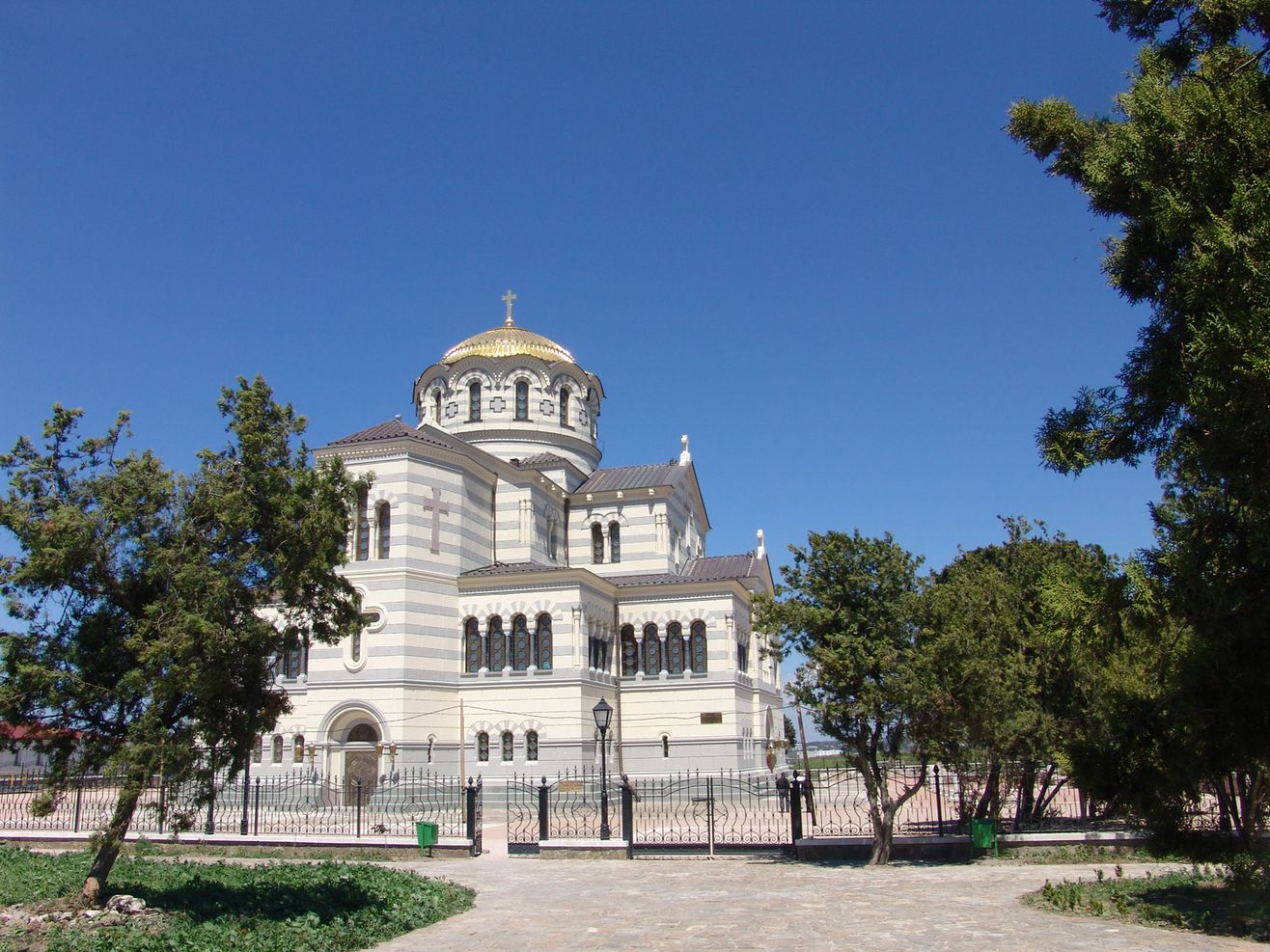
Photo by Anatoliy Kovalskyi
Chersonese: Kyiv must give up Crimea because a Kyivan prince was baptized there?
The obvious illegality of Russia's actions during the seizure of Ukrainian Crimea required additional justifications besides pseudo-legal "fig leaves" ("referendums" under gun barrels, adoption of Russian laws on the annexation of another state's territory). And on March 18, 2014, in his "Crimean-Sudeten" speech, the President of the Russian Federation put forward quasi-historical justifications for the seizure of two southern regions of Ukraine. This speech in general contains a number of absurdities: for example, the assertion that "Russians are the largest divided nation." Does the Kremlin consider the Han Chinese to be numerically smaller than Russians?
Have they not heard of the Taiwan problem? Regarding quasi-historical arguments for the need to divide Ukraine, perhaps the most absurd was the mention of "ancient Chersonese, where the holy prince Volodymyr was baptized." It turns out that Crimea had to be torn away from the state with its capital in Kyiv because the Grand Prince of Kyiv was baptized in Chersonese over a thousand years ago, and after that, he also baptized Kyivans? Can this convince anyone in their right mind?
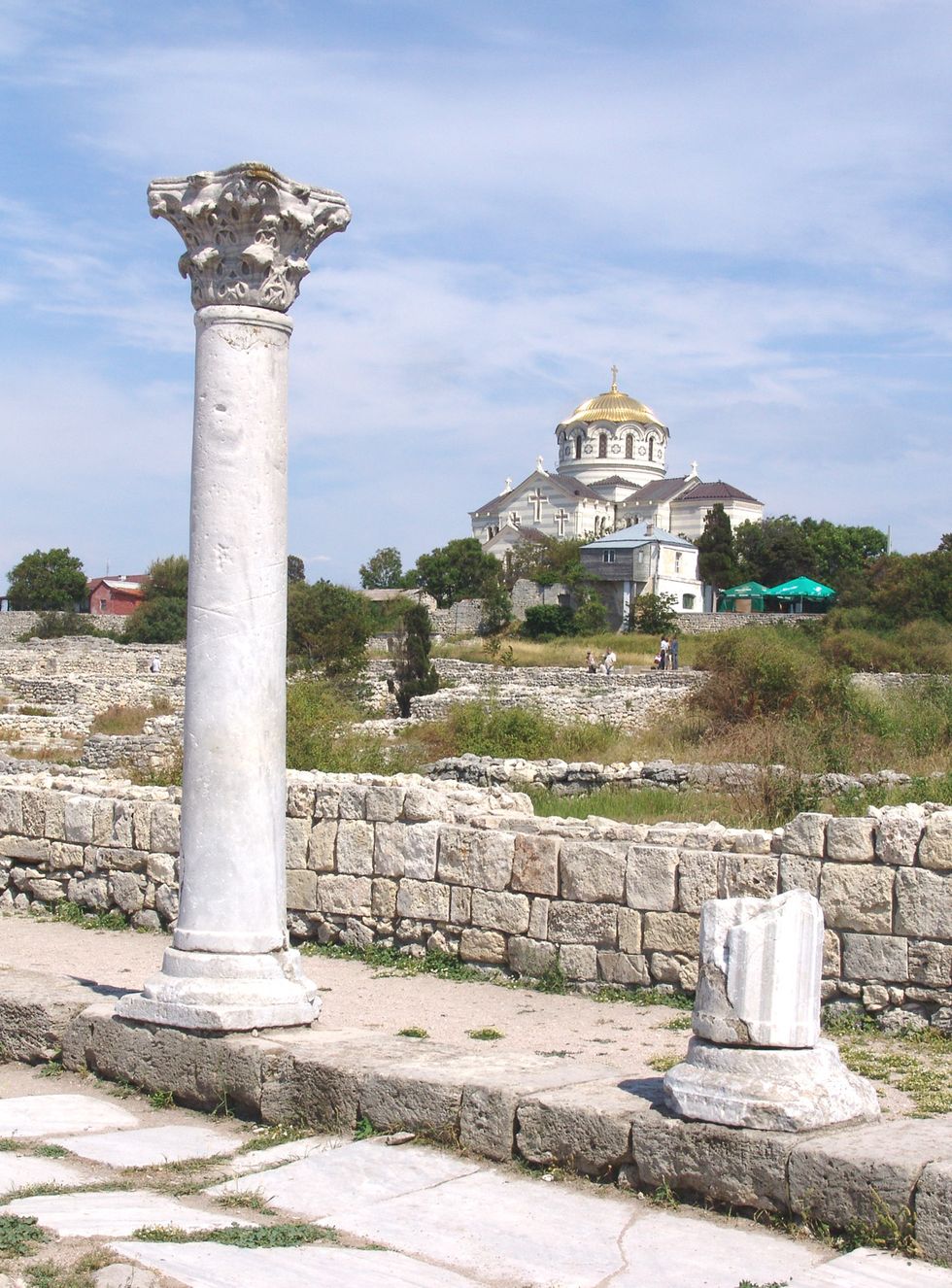
Despite the obvious ambiguity of the situation with Chersonese, the Kremlin turned this issue into one of the cornerstones of the ideology of "Crimea-is-ours-ism" (krymnashizm). The sacralization of Chersonese by the Kremlin was supposed to shield its unlawful actions from criticism. However, it soon nearly called into question the internationally recognized status of this ancient and medieval city, which existed for over 1,800 years and was a significant political, economic, and cultural center of the Northern Black Sea region. The point is that in 2013, Ukraine inscribed the National Reserve "Tauric Chersonese" on the UNESCO World Heritage List. Archaeologists have been studying this ancient city and its agricultural chora, which has a level of preservation unique for ancient poleis, since 1827. Back in 1892, a museum was created in Chersonese, which during the Ukrainian SSR became a historical-archaeological museum-reserve, and in independent Ukraine received the status of a National Reserve. Immediately after the seizure of Crimea, the Ukrainian museum institution was illegally re-registered by the occupation administration.
In July 2015, as part of "strengthening spiritual bonds," the Russian "governor" of Sevastopol, S. Menyaylo, appointed Archpriest Sergiy Khalyuta, dean of the Sevastopol district of the UOC of the Moscow Patriarchate, as director of this non-legitimate Russian museum. He did not possess the appropriate professional qualities or educational level (having graduated from a medical school and confessional educational institutions), but he could implement the direction of sacralizing a significant historical site desired by the Russian authorities.
S. Menyaylo emphasized when appointing the cleric as head of the scientific and educational institution that Chersonese should be not only a tourist center but also a center of worship and pilgrimage. Perhaps the protest of the national reserve's staff would not have yielded results, but the joining of Russian scientists and museum workers forced the Russian authorities to back down.
The Director of the Hermitage and head of the Union of Museums of Russia, M. Piotrovsky, emphasized that the transformation of Chersonese from a scientific and educational center into a religious one is unacceptable, and the appointment of a cleric as director of the reserve could lead to the exclusion of this valuable site from the UNESCO World Heritage list and the loss of the monument. In passing, we note that the author of this correct statement also does not highly respect the law in the field of cultural heritage protection, since he resumed excavations in Chersonese after the occupation of Crimea without the permission of the Ukrainian side. True, his name has not yet been included in Ukraine's sanctions list of archaeologists who unlawfully work in the temporarily occupied territory.
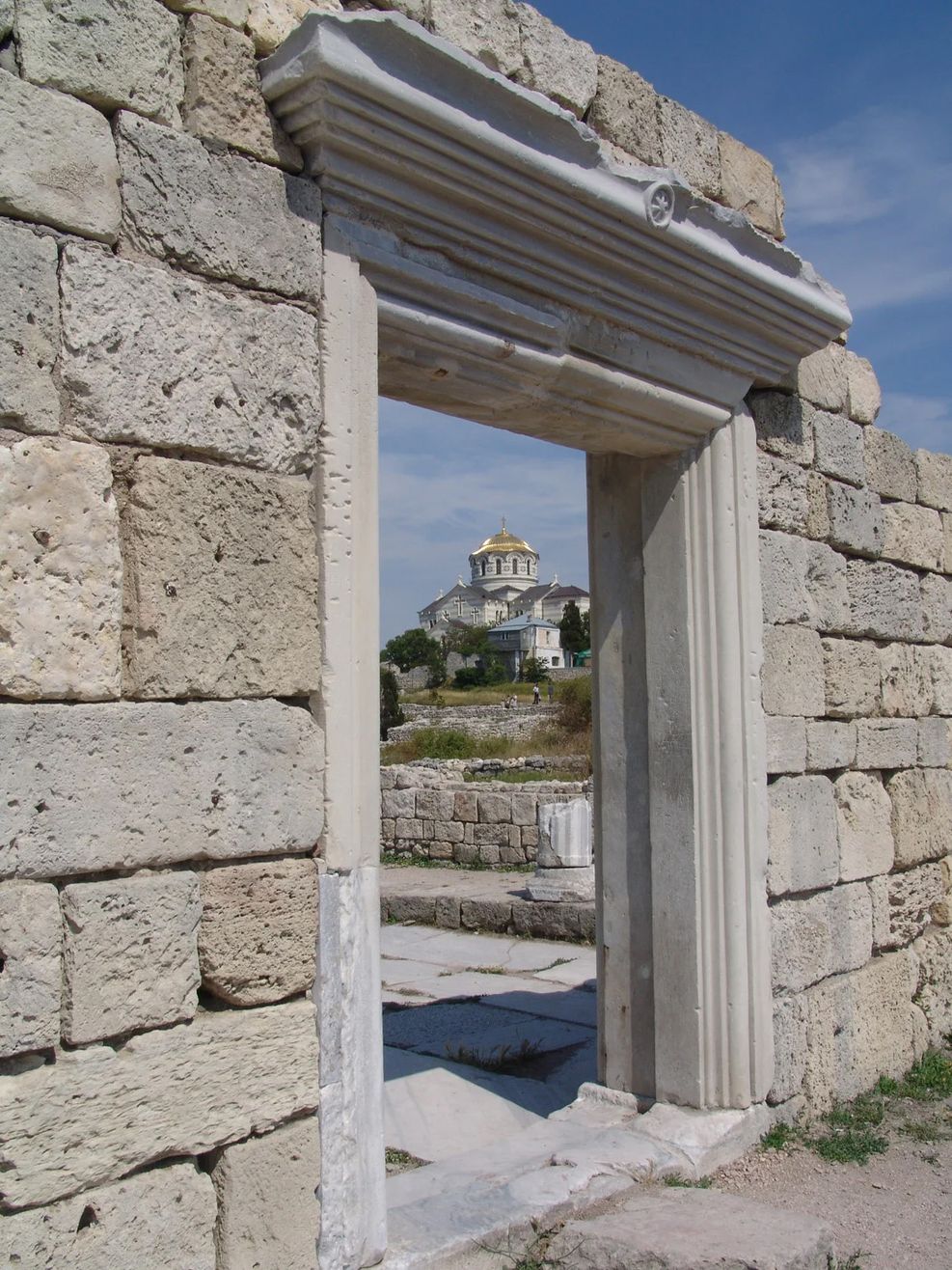
In 2015, a scientist was appointed director instead of Khalyuta, but almost simultaneously the Kremlin unlawfully declared the inclusion of this object of Ukrainian cultural heritage in the list of "especially valuable cultural heritage sites of the peoples of Russia." In practice, this led to the removal of the valuable monument from the jurisdiction of the non-legitimate administration of Sevastopol into the direct subordination of Moscow. However, the vector toward the politicized "sacralization" of Chersonese and its use for political manipulation was preserved.
Just as the destruction of the monuments of Chersonese's chora continued, along with attempts by the ROC to take over the reserve's premises that once belonged to the monastery, and the current director of the non-legitimate museum institution is considered a protégé of a ROC hierarch close to Putin... By the way, back in 2016, the Permanent Representative of the Russian Federation to UNESCO, E. Mitrofanova, publicly admitted that the museum-reserve "Tauric Chersonese" is not under the responsibility of Russia.
V. Putin has visited this monument at least once a year since the seizure of Crimea, and the Ministry of Foreign Affairs of Ukraine tirelessly reminds him that by doing so he violates legislation. Usually, the head of the Kremlin does this in August during the opera festival in the ancient theater. He also does not forget to visit the St. Vladimir Cathedral, which was restored in 2004 with funds from the Kyiv City State Administration. Of course, such visits have a political and propaganda character. In 2017, V. Putin made a statement that modified the neo-imperial myth of Chersonese. He said then: "Here it is necessary to create a Russian ('russkaya'), Russian-state ('rossiyskaya') Mecca. The point is not that Prince Vladimir was baptized here, but that after this, the strengthening of the centralized Russian state ('rossiyskogo gosudarstva') began here."
The assertion is frankly fantastic. After all, the centralized Muscovite, and in the future—Russian, state arose under the influence of the traditions of the Golden Horde several centuries after the baptism of the Kyiv prince. However, V. Putin is right when he speaks of the "unique" significance of Chersonese for the Russian state, because for many it has become a symbol of returning in Europe to the practices of the Third Reich in interstate relations. Interestingly, one of the Russian publicists in the spring of 2014 called V. Putin "a good Hitler before 1939." The mentioned statement of the President of the Russian Federation is interesting in that it shifted the emphasis in the neo-mythological perception of Chersonese from Orthodoxy to statehood.
While in 2014, when mentioning this vanished city, the President of the Russian Federation spoke about laying the common civilizational foundation of Russia, Ukraine, and Belarus with the baptism of 988, now he emphasizes the significance of Chersonese for the creation of the "centralized Russian state." We see here an example of another attempt to symbolically "privatize" the memory of Chersonese. This resembles V. Putin's cynical statements before the attack on Ukraine that Russia would have won the Great Patriotic War on its own anyway. Back then, the head of the Kremlin seemed to symbolically "push out" other peoples of the USSR from the memory of the victory over Nazism, publicly showing contempt for the colossal sacrifices they suffered. For example, Ukraine lost over 8 million people during World War II.
The Putin regime also uses the Chersonese theme for indirect recognition of the annexation of Crimea. The simplest method is visits by foreign officials or cultural figures at the invitation of the Russian side to the reserve, a number of concerts and festivals that take place on its territory, in violation of Ukrainian legislation on crossing the border. However, in 2019, the use of the Chersonese theme reached a fundamentally new level. In the early summer, Russian blogger A. Shipilov reported that Russia, with the help of its special services, was conducting an operation to use Cyprus to try to obtain at least indirect recognition by the EU of the Russian status of Crimea, and even cited a number of documents on this.
From these materials, it appeared that the so-called Noble Assembly of Crimea, represented by its marshal (leader) A. Ushakov, the non-legitimate Russian institution "historical-archaeological museum-reserve 'Tauric Chersonese'" with the support of the "Vice Prime Minister of the Government of Crimea," former Ambassador of the Russian Federation to the Republic of Cyprus Muradov, and the current Ambassador of the Russian Federation to Cyprus Osadchiy, along with ROC structures, deployed multi-move political and cultural activities on the Mediterranean island with the aim of recognizing, at least de facto, the legitimacy of the annexation of the Ukrainian peninsula. The plan probably lies in the fact that since it is impossible to directly establish contacts between non-legitimate occupation structures in Crimea and the state bodies of EU countries, structures of civil society controlled or even created by Russian special services should be used to lobby European states.
One of the key roles in attempts to use Chersonese to gain recognition of the annexation of Crimea in Europe is played by Muscovite A. Ushakov, honorary president of the "Expert-Analytical Service Commonwealth" group of companies. A. Shipilov qualified him as a "fighter of the invisible front," before whom representatives of the Russian administration of Crimea almost stand to attention. Already in 2014, the Muscovite began to work actively in the occupied territories of southern Ukraine, becoming a member of the working group of the Chamber of Commerce and Industry of the Russian Federation on the development of ties with Crimea.
In 2015, he heads the Noble Assembly of Crimea, and in the summer of 2016—the "Cultural Heritage of Crimea" Fund of Cultural and Educational Programs, which had just been created in Simferopol. The "charitable" organization openly declares its political intentions: "With the funds of the fund in 2016-2019, a number of internationally significant events were carried out that contribute to strengthening the positive image of Crimea and objective information about the legality and historical validity of its return to Russia."
Already in the autumn of 2016, this fund holds a meeting with the management of the Russian reserve "Tauric Chersonese" regarding wide-scale cooperation. At that time, the structure headed by Ushakov declared its intention to help the museum institution in a wide range of issues, ranging from the development of a logo and the concept of updating the exposition to the processing of documents in the Bureau of Technical Inventory (BTI). In 2018, the fund agreed with the Cyprus Orthodox Church to hold exhibitions in the Republic of Cyprus in 2019 about the holy sites of Crimea and to direct Cypriot tourists to pilgrimage routes in Crimea.
Ushakov also becomes the representative of the "Union of Descendants of the Russian Noble Assembly – Noble Assembly of Russia" in Cyprus and tries in 2019, on behalf of this organization, to create the so-called Cultural Center "Crimean House in the EU" in the Republic of Cyprus. However, soon the organization was renamed the "Club of Friends of Tauric Chersonese." De facto, as its members themselves admit, it operates under the Russian Embassy in the Republic of Cyprus, but formally it is a civil society structure.
In June 2019, in Cyprus's second-largest city, Limassol, and in the capital, Nicosia, under the auspices of this "club," the non-legitimate Russian "reserve 'Tauric Chersonese'," and the ROC, the exhibition "Shrines of Chersonese" took place. Metropolitan Lazar of Simferopol and Crimea of the UOC-MP blessed its holding. Once again, the Russian authorities cynically used the church to achieve their geopolitical goals and carried out the transfer of items from the museum fund of Ukraine outside the borders of the temporarily occupied territory without the permission of Ukraine. It is a pity that the clergy of the UOC-MP/ROC once again allowed themselves to be dragged into these dirty political games.
The Ambassador of Ukraine to Cyprus, B. Humeniuk, regarding the opening of the so-called "Club of Friends of Chersonese"—"the representation of Russian Crimea" in Europe—officially stated that "we are witnesses to how Russia once again uses the 'Trojan horse' tactic to mislead the public and avoid responsibility for war crimes against Ukraine." The ambassador assessed this specific case as another attempt to legitimize the annexation of Crimea by the Russian Federation in the EU, which resembles a well-planned special operation by Moscow to bypass EU legislation and achieve its imperial goals. In this regard, B. Humeniuk raised a rhetorical question: "I would like to know what the Greek Cypriots would say if some Turkish non-governmental organization abroad found some 'historical connections and cultural values' between the so-called Turkish Republic of Northern Cyprus and Turkey?".
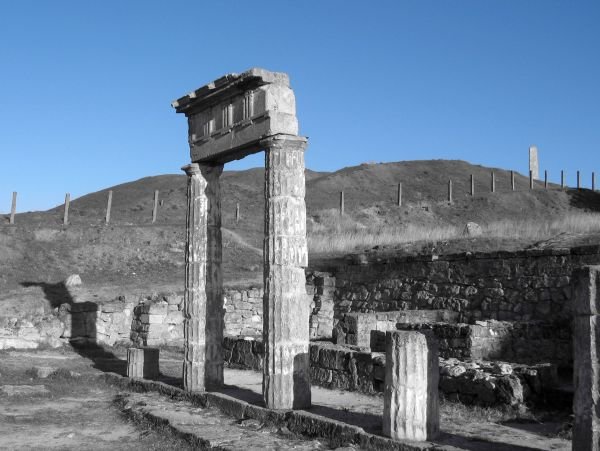
Columns of the ancient portico on Mithridates
How a city of Ukraine was proclaimed the oldest in Russia
Another attempt to "privatize" by Russia the symbolic capital of a city in the temporarily occupied territory of Crimea is connected with Kerch. While the case of Chersonese is rather an attempt by Moscow to use soft power in the war against Ukraine and the West, the games around the easternmost Crimean city could have been started directly by the Russian administration of occupied Crimea, of course, within the limits of the tasks and rules set by the Kremlin. The fact is that in 2015, official celebrations began in honor of the two-thousandth anniversary of the city of Derbent in Dagestan, officially recognized as the oldest in the Russian Federation. Almost simultaneously, the public promotion of the topic of Kerch as "the oldest city in Russia" began.
Over its 26-century history, it had different names—Panticapaeum, Bosporus, Karsha, Korchev, Cerchio, Vosporo, Kerch. The Greek polis of Panticapaeum was founded on the Crimean shore of the Kerch (then Cimmerian) Strait, according to the latest data from Russian archaeologists, in the period between 610 and 590 BC. In passing, we note that Russian scientists obtained updated information on the founding of the city after the annexation of Crimea without proper documentation of documents for excavations with Ukrainian authorities. However, long before 2014, Kerch was called the oldest city of Ukraine, since the date of its foundation was considered to be the 6th century BC.
In the 5th century BC, Panticapaeum became the capital of the Bosporan Kingdom, which united the shores of eastern Crimea and Taman. At the turn of the eras, it was part of the Kingdom of Pontus, the Roman Empire, later it was captured by the Goths, and destroyed by the Huns. Further, the city was part of Byzantium, Khazaria, the Tmutarakan principality, the Golden Horde, the Genoese republic, the Ottoman Empire, the Russian Empire, the RSFSR, the USSR, the Ukrainian SSR, and already independent Ukraine. Despite ups and downs, periods of destruction and devastation, life in the city pulsed constantly for over 2.5 thousand years.
However, the inhabitants of Derbent can sleep peacefully—Kerch is not a competitor to their city. The point is not even that in the 1970-1990s, archaeologists found evidence of the existence of a significant settlement in this Caucasus city as early as the first half of the 1st millennium BC and, accordingly, one cannot rule out its somewhat older age than that of Kerch. The question of dating the time of Derbent's foundation is still debated in science. The problem is that Kerch is not within the internationally recognized borders of Russia, is from the point of view of law a Ukrainian city, and therefore cannot be considered on an official level as the oldest in any other state besides Ukraine.
The motives of the representatives of the Russian administration of the occupied territories, who began the campaign for the recognition of the East Crimean city as "the oldest in Russia," are quite obvious. This is an attempt to gain weight among the regional establishment of the Russian Federation, to increase their significance in the eyes of the Kremlin, and, of course, a way to attract more tourists and obtain additional funds from the federal budget. After all, it is no secret that celebrating anniversaries is a window of opportunity for attracting state subsidies. It is also PR for the city, and, what is very important in Putin's Russia, ideologically verified PR. The Dagestanis hoped to receive tens of billions of rubles for the anniversary of Derbent. In fact, it turned out significantly less, yet the authorities of Dagestan barely managed to absorb even this money.
The ideologized fuss around Kerch began after the discovery in 2015 by the Bosporan expedition under the leadership of archaeologist V. Tolstikov, head of the department of the A. Pushkin State Museum of Fine Arts (Moscow), on the top of Mount Mithridates in the oldest layer of Panticapaeum of a building and other artifacts of the late 7th century BC. The Russian ideological machine immediately dubbed this important find from the occupied territory of Ukraine "the oldest building in all of Russia."
In January 2016, at a meeting of the "Government of the Republic of Crimea," "Vice Prime Minister" L. Opanasyuk announced that Tolstikov's expedition, which had been working on Panticapaeum for 40 years, had made discoveries that give reason to claim that "Kerch is the oldest city of the Russian Federation." In June 2016, "Head of the Government of the Republic of Crimea" S. Aksyonov instructed the "Ministry of Culture of the Republic of Crimea" and the East Crimean Museum-Reserve to begin gathering information to prove this officially.
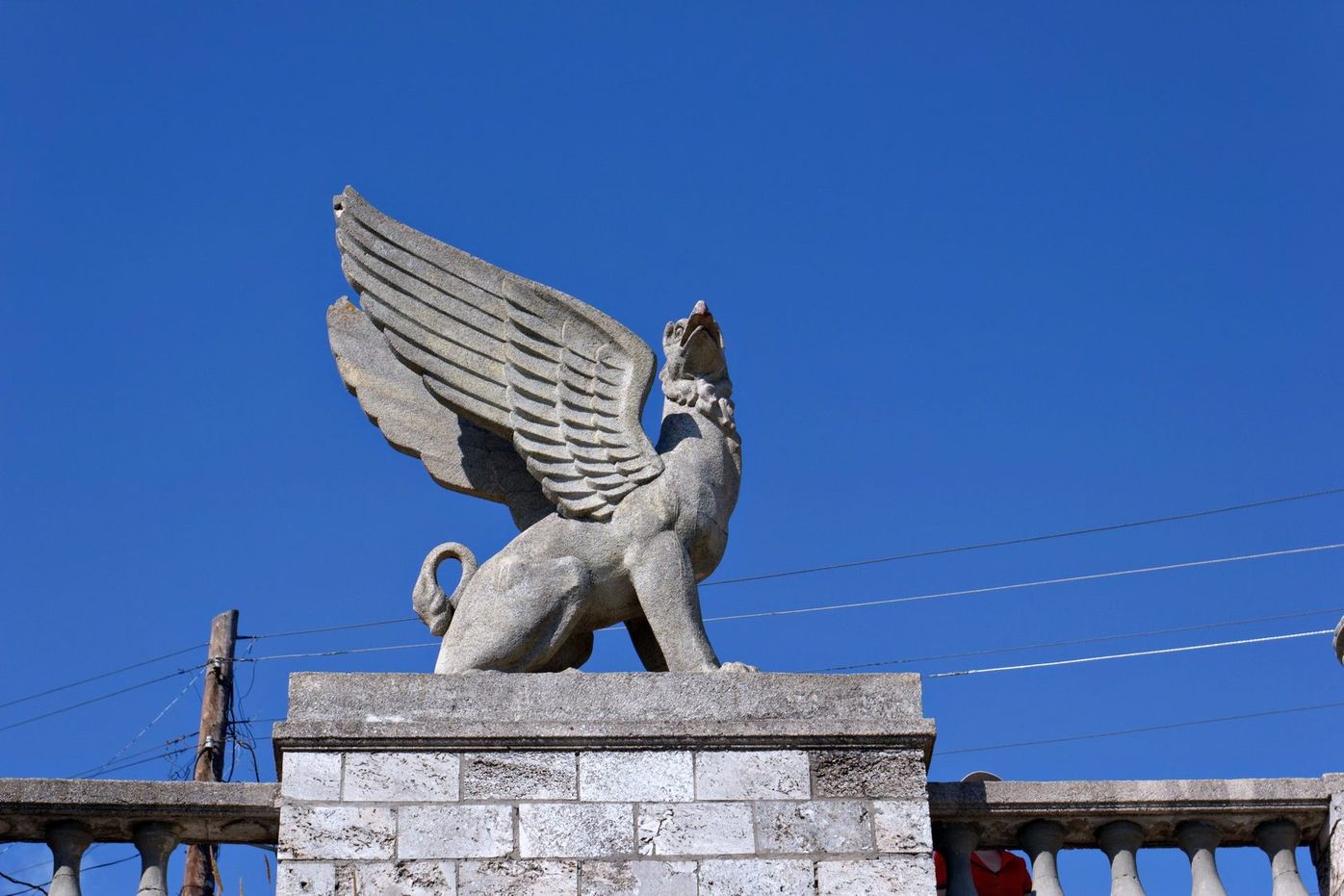
Griffin — symbol of the city. Great Mithridates stairs
In August 2016, V. Tolstikov made a report at the international conference "Archaeology and History of the Bosporus" on findings that allow determining the age of Kerch at approximately 2,650 years. In execution of Aksyonov's instruction, at the end of 2016, the director of the East Crimean Historical and Cultural Museum-Reserve, T. Umrikhina, prepared documents for the Presidium of the RAS and government structures of the Russian Federation for the official recognition of the date of Kerch's foundation in the interval of 610-590 BC. Attached to them were relevant certificates signed by the Director of the A. S. Pushkin Museum of Fine Arts, M. Loshak, and V. Tolstikov, as well as the head of the department of field research of the Institute of Archaeology of the RAS, A. Maslennikov.
Russian scientists were not far behind their Crimean colleagues—the official protocol on the age of Kerch was prepared by historians of the "V. Vernadsky Crimean Federal University" led by the head of the department of history of the ancient world and the Middle Ages, archaeologist A. Gertsen. In June 2017, Russian media actively disseminated Umrikhina's statement that after V. Tolstikov's report, the academic council of the Institute of Archaeology of the RAS recognized that the turn of the 7th-6th centuries BC can reasonably be spoken of as the date of Panticapaeum's foundation during the Miletus colonization, and therefore, "there is no older city in Russia than Kerch."
However, the bureaucratic machine of Russia works slowly. While T. Umrikhina back in 2016 proposed to the leadership of Russia to officially celebrate the 2,600th anniversary of Kerch in two years, at the beginning of that same year 2018, she said that the process of official recognition of the city's new status is complex and a lot of "paper" work needs to be done. On the other hand, the ideological machine of Russia works much more promptly. In the East Crimean Historical and Cultural Museum-Reserve, the exhibition "Kerch – the Oldest City of Russia" was opened.
In the summer-autumn of 2018, an exhibition of the same name operated in Yekaterinburg; as had become habitual, in violation of the law and simply civilized norms of handling cultural values, items of the museum fund of Ukraine were exhibited at it. And while these ideological games continued, immediately after the annexation of Crimea, problems began for the iconic monuments of Kerch—the city's landmarks.
The first to begin crumbling was the famous creation of the Italian architect Digby—the Mithridates Stairs, which lead from the central square of the city to the top of Mount Mithridates. In 2016, during Putin's visit to Kerch, the Crimean leadership promised him that the necessary works would be carried out promptly, but de facto the situation only got worse after a huge number of piles were driven by "restorers" directly into the cultural layer of Mithridates. In 2018, the Obelisk of Glory—the first monument of the Great Patriotic War (1944)—began to collapse.
At the beginning of 2019, according to one version, due to the threat of collapse, the columns of the ancient portico on Mithridates were dismantled and temporarily removed, and according to another—they fell and suffered damage. Should we expect problems next year with the oldest active Byzantine church in Ukraine—the Church of St. John the Baptist, located in the center of Kerch?
This is not known, but there is no doubt that Russia will continue to actively use the cultural resources of the occupied Ukrainian territories in the war against Ukraine. And without regard for common sense and law. The war continues, and the Kremlin's ideological machine spins the flywheel of war propaganda, despite all the changes on the ruling Olympus of Ukraine. The state that suffered Russia's aggression, and the world, should prepare for a prolonged struggle to restore the rule of international law, since the Russian leadership has set itself to implement a long-term strategy to change the world order...
Supported by the Ukrainian Cultural Foundation