One Step from the Abyss
The Swallow's Nest is the undisputed landmark of all Crimea.
Valeriy Verkhovskyi. Newspaper "Krymska Svitlytsia", 2019, Issue No. 49-50
"The Swallow's Nest, although not built by Goths or Genoese, and not in ancient times, but at the beginning of the 20th century, is already an integral part of the Yalta landscape and, undoubtedly, a unique landmark of all Crimea."
Can the incompatible be combined? Here is a vivid example of how this was usually done and is being done in Crimea: a Gothic castle of a Russian baron named von Steingel, owner of oil fields in Baku, designed by a Russian architect of English descent and built on the Aurora cliff, on Cape Ay-Todor (St. Theodore). All in one: a Roman goddess, an Orthodox saint, and a Russian German from Azerbaijani Baku... And it should also be added that for some time—from 2002 to 2011—a restaurant of Italian cuisine was located in the Swallow's Nest.
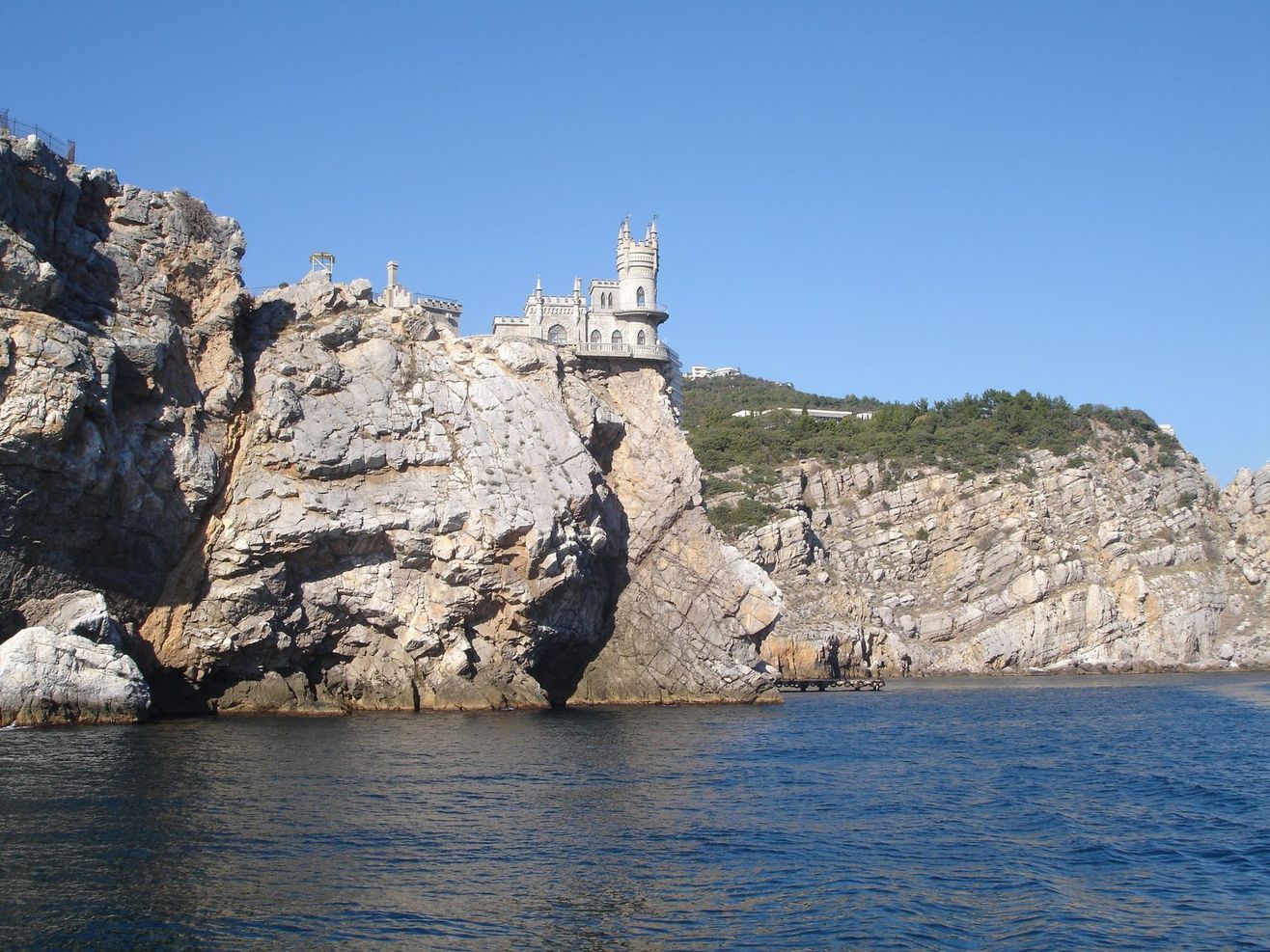
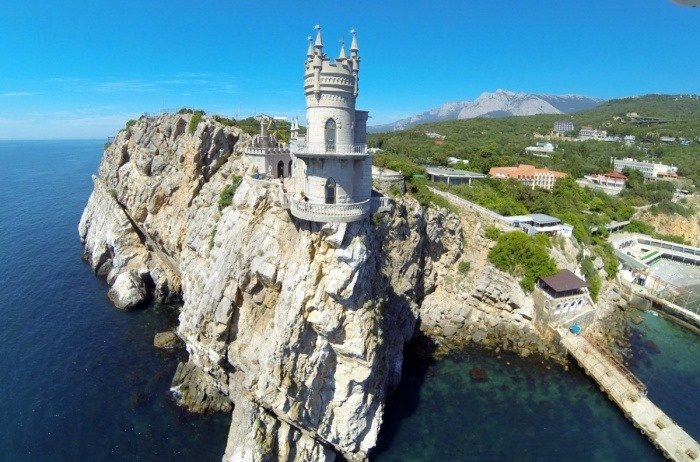
Before Steingel, who built this very Gothic castle likeness we know here, a wooden building stood on the Aurora cliff, originally called the "Castle of Love," and around 1902 the new owner completely rebuilt this house, and from that time it received its modern name. In 1912, Baron von Steingel bought the wooden Swallow's Nest and demolished it, building a stone castle with crenellated towers and loopholes in its place. The architect of this masterpiece was Leonid Sherwood. Since the piece of land suitable for construction on this cliff was only 10x10 meters, the castle turned out to be quite compact, but a concrete foundation was still poured for its construction, on which everything rests. It stands, despite all misfortunes, wars, and natural disasters.
In 1927, an earthquake occurred in Crimea. Although the castle itself was not damaged, a very significant piece broke off from the Aurora cliff and fell into the sea, and a crack was formed that threatened the entire cliff.
In this state, the Swallow's Nest remained for four decades—until 1967, when restoration work finally began to be carried out here. A powerful crane was needed, but the access roads turned out not to be designed for the passage of such large machines. The work was extremely risky: builders in cradles suspended from the cliff manually laid stones and poured mortar into the crack in the cliff. A new reinforced concrete slab was placed under the structure, and the joints were filled with lead. Only after this, when one could not worry about the foundation of the Swallow's Nest, did the restoration of the palace itself begin. It was after that reconstruction that conical domes appeared on the towers. Today, the castle is officially recognized as an architectural monument of the 20th century.
The Swallow's Nest became an attractive tourist destination. Its image, recognizable and unique, can be found on postage stamps and postcards, calendars and coins, in movies and TV series.
Even the Cook Islands (a self-governing New Zealand territory in the Pacific Ocean) ordered a collectible coin of one Cook Islands dollar, on the obverse of which are depicted Queen Elizabeth II and... Ayu-Dag, and on the reverse—the Swallow's Nest. Boasting their "victory" over Ukraine in seizing Crimea, the Russians also issued a coin with a face value of 10 rubles with the silhouette of the Swallow's Nest on the obverse, and later—a hundred-ruble banknote depicting this palace.
In addition to Soviet, and later Ukrainian and Russian filmmakers, this outdoor shooting location was also liked by foreigners: these are the films "Mio in the Land of Faraway" with Christian Bale, "The Blue Bird," and in 1996 an episode of the movie "Police Story 4: First Strike" with Jackie Chan was filmed here.
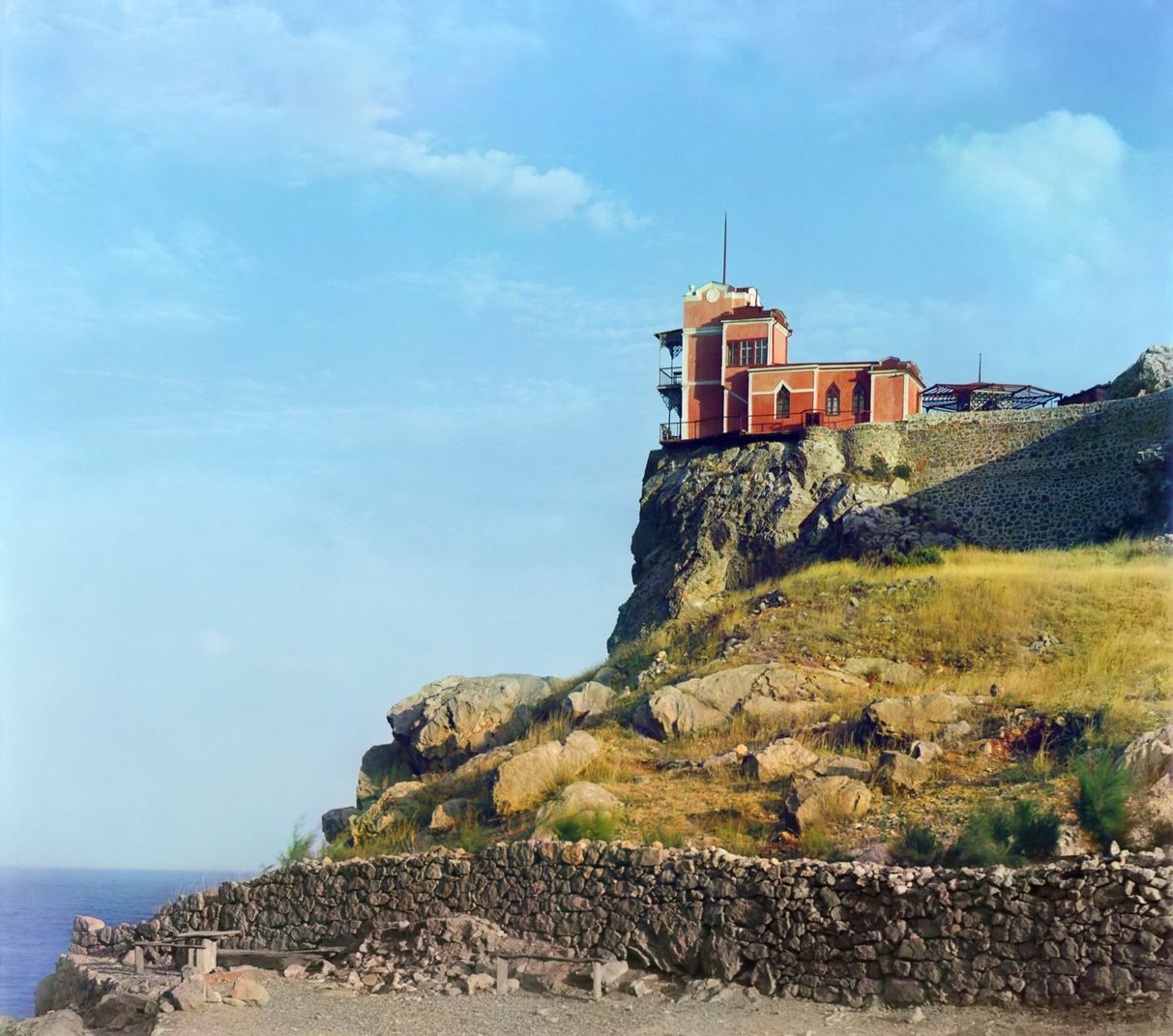
Building on Cape Ay-Todor at the beginning of the 20th century. Photo by S. M. Prokudin-Gorsky
The palace had needed another reconstruction for a long time. Back in 2013, cracks were found in the slab laid in the foundation of the palace, because of which visitor access was suspended in the autumn of that year.
In 2014, "spring" came to Crimea, the peninsula was occupied, and all historical monuments were proclaimed Russian property. Demonstrating considerable concern for the preservation of the captured assets, the occupiers took up the reconstruction of the Swallow's Nest.
The head of the ministry of culture in the collaborationist government of Crimea, Arina Novoselskaya, characterized the state of affairs with the Swallow's Nest frankly and unambiguously: "Absolutely critical danger"...
However, these words can describe the situation of the entire Crimean historical and architectural heritage. And if the Ukrainian authorities can be blamed for cautious inaction, they at least did not disturb the eternal sleep of Crimea's monuments; the Russian construction "hyperactivity," with millions in budget injections and under-the-table distribution of state contracts, is a much worse and more dangerous thing.
"This is a gross violation of the 1954 Hague Convention for the Protection of Cultural Property in the Event of Armed Conflict. The Convention and its First Protocol (1954) forbid any archaeological excavations on the occupied territory, as well as any alteration of cultural property," the UNESCO report says.
In 2015, the Ministry of Culture of Ukraine called the actions of the current authorities of the peninsula regarding cultural heritage sites protected by the laws of Ukraine and entered into the State Register of Immovable Monuments of Ukraine illegal. But the occupiers and their local accomplices are confident that they came forever, so they continue to do their thing.
During the research work in 2017 to find out the state of the cliff base, the cliff under the palace was drilled. These actions caused protest from Ukraine and concern in UNESCO. "It became known that the occupation authorities proceeded to conduct illegal excavations and engineering geological works, namely: to drill the cliff on which the national monument, the Swallow's Nest palace, is located," says the UNESCO report for 2017.
Any drilling work means constant vibration and a continuous flow of washing fluid under high pressure. The first causes new cracks in the rock of which the cliff is composed and the concrete foundation of the Swallow's Nest; the washing fluid penetrates all existing cracks in the cliff, which can lead to their deepening.
Fortunately, so far it has been without catastrophes. But after the research work, the reconstruction of the building itself begins, and it is still unknown what the consequences of careless and incompetent interference might be.
"The restoration of the castle has begun—fully—interior and exterior, up to landscaping lawns and the observation deck. Air heating, electricity, and lighting systems will be fully arranged. In addition, the illumination of the Swallow's Nest will be installed," the same Arina Novoselskaya says.
However, UNESCO has a different opinion: "The greatest concern is caused by the fact that these restoration works are carried out under the guidance of construction personnel who have neither experience nor qualification in the field of restoration of historical buildings."
LLC "Meandr," the notorious "pocket" firm of the RF Minister of Culture Medinsky, got the contract for the preparation of project documentation, and the tender for the execution of repair and construction work was won by LLC "Design" from Cheboksary. Unfortunately, this firm has no experience in such complex work on such a unique object. That is, they will acquire experience in the process of work. If it works out, it works out, and if it doesn't, then apparently the Ukrainians will be to blame for letting the federal-significance cultural monument fall into disrepair.
On the ceiling joists on the first floor of the Swallow's Nest, destruction of the protective layer of concrete and corrosion of reinforcement were found. These defects are associated with the influence of atmospheric precipitation and the long absence of repairs. Some sections of the floor slabs are assessed as critical.
According to the plan, the restoration and repair of the Swallow's Nest should last until the autumn of 2020; almost 80 million rubles have been allocated for them.
In the balcony slab on the first floor (part of which dramatically hangs over the sea), many half-centimeter cracks were found, the protective concrete layer has chips up to three centimeters, weathering is occurring, and the cliff base of the building is cracking, with some cracks reaching fifteen centimeters.
Back at the beginning of last year, the Prosecutor's Office of the ARC initiated proceedings on the fact of illegal archaeological works, intentional destruction, demolition, and damage to historical and cultural monuments on the territory of Crimea annexed by Russia under Articles 298 and 341 of the Criminal Code. This concerns the issuance by the Ministry of Culture of the RF of permits for archaeological excavations, as well as restoration work on architectural monuments in Crimea, as a result of which these objects suffered irreparable damage. In particular, the Swallow's Nest is mentioned among other monuments.
It is unknown whether the architect Sherwood and his client Steingel expected their creation to be able to stand for a hundred years or more. But if the Swallow's Nest has held out on this cliff to our time, one would not want our period to remain in history as an era of losses and destruction.
Any ancient architectural structure remains in danger of destruction from ill-conceived or irresponsible actions of modern rebuilders, but the Swallow's Nest stands out among all historical monuments on the territory of the occupied peninsula by its very essence—this fairy-tale castle is frightening to look at. It towers over a vertical cliff, showing a challenge to the forces of nature, and risks losing to them, falling into the sea, but it does not give up.
Daily struggle, minute-by-minute resistance to unfavorable circumstances—that is what the Swallow's Nest is. That is why it is indeed a symbol of Crimea—enslaved, but unconquered.
Supported by the Ukrainian Cultural Foundation