The Crimean Lavra: On the Border of Two Worlds
Surrounded by the inaccessible Crimean Mountains, not far from the city of Bakhchysarai, in the Maryam-Dere (St. Mary) gorge, a unique active male Holy Dormition Monastery is hidden.
Yevheniia Borysenko. Newspaper \"Krymska Svitlytsia\", 2020, Issue No. 11
Surrounded by the inaccessible Crimean Mountains, not far from the city of Bakhchysarai, in the Maryam-Dere (St. Mary) gorge, a unique active male Holy Dormition Monastery is hidden. The cliffs around it are covered with greenery dried in the hot Crimean sun—an incredible creation of the pristine Crimean flora.
The question of the time of the emergence of the cave church of the Dormition of the Most Holy Theotokos and the monastery itself remains open. According to one version, the monastery was founded by Greek monks who in the 8th–9th centuries, along with thousands of Christians—supporters of icon veneration—fled from Byzantium to freely practice the Christian faith. The first monks who settled here hollowed out a church and cave-cells in the wall. The location of the monastery turned out to be interesting and advantageous: it existed as if on the border of two worlds—Christian and pagan.
In the valleys not far from the monastery, archaeologists discovered Christian burial grounds dating back to the 6th century. These finds indirectly confirm this version: if Christian settlements existed, then the believers needed churches to hold services. Christian settlements coexisted with pagan ones of the Alano-Gothic tribe. This allowed the first monks to engage in missionary activity, bringing the light of the Divine revelation to local tribes.
It is precisely to the period of the 8th–9th centuries that the emergence of the first vivid stories about the appearance of the miraculous icon of the Mother of God on the Dormition cliff dates back. According to one legend, the icon was found on the cliff by a shepherd named Mykhailo, belonging to a local Mangup prince who twice carried the shrine to his house, but the image returned to the cliff in a miraculous way. Realizing that the Mother of God wanted to leave her icon on the cliff, the people built a cave church named Dormition for the image. According to another legend, the appearance of the image of the Mother of God on the cliff saved local residents from a terrible dragon that attacked people and livestock.
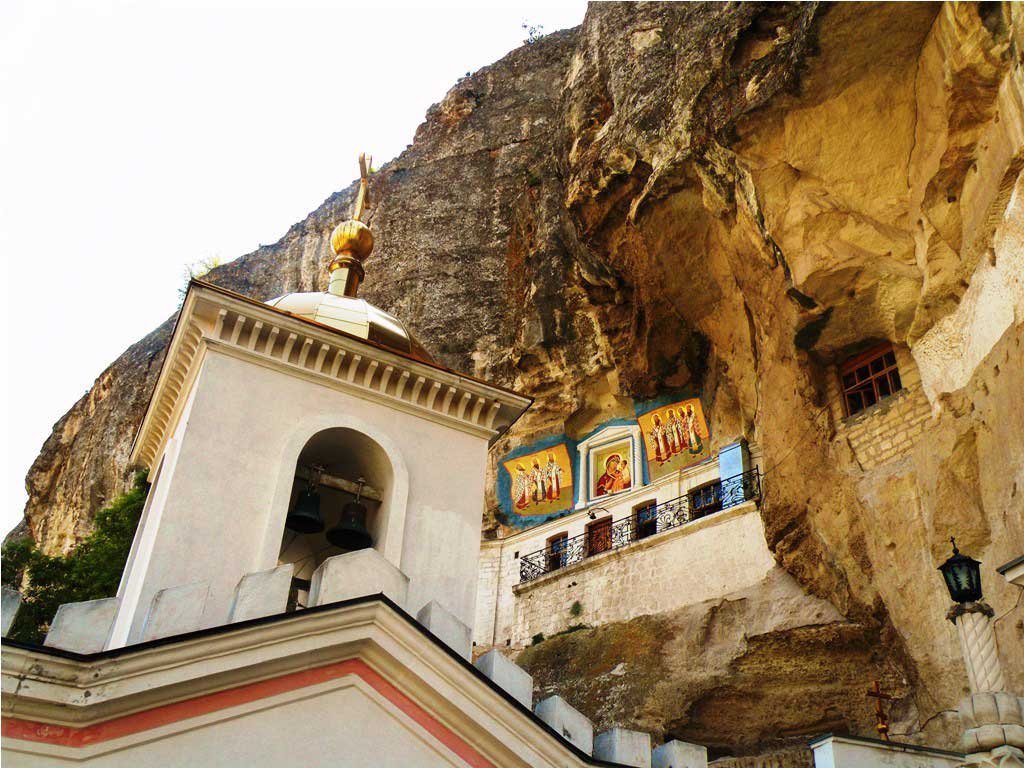
Holy Dormition Monastery
The oldest documentary mention of the monastery belongs to the 16th century. "The Monastery of the Most Pure Mother of God on Salachik"—this is exactly how the Dormition monastery is named in the charter of Tsar Fyodor Ivanovich dated May 27, 1596, which indicates that the sovereign sent 15 rubles of alms to the brethren.
In the 11th–14th centuries, according to some researchers, the monastery was located in caves near the southern gates of the Chufut-Kale fortress, but after its capture by the Turks in 1475 it was moved to a new location. This version was also supported by the famous researcher of Crimea A. Berthier-Delagarde, referring to manuscripts that have not survived to our days.
At the end of the 15th century, the monastery became the residence of the Gothia-Kaffa Metropolitans and the center of Orthodoxy on the peninsula. The grace of the monastery was so great that it was honored not only by Christians but also by Muslims: they called the monastery Mairim-Anay (Mother Mary), and the entire gorge where the monastery is located—Maryam-Dere (Mary's Gorge). Some Crimean khans, after successful campaigns, made rich gifts to the image of the Mother of God in the monastery.
At the beginning of the 20th century, the monastery had 5 churches, namely: the Dormition Cave Church, the Cave Church of St. Mark, the Church of St. Innocent of Irkutsk, the Church of Sts. Constantine and Helen, and the Cemetery Church of St. George the Victorious. In addition to churches, many cells and outbuildings, the house of the father superior, and a house for pilgrims were built here, and an orchard with a fountain was laid out. During this period, the monastery experienced a real bloom, with more than 50 monks living in it.
After the revolution of 1917, the monastery existed for several more years. However, in 1921, the authorities closed the hermitage as a \"nest of counter-revolutionary underground\" and destroyed a significant part of the church property. A labor colony for disabled people named after Artem was established on the territory of the monastery.
As a result of ignorance and indifferent attitude to historical, especially church, shrines in the first years of the new government, magnificent monuments perished: the churches of Saints Constantine and Helen, Mark the Evangelist, Innocent of Irkutsk, and George the Victorious. By 1929, five churches and chapels of the monastery were dismantled, and the interior decoration of the cave church of the Dormition of the Mother of God was desecrated and looted.
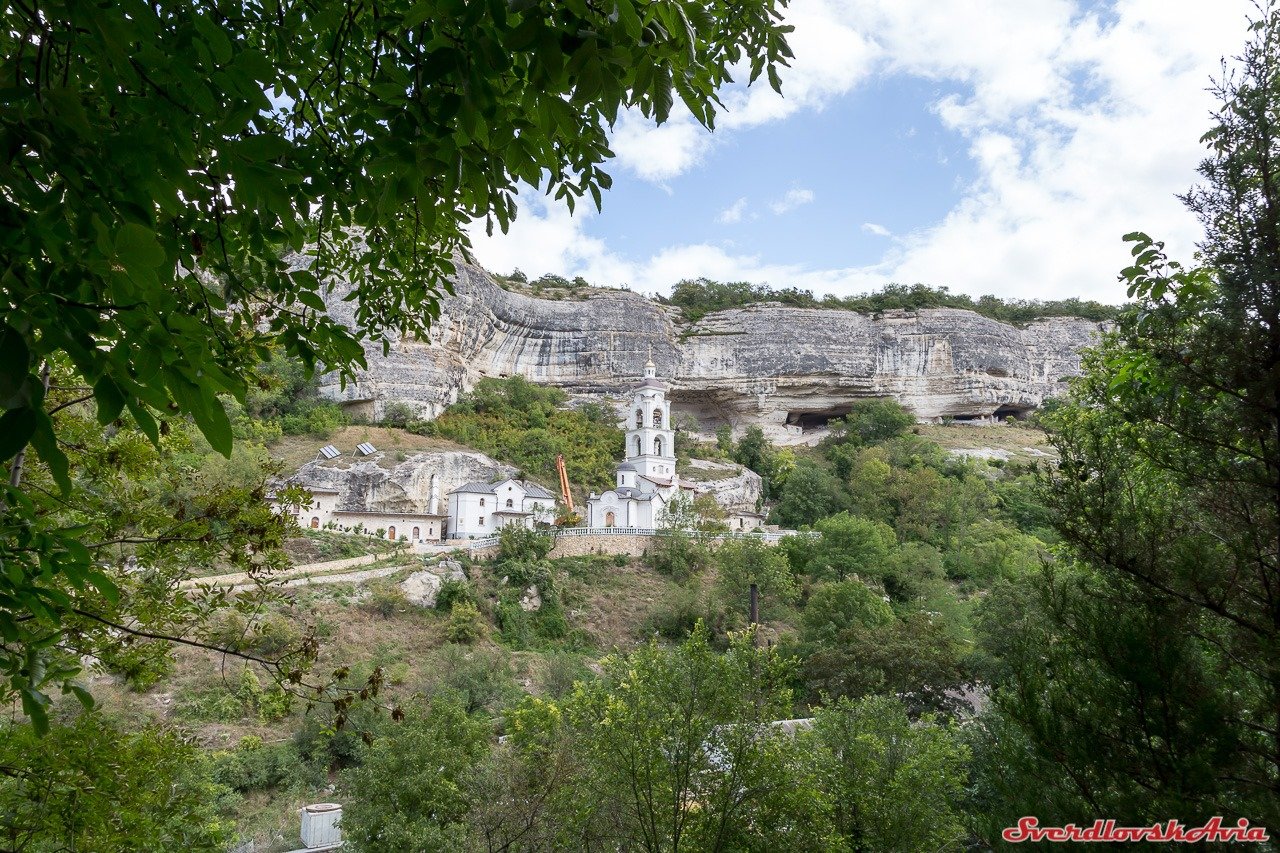
Church of George the Victorious, with the cliffs of the Burunchak plateau towering above it, where the cave town of Chufut-Kale is located
The fate of the miraculous Bakhchysarai Icon of the Mother of God also turned out to be tragic. Carried away in 1778 by the Greeks from the monastery during their mass deportation from Crimea, it was located until 1918 \"near Mariupol of the Katerynoslav Governorate, in the Dormition Church,\" and after that its traces disappear.
During the years of the Second World War, the abandoned monastery again, as during the defense of Sevastopol (1855–1856), provided shelter to wounded soldiers. In the military cemetery next to the graves of soldiers who fell during the Crimean War, new ones with red stars appeared—soldiers who liberated Crimea from fascist invaders. In the 1970s–1980s, a psychoneurological boarding house was located on the territory of the monastery.
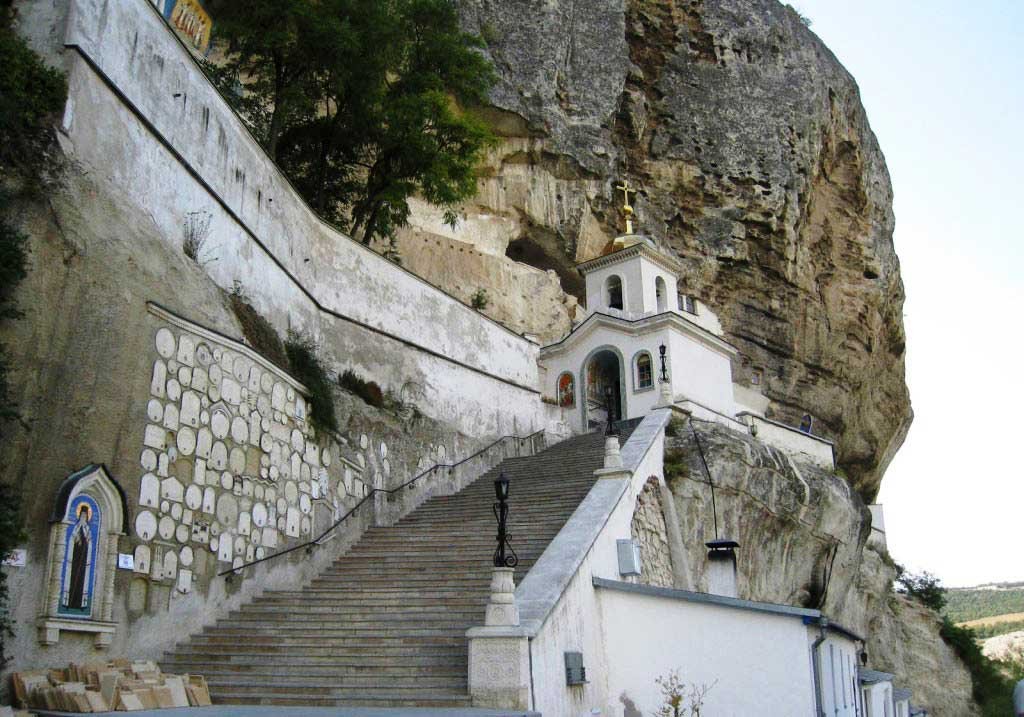
A new revival of the Holy Dormition Monastery began in 1993. Currently, the cave Dormition Church and the stairs leading to the upper tier of the monastery and the cells have been restored, the rock icon painting above the balcony of the Dormition Church has been restored, and its dome shines with gold. And the road to Chufut-Kale, along which hundreds of tourists pass every day, is enlivened by the ringing of its bells. The lost image of the Bakhchysarai Icon of the Mother of God has also been restored. The newly painted copy exactly repeats the original and is currently located in the main temple of the monastery. In addition, the icons of the Mother of God \"Of the Three Hands\" and \"Pantanassa\", as well as two reliquaries with the relics of saints, are venerated in the monastery.
An incredibly beautiful place, majestic grace, fresh air, luxurious architecture—here, in the Holy Dormition Monastery, on the border of two worlds—Christian and Muslim, the breath of history is felt like nowhere else. It is not for nothing that this place is one of the most revered Orthodox shrines of the peninsula, also called the Crimean Lavra or the Crimean Athos.