Coastal Stars of Crimea
Crimean lighthouses standing guard over peace and quiet.
Maksym Dubovyaz. Newspaper "Krymska Svitlytsia", 2017, issue No. 30
Latin preserved the saying of the ancient Romans "Navigare necesse est", which translates into Ukrainian as: "to sail the seas is necessary". But the Romans were not the first to sail the seas. The history of this occupation is lost in the centuries. At night, the stars guided the helmsmen of ships; away from the shore, they remained almost the only guides.
But natural guideposts are not enough for a person at sea. Therefore, a fire was once lit on the shore. Thus, lighthouses appeared on the shores of many seas. Lighthouses are still working today; this is a necessary safety element, and like everything associated with the romance of the sea and travel, they still attract attention.
There are about a hundred of such objects in Crimea. A quarter to a third of them remain relevant to this day. A few can be safely included in the list of objects that are interesting not only in cognitive terms, but also aesthetically.
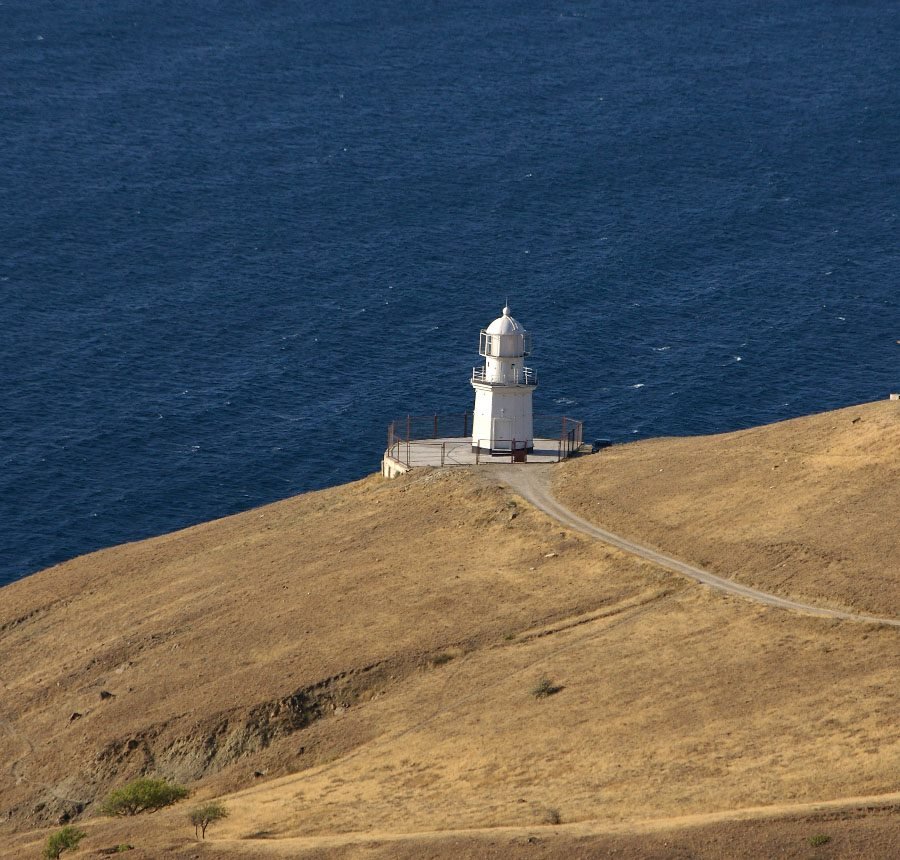
Meganom Lighthouse
There are about a hundred of such objects in Crimea. A quarter to a third of them remain relevant to this day. A few can be safely included in the list of objects that are interesting not only in cognitive terms, but also aesthetically.
It is difficult to determine the most beautiful one. Here is the lighthouse of Cape Ai-Todor. At the top of the cape, it does not need additional height. It is squat, old-fashioned. It was built back in 1835.
Among the old lighthouses, Tarkhankut Lighthouse stands out, which was "modernized" twenty years ago. Exactly so, "modernized", because signaling structures must definitely be in that dangerous place. Ancient ships perished in those waters because of a treacherous, invisible, almost three-kilometer shoal, and in the ancient Genoese sailing directions, the cape was named "Rossofaro", which means "Red Light". After the completion of the 36-meter tower, lamps ordered from Britain were installed on it, which shone with a "steady white light, providing a visibility range of up to 12 miles," as the "History of Tarkhankut Lighthouse" states. Yes, the lighthouse has its own chronicle, with strange stories resembling a legend. This lighthouse is tall, but not the tallest.
The Evpatoria Lighthouse has the tallest tower on the entire Black Sea coast. Despite the fact that this place has been populated since ancient times and is quite dangerous for navigation because it is just barely above sea level, no ancient signaling structures have survived here. Only in 1861, at the numerous requests of local sea merchants, a signaling metal structure was built here. Later, it was replaced by a 20-meter stone tower that appeared immediately after the Second World War. The current 52-meter structure was erected only in 1970.
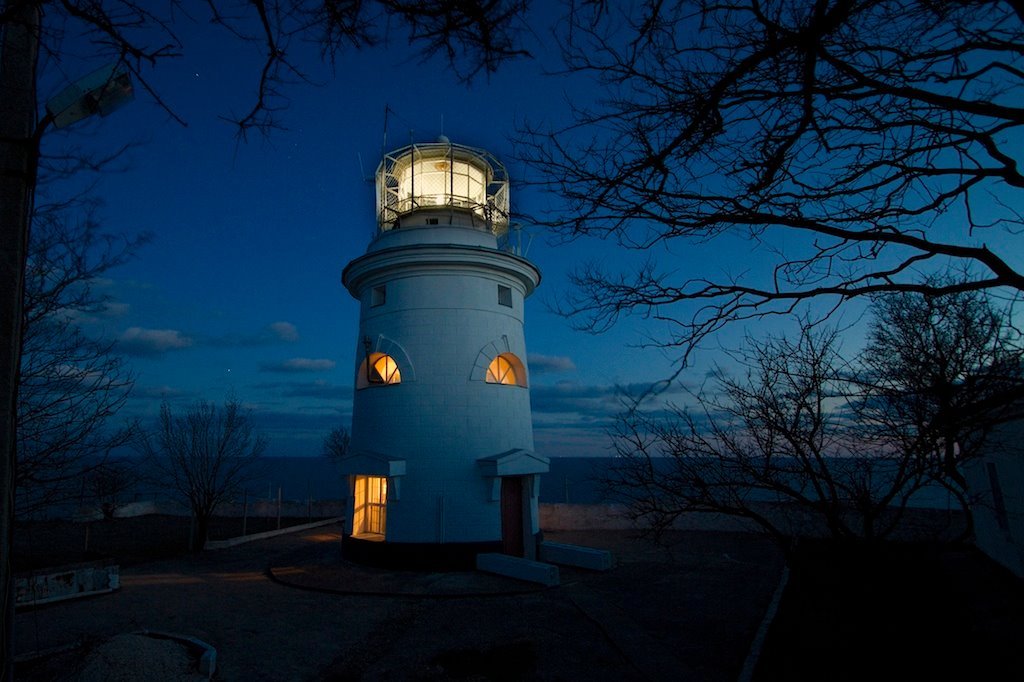
Ilinsky Lighthouse
In general, the primary and main purpose of lighthouse structures is to carry fire to a sufficient height. Therefore, their towers are marked by the charm of minimalism. There is no point in decorating a structure that usually stands in a not very populated area. It is this sparse elegance of architecture that makes some lighthouses aesthetically attractive as well.
Although a structure reduced to complete pragmatism may not be aesthetically pleasing, like most mast-type lighthouses, it must be recognizable during the day. For this purpose, they are usually painted in a typical way: red and black horizontal stripes on a white background. Where this is no longer relevant, they remain pristine white, like the Ai-Todor Lighthouse, the Meganom Lighthouse (the most romantic in Crimea), the Ilinsky, and the Tarkhankut Lighthouses.
There are exceptions, such as the new temple-lighthouse in the village of Kuchuk-Uzen (Malorichenske). This is a masterpiece of architecture in the full sense! And not only architecture. It was a complex and controversial political-business and corrupt process. First, it is clearly visible that another lighthouse was already very close. Second, the construction, which cost about five million dollars, was financed by the National Reserve Bank of Russia and consecrated by the highest hierarchs of the Ukrainian Orthodox Church (Moscow Patriarchate). The process was directly managed by a certain Aleksandr Lebedev, a millionaire from the top hundred of Russia's rich, and also from the top ten of local patrons.
But unofficial public opinion considers the famous architect Anatoliy Haidamaka to be the author of the temple-lighthouse project, although in public sources about his participation in the project it is said that "He is the author of the Memorial to those who died at sea (Crimea, 2005–2006)". Indeed, the Malorichenske church complex is a temple, a lighthouse, and the mentioned memorial. One could speak beautifully about Ukrainian-Russian cooperation on the example of this extraordinary object, if not for the same unofficial public opinion. There are rumors that this "donation" was connected with granting the very same millionaire permission to build a rather large boarding house right on the Black Sea coast in the neighboring seaside village of Tuak (Rybache), almost at the foot of the old Tuak Lighthouse.
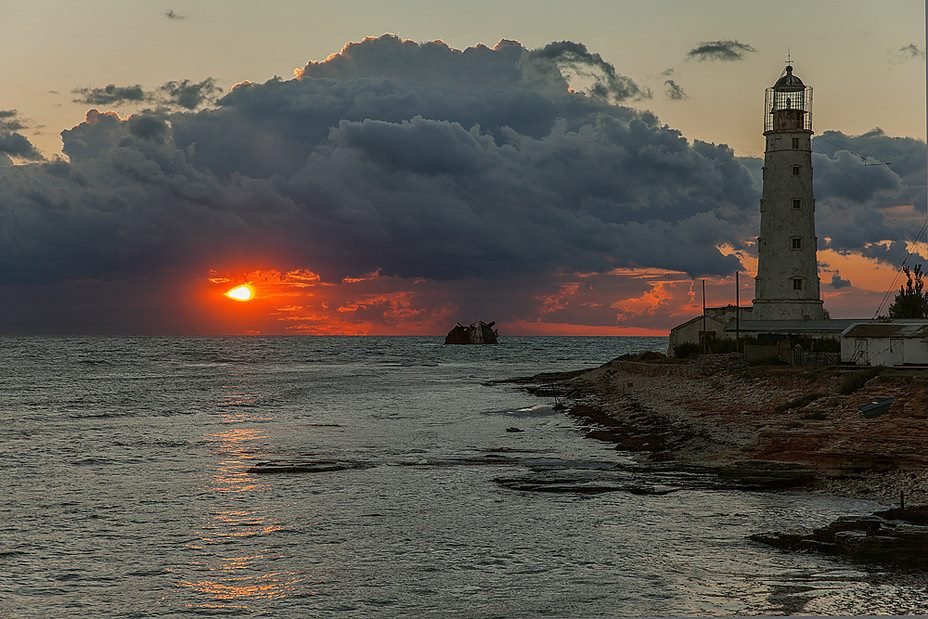
Tarkhankut Lighthouse
According to modern sources, for the last quarter of a century, the Crimean coastal guideposts have been a permanent subject of dispute between the relevant departments of Ukraine and the Black Sea Fleet of the Russian Federation. Eventually, the Russian Federation brazenly appropriated them. The summer before last, they were even studied by the Russian Geographical Society; some beautiful photos from this expedition illustrate this post as well. But time goes on, everything changes, and the lighthouses shine at night and tower during the day, for navigare necesse est.