Mosques of Southeastern Crimea in Drawings and Lithographs
Vincent Roussin: enchanting drawings of Crimean mosques.
Roza Krymska. Newspaper "Krymska Svitlytsia", 2018, issue No. 51
The southeast of Crimea is unique from the point of view of the medieval history of the peninsula, but not as popular among visitors as the Southern Coast. And if people drop by Feodosia at least to visit the Aivazovsky Gallery and lie on the sands of the Golden Beach, then Staryi Krym resembles more of an urban-type settlement. But both cities and the surrounding villages are united by a single historical leitmotif: it was in these places that important events of Muslim Crimea took place.
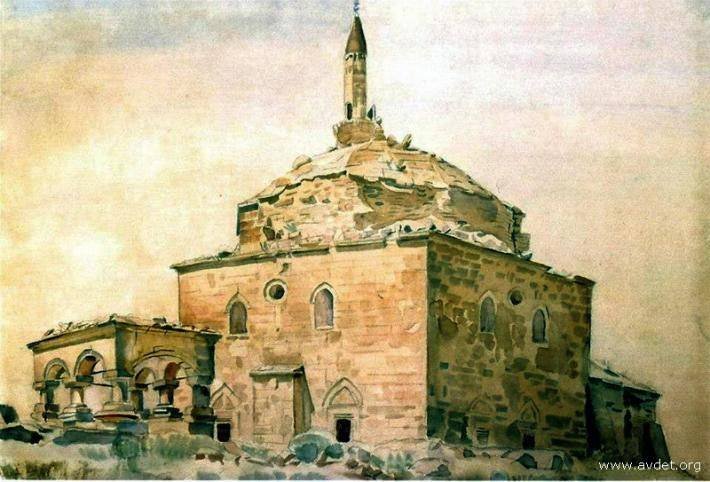
Mosque in Kolech, Konstantin Bogaevsky
Today, associations with Crimean Tatar culture are geographically linked precisely with Bakhchisaray, that is, with the west of the peninsula. At the same time, people forget (or do not know) about the role of the southeast. While Staryi Krym (Qırım, Solkhat) in its heyday (14th century) was compared to Damascus, Feodosia (Kefe) was called nothing other than "Kuchuk-Istanbul", that is, "little Istanbul", because the city belonged to the Ottoman Empire and, before the arrival of Russia, was the second most important in the Black Sea and the first in size on the entire Crimean Peninsula.
But the change of power led to radical transformations: for example, the majority of the Muslim population emigrated from Feodosia, and at the beginning of the 19th century, the mosque of Sultan Selim, Buyuk Cami, was dismantled (ironically, the mosque was built on the site of a Byzantine church, and already during the Russian Empire, in 1870, the Alexander Nevsky Cathedral was erected here, which was destroyed by the Soviet government literally half a century later).
Fortunately, not all monuments were destroyed. This is evidenced by the drawings and lithographs of the Feodosia artist of French origin Vincent (Vikentiy) Roussin. Here you can see mosques of which only foundations remain today – the Karagoz and the mosque in Kolech-Mechet.
A lithograph depicting a mosque in the settlement of Karagoz (after 1948 – the village of Pervomayske in the Kirovsky district) was created in 1843. On it we can see peasants walking (and some riding) to the mosque – a rectangular building with a tiled dome-shaped roof traditional for Crimean Tatars and a minaret. The Karagoz Mosque is one of the oldest monuments of the Golden Horde period, a typical example of Ottoman architecture. It was dismantled in Soviet times.
Similar to the Karagoz Mosque is the mosque in Kolech, which disappeared together with the settlement. Today, Kolech-Mechet is the southern part of the village of Novopokrovka in the Kirovsky district. The mosque has remained on pencil drawings – sketches for lithographs. It is also characterized as an example of Ottoman architecture built during the Golden Horde. Interestingly, it was renovated around 1917, but the monument was destroyed during the Civil War. And in the 1950s, in the process of replanning the village of Pokrovka, the mosque was dismantled.
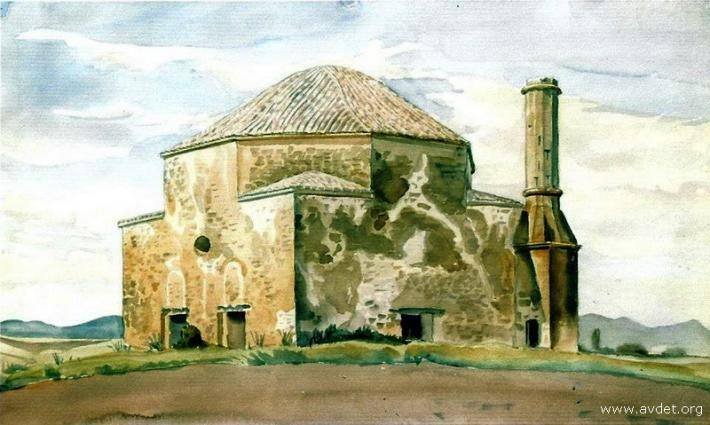
Karagoz Mosque, Konstantin Bogaevsky
Of course, Vincent Roussin did not ignore the famous mosque of Khan Uzbek of 1314. In several pencil drawings, it can be seen that this monument was in a much worse condition than the previous two. A broken courtyard and a ruined minaret top, the ruins of a madrasa – all this is disappointing. But Uzbek's mosque was the most fortunate: the building and the area around were restored back in the 20th century, and today this amazing architectural monument gladly welcomes tourists. Khan Uzbek Mosque has a rectangular shape with a gabled tiled roof, which is typical of Anatolian mosques. But the mosque is most remembered, of course, for its unusual entrance: a kind of stone niche framing a carved wooden door.
Today, the Uzbek Mosque is the oldest surviving mosque in Crimea, despite everything. Although, of course, these are only remnants: there were more than a thousand mosques in Crimea. In the context of the conversation about painting and historical monuments of Crimea, it is impossible not to mention another Feodosia artist – Konstantin Fedorovich Bogaevsky.
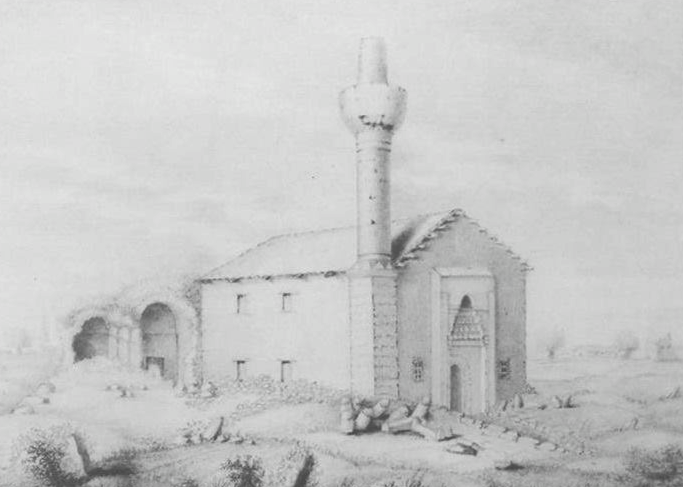
Khan Uzbek Mosque, Vincent Roussin
Bogaevsky's watercolors differ significantly from Roussin's drawings, but both artists depicted iconic historical monuments of Muslim Crimea: the Karagoz and Kolech mosques. Bogaevsky's works were created in the 1920s. The artist depicted the state of both monuments at that time in quite detail, so we can see the changes that occurred since Roussin's time: the minaret of the Karagoz Mosque is already without a top, and the Kolech Mosque has suffered destruction.
It is known that K. Bogaevsky took part in excavations on the territory of the mosque of Khan Uzbek in 1926, which is indicated by watercolors depicting these places. Medieval Crimea is a mysterious Crimea. We know very little about it, and one of the few sources of information is fine arts. Therefore, the Feodosia artists Vincent Roussin and Konstantin Bogaevsky became true chroniclers of the medieval history of Crimea, who preserved a piece of the past for us.