A Grave for Mithridates
Kerch is the oldest city in Ukraine. It is already more than two thousand six hundred years old, so one can rightly speak of its status as an eternal city. However, even here there are certain myths that dominate, creating specific contexts.
Ivan Klepyk. Newspaper "Krymska Svitlytsia", 2019, issue No. 45-46
Kerch is the oldest city in Ukraine. It is already more than two thousand six hundred years old, so one can rightly speak of its status as an eternal city. However, even here there are certain myths that dominate, creating specific contexts.
For Kerch, these are three eras: antiquity of the period of the Bosporan Kingdom, the "annexation" of Kerch to the Russian Empire (the city found yourself within Russia in 1774), and the Second World War and the status of a hero city – the USSR.
The Middle Ages are covered in a shroud of mystery. The Byzantine period, for example, does not evoke such a large number of vivid images as Ancient Greece (although in the very heart of the city stands the Church of St. John the Baptist of the 8th century). The kaleidoscope of cultures and peoples that existed in Kerch before the first annexation of Crimea in the 18th century is also preferred not to be mentioned once again. But this is a topic for a separate conversation.
Currently, we will talk about Mount Mithridat, which in a sense is the center of the city: cultural, tourist, and even spiritual. To live in Kerch and never climb to the top of the mountain named after the glorious Mithridates Eupator is the same as living in Kyiv and never walking along Khreshchatyk. In principle, the same can be said about tourists. In both cases.
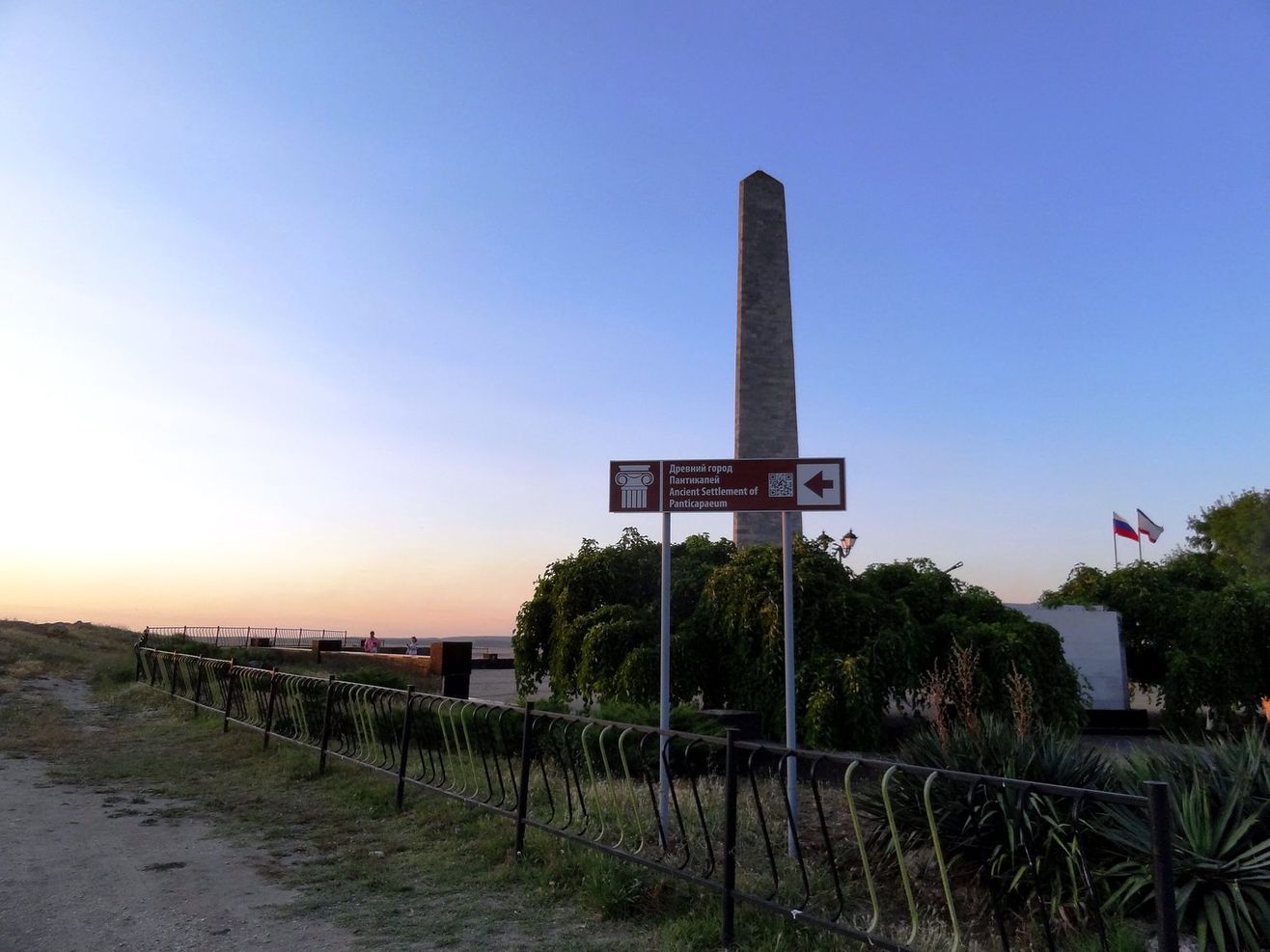
Mount Mithridat, as the highest point of the city, unites these three myth-making eras. The Obelisk of Glory is located here, built in 1944 from the walls of the Trinity Cathedral. The acropolis of ancient Panticapaeum stood here, which Pushkin so relentlessly wanted to see in 1820. And in order to see all this, one must climb the Mithridates Stairs – the Great or the Small.
The Mithridates Stairs appeared not so long ago: the Great Stairs were built in 1840, the Small in 1860. However, this is enough to be architectural monuments and landmarks of the city.
Their significance can hardly be overestimated, as the stairs to Mount Mithridat are important both practically and deeply symbolically. One of the most famous city governors, Ivan Stempkovsky, dreamed that the Great Stairs would unite the modern city and the ancient city. Unfortunately, he did not see the realization of his dream, as he died in 1832, a year before the first stone was laid.
During the Crimean War of 1853-1856, the Great Mithridates Stairs were damaged as a result of shelling from ships. A major restoration took place 130 years later. It was then that the griffins, destroyed in the 1850s, were recreated (gravures of that time served as a model). The project was headed by the famous Kerch sculptor Roman Serdiuk. And it was he who created the bowls that were copies of ancient ones – found during archaeological excavations.
The Small Mithridates Stairs (or Konstantinovsky Stairs), built with the assistance of the merchant Aleksey Konstantinov, are less noticeable because they are located slightly inland. Perhaps the townspeople do not even realize that these stairs were also built in the century before last (although a commemorative plaque hangs in the very center).
However, both the Great and Small Mithridates Stairs are in a terrible state.
This began in May 2014. It was then that Kerch journalists and residents noticed a huge crack on one of the walls. And just a year later, in June 2015, a part of the Great Mithridates Stairs collapsed, casually implying that things would only get better, more fun, and more cheerful from then on. At that time, no one could have imagined the consequences of this collapse.
Time passed, but nothing happened. Eventually, a miracle occurred that no one could have hoped for: on September 15, 2016, the President of the Russian Federation Vladimir Putin arrived in Kerch for a visit and promised fantastic money – 1.5 billion Russian rubles (at the moment of the promise, this sum was equal to 23,087,579 US dollars) for the repair of the stairs.
For the first time, Kerch residents learned about the power of the highest leadership of the occupying country. And for the first time, they learned about its empty promises.
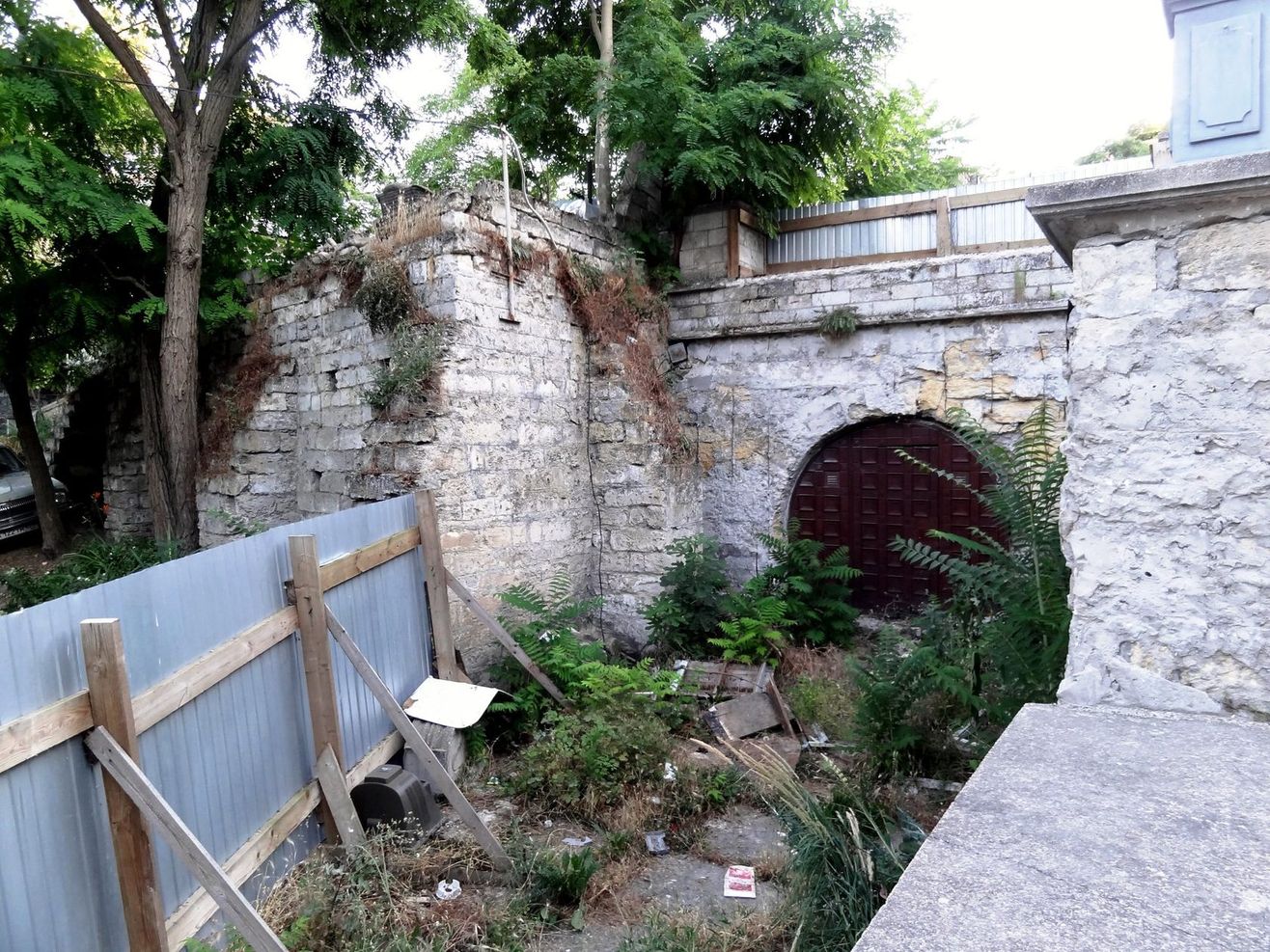
Here was once the entrance to the "Crypt of Demeter"
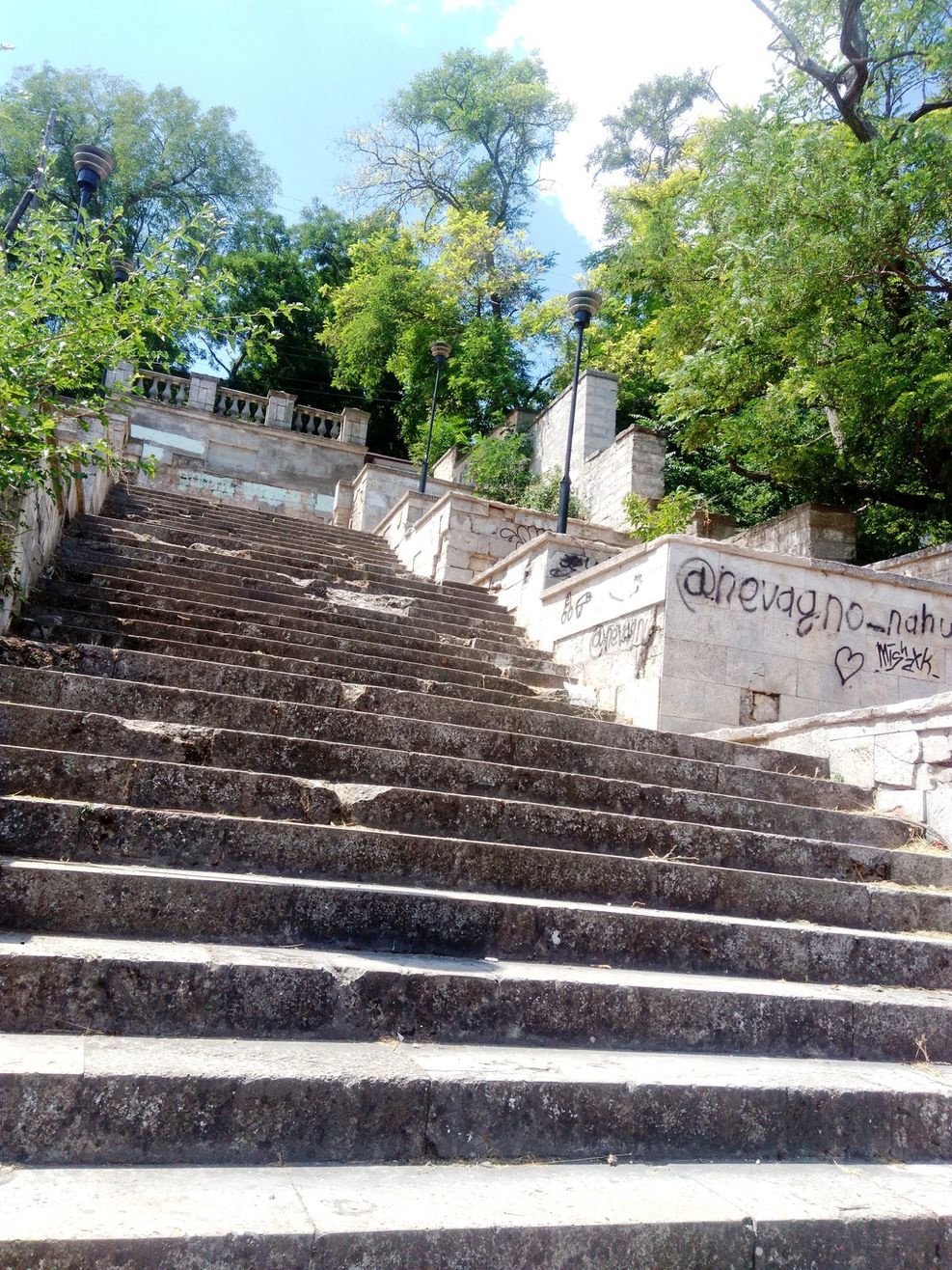
The Great Mithridates Stairs caused a huge resonance in the city. This is evidenced not only by the huge number of materials on local news portals, but also by conversations among the townspeople. Only a blind person could fail to notice that Kerch is crumbling before their eyes. But even a person deprived of the ability to see would still find out about the sad state of affairs, because everyone around was talking about it.
Yes, they spoke carefully, because they felt that this could turn into something bad. Only the overly brave could risk and scold the authorities in a public place. For example, once I happened to hear an elderly woman complaining while sitting in a trolleybus about the design works, on which 100 million rubles had been spent. "What did this money go to? – she asked the pensioners sitting around, – can you really spend so much on paper?". But no one answered her. This was 2018. The road part of the bridge across the Kerch Strait had already been opened. But the stairs, which began to decay before the project of the "construction of the century" was ready, just stood there. Silent, stripped, mangled.
More than three years passed when a tender was finally held and the winner was chosen – the St. Petersburg company "Meander". We find the announcement of this on July 7, 2017. For several more months, work on creating projects and soil research continued... Finally, the first emergency prevention works began in November, and the dismantling of tiles – on January 22, 2018, and the city watched the Great Mithridates Stairs fade, losing their beauty. A month later, the griffins were dismantled. The very ones that were installed in 1987 by Roman Serdiuk's team. At the same time, it became known: the place of the griffins, created by the hands of Kerch masters, would be taken by other sculptures.
It seems that "Meander" wants to completely change the face of the city, because how else to explain such a radical desire to rebuild everything in their own way? And can this be called a reconstruction? The question, of course, is rhetorical. (Fortunately, the "old" griffins have been restored and moved to the Kerch Lapidarium).
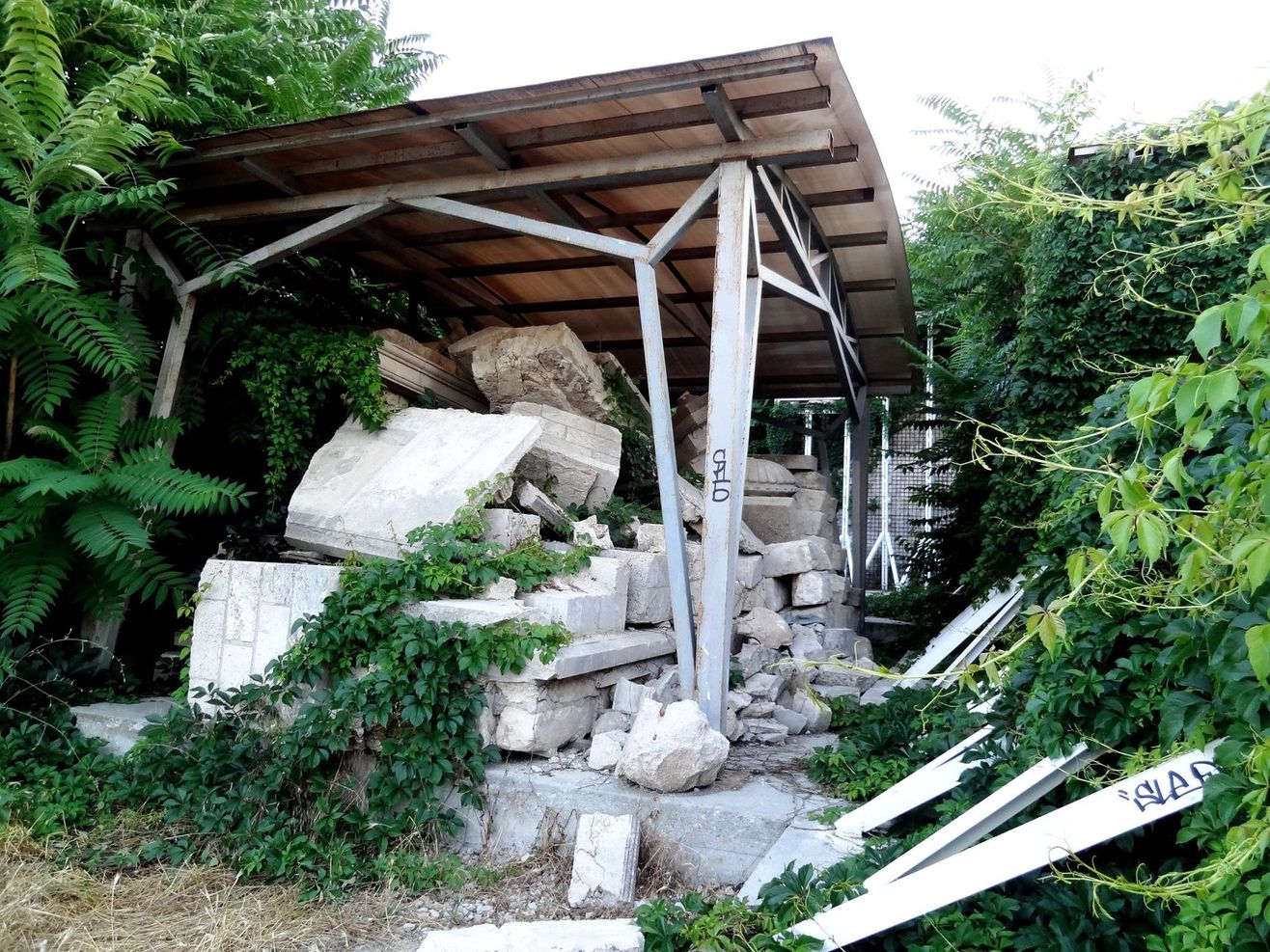
Remnants of tiles lie nearby
"Meander" did not work on the "restoration" for long. Already in September of the same 2018, the complete failure of the stairs repair became known. The "head" of Crimea Sergey Aksyonov reported that the State Committee for the Protection of Cultural Heritage failed to properly control the work.
The point is that for almost a year since receiving the tender, "Meander", in addition to dismantling the griffins and bowls, beating off the tiles, and partial concreting, began to "strengthen" the slope of Mount Mithridat.
The "vice prime minister" of Crimea Vitaly Nakhlupin noted: "The situation turned out to be much more complex and worse than we assumed in our most unfavorable forecasts. We will probably have inefficient use of over 167 million rubles. Because the works carried out within the framework of emergency repair had no effect on the stairs."
Moreover, the works were carried out outside the cadastral zone of the stairs, and the expertise of the estimated cost of the object took place without the approval of the customer (the customer of design and research works is the city administration, the customer of construction works is the state enterprise "Cultural Heritage", i.e., the state commission itself). What does all this mean? "Meander" only created the appearance of work, the result of which is extremely disappointing: the stairs, which have been standing without tiles for more than a year, are crumbling even faster than before. The fantastic projects presented to the judgment of the townspeople are unlikely to be implemented.
But the biggest tragedy is the so-called "strengthening of the slope." Near the fourth tier of the stairs (a section built specifically to reach the obelisk), a fence was installed. A trailer with workers was also located nearby. This was probably the only work front where something was happening. Anchor fields began to be built on the slope. And now I will tell you how it happened. Three drilling rigs and 1,134 piles (each 30 meters long) were brought to Mithridat. Each pile (30 meters long!) ends up deep in the ground, cement is poured inside it. And so 1,134 times.
"Meander" analyzed the soil. However, for some reason, no archaeological excavations were carried out, although the acropolis was located on this very slope. Now the administration and the state committee throw up their hands, trying to blame each other and make it look as if they were unaware that state funds were being stolen. And no one mentions the barbaric actions on the slope of Mount Mithridat, where at every step there is a reminder of antiquity in the form of ceramic fragments.
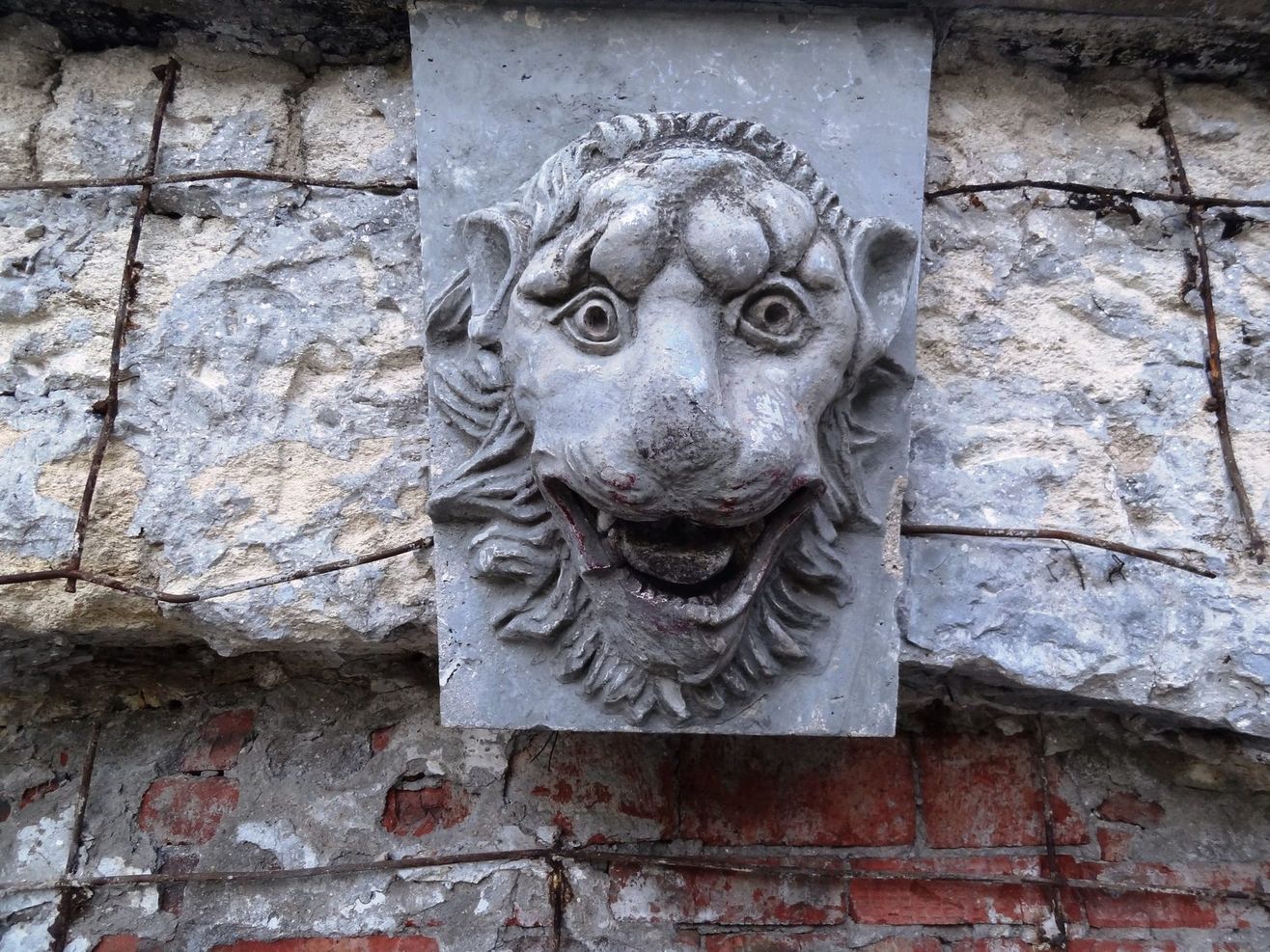
The same lion on the first tier of the stairs
Against the backdrop of the events related to the Great Mithridates Stairs, almost nothing is heard about the Small, Konstantinovsky Stairs. They are also of great importance, primarily for the residents of Kerch themselves, and in fact are in not much better condition. I would even note that in some ways the Konstantinovsky Stairs are more neglected: it is almost impossible to walk down them, because the steps resemble knocked-out teeth, with heaps of garbage and dry grass everywhere. When I was walking up, my way was blocked by a piece of hay that resembled tumbleweed.
It is depressing that the Small Stairs lack basic cleaning. Although the Konstantinovsky steps indicate that they also need repair. Immediate repair. Otherwise they will simply fall apart. Or they will be disassembled for the construction of some new vital federal object.
Instead of Conclusions
Of all the cities of Crimea, Kerch was the very first to become part of the Russian Empire – in 1774. And that is probably why it suffered losses from the new owners the fastest. The level of finds and the attitude of the city authorities and the Russian population of Kerch to them shocked travelers of that time.
For example, in 1795, the Englishwoman M. Guthrie, under the impression of visiting Kerch, wrote that the ancient monuments survived the barbaric Middle Ages and the Tatar invasion, but Christians use them to build their houses and for other needs. "How is this: items worthy of being exhibited in the best museums of the world are used completely not for their intended purpose."
Also, for a long time, chaotic excavations were carried out in Kerch and its surroundings, which can be safely called robbery, as a result of which valuable things were sold or completely destroyed due to banal ignorance of their cultural and historical value.
Therefore, the question of preserving the monuments arose sharply, so in 1820 a museum of antiquity was created. The main one was located in Odesa, with a branch in Kerch. But the creation of the museum also did little to help in the struggle to preserve ancient monuments. Very often the most valuable things simply "disappeared." This was mentioned by the famous traveler F. Dubois de Montpéreux in the 1830s. He noted that the museum lacked an experienced scientist who could bring order and make a classification of unique ancient things, which fundamentally differ from ordinary ancient Greek finds.
It was only after 1850 (!) that it was possible to somehow correct the situation, when a commission for the study of antiquity was created. That is, for more than eighty years, Kerch was literally dragged away for "souvenirs".
The annexation of the peninsula in 2014 demonstrated a certain continuity of tradition, as illegal archaeological excavations are also carried out in the city (or historical layers are simply destroyed). Of course: one cannot compare the Kerch of the end of the 18th century and the beginning of the 21st, because during all this time not only ancient monuments disappeared in the city, but also houses of the period of the Russian Empire. And now everything that recalled the centuries-old history of the city is under threat of disappearing.
With the support of the Ukrainian Cultural Foundation.