Simply, This Is Also Crimea
The marine potential of Crimea.
Maksym Dubovyaz. Newspaper "Krymska Svitlytsia", 2017, issue No. 24
Reflecting on Crimea, one of our fairly well-known politicians recently noted bitterly that for Ukraine, Crimea was supposedly nothing more than just sea and beach. Agreeing with this opinion or refuting it like any sharp maxim, of course, is not difficult. For there is a place in Crimea where indeed there seems to be nothing more than sea and beach. The sea is warm, shallow, and not very salty. This is on the one hand, this is the Sea of Azov. On the opposite side – on the contrary, very salty, is the Syvash Bay, which until recently was called the "Rotten Sea". The beach between them is reddish, made of bottom sand and crushed shells ground by storms, very, very long: 115 kilometers. And in some places its width does not even reach a kilometer. This is the Arabat Spit, the longest sandspit in the world.
Humanity has been living on Earth for quite a long time. So long that its "RAM" retains the memory of a completely different appearance of famous corners of the planet. Humanity remembers live, and not through later research, some of what has a geological scale in space and time. The lowland in the lower reaches of the Don and Kuban, the Molochna and Kalmius, the Mius and Yeya became a sea already in those times when the ships of the ancient Hellenes went on their first explorations through the inhospitable waves of the Pontus, squeezing into it between Scylla and Charybdis of the sea strait, which only yesterday was a river.
The Pontus, that is, the Black Sea, in prehistoric times was a bay of a completely different Ocean, namely the one now called the Arctic Ocean. Once the Ocean retreated, leaving behind large lakes: the Aral, the Caspian, and this closed lake-sea, an unusual basin called today the Azov.
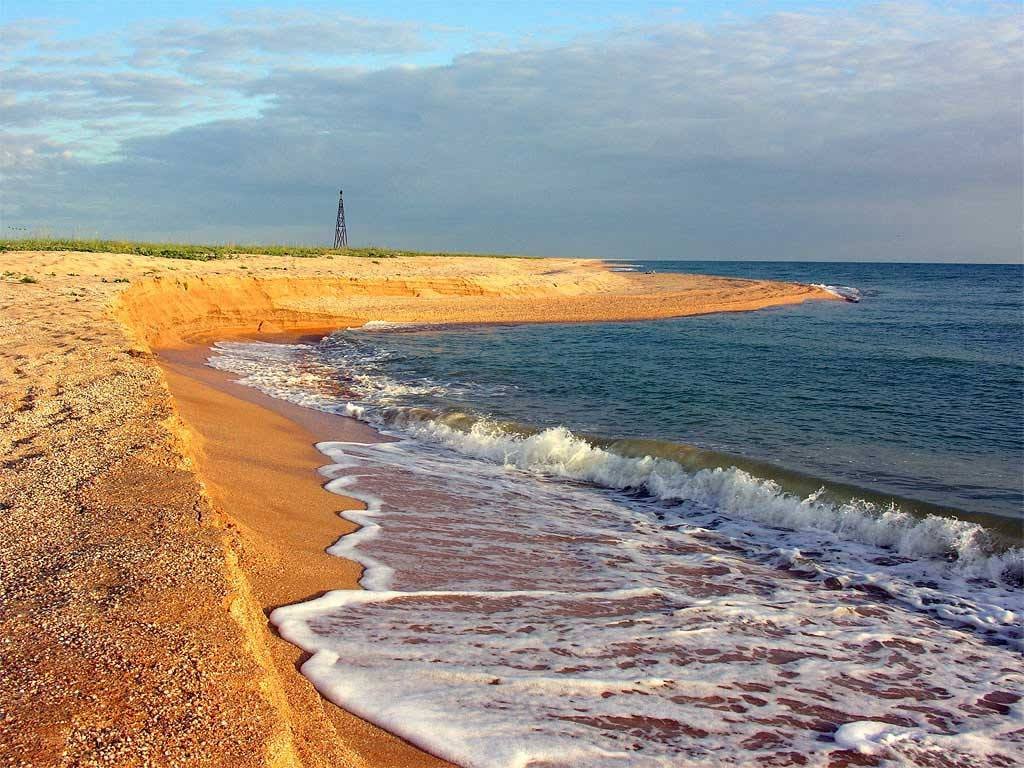
This sea is the deepest of all seas on the planet plunged into the depths of the Eurasian continent. It is also the shallowest of all seas and the most freshwater – because the Ocean is far away, and rivers carry and carry their fresh water, their river silt, their freshwater fish into it. Because of this, it was sometimes called the Fish Sea, and the Blue Sea, and the Surozh Sea, and... what didn't people call it! The ancient Romans called it the Maeotian Swamp, which indicates that two thousand years ago it was even much shallower.
And today its average depth is 7-8 meters, and the fairways for the passage of modern ships have to be deepened artificially. Because it is freshwater, it easily freezes in winter. The ice that moves out of it in spring through the Kerch Strait once even swept away the Kerch Bridge...
The Arabat Spit is even younger. It is not yet on medieval sea charts, appearing for the first time on Beauplan's map of 1652. However, the spit, of course, did not arise suddenly; coastal currents and surf waves of the Azov naturally form long bar-shafts that can reach from the bottom to the sea surface, from time to time creating spit-islands. For example, such a powerful bar can be traced from the mouth of the Salhyr to the confluence of the Yeya River on the opposite shore, but it remained underwater. And the one that became Arabat began to form less than a thousand years ago, and over the next half-millennium it finally formed a stable land, rising forever straight from the foam of the sea...
This path is not a commercial one, because it was gladly used by military units of various strengths and flags. Both the Zaporozhians and the empire's troops marched along it, so the Turks had to build a fortress here. The word "Arabat", most likely, in this context should be translated in its Arabic meaning – "military camp". Thus, this fortification was neither a city citadel nor a knight's castle; there is not much romance in the ruins of an ordinary, almost modern fort, so it is not even an excursion object. Although historians can tell a few interesting combat episodes...
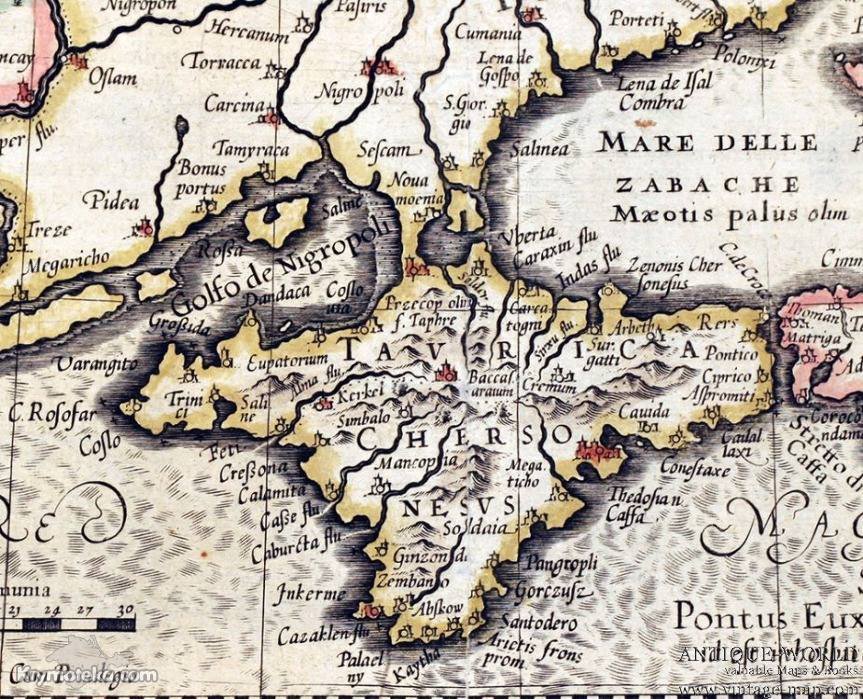
Map by Mercator, 1613
What does a person seek on vacation? Perhaps to escape from the daily routine of functioning in society to where you are one-on-one with your "self". Or, on the contrary, to escape even from this, to dissolve as a molecule in the noisy and thoughtless cocktail of crowds in large resort cities, where standard entertainment is diluted with the exoticism of southern vegetation, variety of relief and architecture, and somewhere out there, it seems, there is a sea and, they say, a beach too.
On Arabat there is also a bit of this: the resort infrastructure of the outskirts of Henichesk, and hot lakes of mineral waters, and winds under which it is so cool to sail on a board. The main thing is that there is just the sea. Just the beach. Simply, this is also Crimea.