Cities on the Seabed
Countless secrets of the seabed.
Maksym Dubovyaz. Newspaper "Krymska Svitlytsia", 2018, issue No. 12
Quite close to ours, there exists a parallel – and completely different – world! Of course, it is the sea. Under its blue, countless secrets are hidden, and only some of them are already known and researched. The rich history of Crimea's development left numerous artifacts on the dry land near the Crimean shores. The walls of ancient fortresses rise on the capes, the remains of ancient monasteries hide in mysterious tracts, not all the silted ancient cellars in the outskirts of old towns have been discovered... From the seabed, which is not rich in precious treasures, people retrieve now an amphora, now the bottom of a glazed jug... But there are findings on the bottom that cannot even be raised – it's not easy, and after all, it is not necessary.
These are the walls and vaults of ancient human settlements, and not enough is known about all of them to understand what they were, when and how they ended up underwater. There are two or three such places in Crimea, maybe even more, but at least two cities have been found and have become known.
The most researched and, perhaps, the least romantic – if one can deny the romantic component to the ruins of battle towers at all – is Akra. Founded in the 6th century BC, thanks to its location in a Cimmerian place of fundamental importance for navigation through the Bosporus, this tiny town, with an area ranging by various estimates from 2-4 to no more than 6 hectares, was very well known. Strabo indicated in his "Geography" that this is precisely where the Bosporus borders the Pontus proper, and subsequent textbooks repeated information about Akra until the final disappearance of this settlement somewhere in the 4th century.
Nowadays, this is a deserted coast near Cape Takil, where at a depth of about 4 meters below sea level the direction of the defensive wall can be traced. There, on the bottom, remains of about 30 meters in length have been found: laid, roughly hewn limestone blocks and the foundation of a large battle tower on a wooden foundation. On the shore, the remains of a slightly smaller battle tower were found, and the further from the sea, the later the centuries of findings. Thus, the 4th century BC is still underwater, the monuments of the 3rd-2nd centuries are completely scattered by the surf, and on the shore are the remains of what the Panticapaeans built here already after the birth of Christ.
Over the last century, archaeologists have joined this romance several times. More or less regular research was carried out at the end of the 20th years of the last century, then in its middle, and in its last 20 years, due to persistent search work in the vicinity of Akra, many coins from the entire period of their minting by the Bosporan Kingdom were found. However, despite the undeniable circumstantial data, not all scientists still consider it proven that this is precisely Akra, and not the neighboring Nymphaeum or Kitey.
However, clarifying the name will in no way affect the romance of the ancient city structures hidden in the sea; these underwater ruins – and there are not only battle walls, but also the remains of urban buildings and an ancient well! – have long been called the "Crimean Atlantis", and it is even proposed to organize underwater excursions to them – because there are not so many romantic objects on the Kerch Peninsula.
Something similar, but not so large-scale, is found by researchers in the waters of the medieval trading port of Genoese Soldaia – modern Sudak...
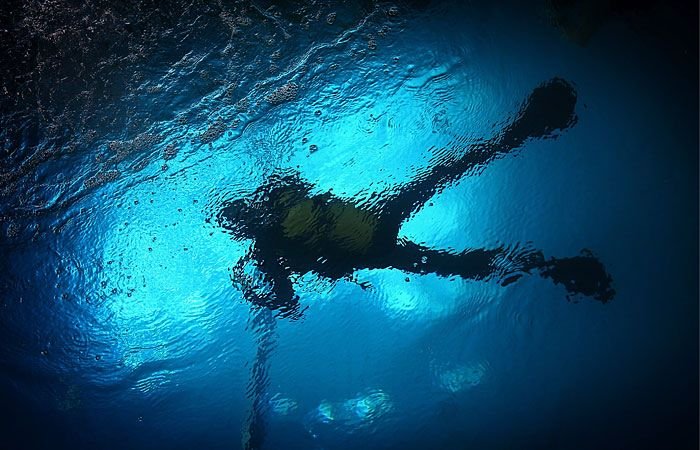
It is assumed that even before the breakthrough of the waters of the Mediterranean Sea through the Marmara and the Bosporus, a freshwater lake of a smaller area lay in the basin of the future Black Sea. The flow through the channels of the former rivers, which became straits between the seas, did not immediately fill that bowl, forming the modern contour of the shores. Perhaps what was found 2 miles from the Evpatoria shores at a depth of more than 10 meters are the remains of a pre-diluvian civilization. Science requires proof, and are the cave complexes found five years ago by divers not a natural formation by chance? Scientists by definition must be skeptics, but circles of stones resembling the remains of hearths, archways, small shelves for lamps, stone nests for securing ropes – everything strongly resembles what was found in the interiors of cave cities on the dry land of Crimea!
The legend of Atlantis may turn out to be not a legend at all.