Crimean Tatar Music of the Khanate Period
Multicenury heritage of Crimea – Crimean Tatar music
Dzemil Karikov. Newspaper "Krymska Svitlytsia", 2016, issue No. 51
Until recently, the music of medieval Crimea was practically unknown in Ukraine. However, Crimean Tatars possess classical music that has a centuries-old history of development. For a long time, this music was absent from the cultural life of both Crimean Tatars and Crimea as a whole.
In many ways, this was the result of the well-known tragic events of the late 18th century associated with the fall of the Crimean Khanate and the catastrophic changes in the life of the peninsula and its indigenous people that arose as a result. Under the conditions of a deep demographic and cultural crisis caused by several waves of emigration, which not only undermined any cultural movement among Crimean Tatars but also threatened the very existence of the people in their historical homeland, the conditions for the development of this music disappeared.
This heritage was forgotten, and for a long time – practically over 200 years – the corresponding traditions had no opportunity to develop. This created a huge vacuum in the corresponding field and contributed to the formation of an incorrect understanding of continuity in the development of Crimean Tatar traditional musical culture.
At present, we can state with confidence that Crimean Tatar musical classics, both performing and composing, do not begin in the 20th century, that it has a longer history of development, going back at least to the era of the Crimean Khanate, of which today, to our great regret, we have a very vague idea. Separate fragments of this heritage, its shards, continued and continue to live in our musical culture, but already in the form of folklore, and this seems somewhat unnatural (and unjust), requiring its logical explanation, and if necessary – a change of approach to the evaluation of such musical phenomena.
One of the brightest representatives of the cultural history of Crimea is the outstanding ruler, valiant warrior, personality of the widest intellectual, political, and cultural horizon (historical sources paint him as a generous patron of the arts, draw attention to his passion for the sciences, including exact sciences), – Crimean Khan Bora Gazi Geray II (1554-1607, years of reign 1588-1596, 1596-1607). Until recently, we knew Gazi Geray II more as a brilliant poet, but it is interesting that practically all known researchers of his versatile artistic talent rate the musical-performing and composing talent of this figure much higher than the literary and others, definitely calling him the first (!) in the row of the most famous Turkic composers of the 16th century. At the same time, he occupies a fairly honorable place among the earliest representatives of Turkic musical classics in general.
If we add to this the fact of a fairly significant number of works written by him, as well as the fact that a whole number of modes of traditional Crimean Tatar, and more broadly – Turkic classical music (with names that say nothing to the current listener – huzzam, sheddiaraban, bayatiaraban, gulizar, muhalif-i iraq!) are the creation of Gazi Geray II, then before us stands the image of a rather significant personality, which by its scale cannot fail to attract attention. Let us add that, according to the testimony of medieval historians, he perfectly mastered practically all Turkic musical instruments of that time, valuing the tanbur most of all – a stringed plucked instrument. By the way, all preserved works (over 60) are examples of instrumental music specifically. Examples of other genres, in particular his vocal works, have not yet been discovered.
It must be said that in the treasury of Crimean Tatar classical music of the Khanate period, there are works not only by Gazi Geray II. It is known that music was written (and some samples of this music have been preserved), in particular, by several other representatives of the Khan's family. One of the nephews of Gazi Geray, the son of his brother Feth Geray – Choban Mustafa Ahmed Geray (killed in 1629), as well as the famous Hacı Selim Geray I (died 1704), who ascended the Khan's throne four times. There is no doubt that a lively musical atmosphere reigned in the Khan's Palace in Bakhchisaray, there were their own musical groups, there was their own tradition of making music and corresponding composing creativity. In a word, the palace was also the center of development of Crimean Tatar classical musical culture.
Let us add that the members of the Khan's family were not only musicians themselves, but also tried in every way to support the development of musical creativity in the state. In this connection, it is worth mentioning the name of the same Khan Hacı Selim Geray I, who in all sources is characterized as a great patron, whose protection was enjoyed not only by Crimean musicians, but also by practically all contemporary Ottoman musicians and composers, and first of all – the most famous name of Ottoman classical music Itri Mustafa Buhurizade (died 1712).
By the way, both Selim Geray and Mustafa Itri, both poets and composers, wrote music, including to the words of each other, and these works have been preserved. Until recently, the music of medieval Crimea was practically unknown in Ukraine. However, Crimean Tatars possess classical music that has a centuries-old history of development. For a long time, this music was absent from the cultural life of both Crimean Tatars and Crimea as a whole.
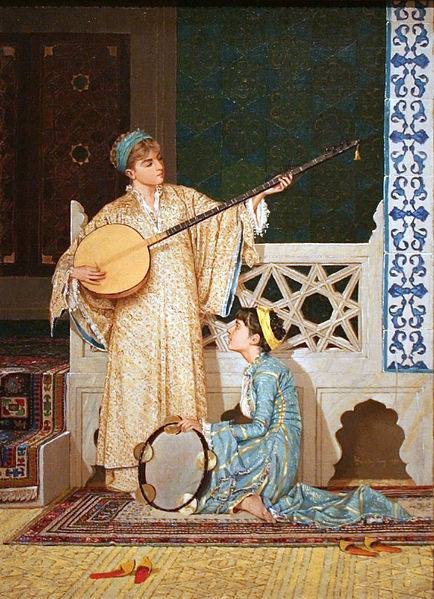
Osman Hamdi Bey. Music-making Girls. 1880. Pera Museum. Turkey.
Such an attitude towards music was characteristic in Crimea, apparently, not only of the representatives of the ruling dynasty. It can be assumed that in this matter, the representatives of educated circles, as well as the nobility, whose palaces, without doubt, had their own creative teams and corresponding performance traditions, did not want to yield to them.
In the music of the Khanate period, there was a whole range of different directions: classical (palace) music, secular in content, the centers of which were the Khan's Palace and the palaces of the Crimean aristocracy; religious music – religious-Sufi, which developed within the walls of mosques, madrasas, and Sufi lodges; and finally, Ashik music – multi-genre creativity of folk performers – poets-singers-musicians-ashiks. It is known that in the Middle Ages, Crimean Khans also used music for military purposes. "...Afrasiab trumpets then began to play, after which the Khan left a thousand archers under the command of Nureddin-Sultan to defend the castles of Or as commandant of the castle, while he himself... under the sounds of tambourines and kettledrums marched from Or into the field at the head of a forty-thousand-strong army" (Evliya Çelebi. Book of Travels. – Simferopol: Tavria, 1996. – P. 63).
"The Khans received the right of possession of two horse-tail standards (tughs), two banners and flags, as well as a band, in which seven musicians play on instruments of any kind. In their army they play, however, on trumpets in the style of Afrasiab's trumpets, which they remember since the times of their great-grandfathers, as well as on trumpets and drums such as Jamshid used to have." (Ibid., P. 106).
"...Under Qırım Giray, the Bakhchisaray Palace became an abode of the Muses and science, the Khan surrounded himself with educated people... From the dramatic genre, the Khan loved French comedy most of all, in particular Molière, and adored music so much that he could not deny it to himself even on his deathbed – a few hours before his death, feeling its approach, he ordered to start a concert composed by him in advance."
Music became an indispensable element of various kinds of theatrical performances, in particular, the puppet (shadow) theater – Karagöz.
Interest in musical art is observed even in religious (Muslim) circles, which, as is known, did not distinguish themselves by special attention to such types of art.
The Crimean Khan Hacı Selim I, like the vast majority of his contemporaries – representatives of various creative circles (musicians, composers, calligraphers, miniaturists, poets, etc.), was a member of the Mevlevi Sufi order (the order of the so-called "whirling dervishes"), originating from the personality of the genius Anatolian poet-mystic and spiritual mentor Jalal al-Din Rumi (Mevlana 1207-1273). The place of music and poetry in the ritual of this order was, as is known, extremely important.
Moreover, Mevlevi lodges were, among other things, also a kind of centers for the development of musical art, performing, in the recognition of modern Turkish musicologists, the role of modern conservatories. As for Ashik music, it will be sufficient, perhaps, to mention the name of only one of its representatives – a native of Kezlev (Gözleve, now Yevpatoria) Ashik Omer (died 1707), recognized by the bearers of the Ashik tradition itself, as well as by the absolute majority of researchers, as the first in the long row of Ashiks not only of Crimea, but also of the entire Ottoman region as a whole (and this means hundreds and hundreds of names!). One of the main genres of music of the Khanate period is Peşrev (peshraf, pishrev, from Persian "pish" – ahead, "rev" – goes); it is an integral part of the large cyclic form of traditional Turkic classical vocal-instrumental music "Fasıl" and is performed at the very beginning of the cycle.
The classical type of peşrev resembles a rondo-like form and consists of sections (episodes) – the so-called "hane", after each of which sounds the part "teslim" or "mülazime", performing the function of a refrain. In the vast majority, peşrevs consist of 4 hanes, although there are pieces that have 2, 3, 5, and even 6 hanes.
If in the first hane (exposition) the melodic pattern is maintained in a certain mode and key, then in the subsequent hanes (development), which develop or are sometimes contrasting in thematic material, certain modal and key deviations occur. The teslim (refrain), performed always without changes, returns the melody to the main key and initial mode.
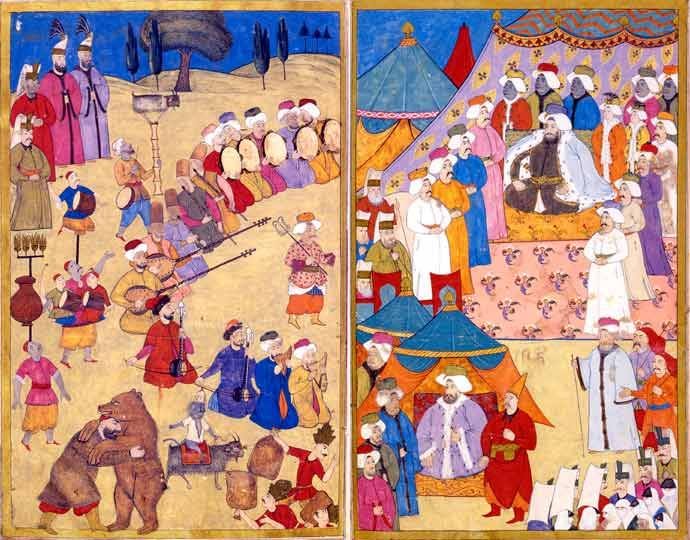
Turkish miniature. Levni. Musicians before Ottoman Sultan Ahmed III. Beginning of 18th century. Topkapi Palace Museum. Turkey
A special group is formed by the peşrevs Karabatak. The main distinguishing feature of pieces in whose name the word karabatak is used is the construction according to the formula "question – answer", where the ensemble – beraber (together) sounding in unison, contrasts with the instrumental solo batak.
The names of peşrevs are closely connected with the modes of Turkic music and often reflect geographical concepts (Isfahan, Shiraz, Iraq, Nihavend, etc.), figurative ideas (Rast – straight, correct; Gülistan – rose garden), real historical events (for example, the siege and conquest of Belgrade by Turkish and Crimean Tatar troops in 1595, etc.).
Peşrev is preceded by Taksim (from Persian "division") – an improvisational form performed in free rhythm (ad libitum) by solo instruments, which highlights the characteristics of a particular mode and is accompanied by a sustained tone. Taksims perform the function of a kind of prelude, and are also interlude connections between sections of a larger cyclic form Fasıl. In religious music, only vocal taksims are found.
Another form of classical instrumental music is Saz Semaisi. This form also consists of four hanes and a teslim.
The fundamental difference of saz semaisi from peşrev is the mandatory (with rare exceptions) accompaniment of the first three hanes and teslim by the usul aksak semai, and the fourth hane being free in metro-rhythmic and tempo respects, usually accompanied by usuls semai, yürük semai, devr-i hindi, etc. Occasionally, there are saz semaisis where the first hane performs the function of teslim. In such cases, the number of hanes is reduced to three.
Traditional classical music of the countries of the East is accompanied by certain ostinato metro-rhythmic formulas – usuls, performed on percussion instruments. Usuls are divided into two groups: simple and compound. Simple usuls include those whose metro-rhythmic basis consists of the time signatures 2/8, 2/4, 3/8, 3/4. Compound usuls are formed by the sum of several simple ones: 4/8 = 2/8+2/8, 5/4 = 2/4 + 3/4 or 3/4 + 2/4, 7/8 = 3/8 + 4/8 or 4/8 + 3/8, etc. Usuls consisting of more than 15 beats are called large, for example: 20/4 = 4/4 + 6/4 + 6/4 + 4/4. In peşrevs, usuls with constant and variable meters are used, which are combined into large cycles (24, 32, 48 and more beats) and have certain names – hafif (light), sakil (heavy), etc.
Musical instruments widely used in Crimea during the Khanate period include: wind instruments – zurna, tulum-zurna, kaval, nay (ney), kamish-kaval; stringed instruments – tanbur, oud, rebab, kemanche, saz, santur; percussion instruments – def, dare, dumbelek, davul, etc.
Unfortunately, currently all this invaluable layer of Crimean musical culture remains practically unstudied. It is impossible not to mention the host of theoretical problems associated with the perception and study of Crimean Tatar traditional classical music – starting from the characteristics of its modal system, instrumentation, form, etc. Before us is a huge world, extremely bright and original, yet completely forgotten, which demands a completely special attitude. Including very serious educational training, up to the formation of the necessary research centers, as well as the opening of corresponding departments in music-educational institutions.
The pride of Turkish literature of the 20th century, the outstanding poet and diplomat Yahya Kemal Beyatlı, in one of his famous poems praising the unique beauty and sophistication of Turkish (Ottoman) classical music, remarks: "He who has not understood our music will not understand us!". In these words is the recognition of the extraordinary role of traditional musical culture in the process of forming the essence of national character and, accordingly, the exceptional importance of understanding musical national classics both for the correct perception of the culture of a people from the outside and for a nation's self-awareness from within.
Time shows that the problems of traditional musical classics are becoming actual, this music itself is becoming actual, people want to listen to it, want to perform it, study it, and, moreover, want to try to develop the traditions embedded in it. The article uses materials from the book "Crimean Tatar Instrumental Music of the Khanate Period" / Compiling Editor Dz. Karikov. Preface by N. Abdulvaap. – Simferopol: "Dolya", 2007.
Photos from the website http://artislam.org.ua