"Doroshenko leads his army in front...": 390 Years of the Campaign against Crimea
Hetman Mykhailo Doroshenko and his campaigns to the Crimean Peninsula.
Serhiy Konashevych. Newspaper "Krymska Svitlytsia", 2018, issues No. 23-24
According to the Treaty of Kurukove of 1625, the Cossacks were to make up no more than a detachment of permanent hired troops subordinate to the Polish hetmans, which was not to exceed 6,000. The Cossacks were obliged not to interfere either in internal estate and religious conflicts in Ukraine, or in the external political relations of the Polish-Lithuanian Commonwealth with its neighbors. In the text of the treaty, there were articles that forbade the Cossacks to resort to sea campaigns against Turkish possessions, to establish contacts with foreign rulers without the knowledge of the government, to hire themselves out to them for military service, and, most importantly, to violate in any way the peaceful relations of the Polish-Lithuanian Commonwealth with the Ottoman Empire.
The Polish government recognized the control it established over the election of Cossack leaders as a guarantee of compliance with these regulations. For the first time, Polish commissioners, without the participation of the Cossacks, appointed Mykhailo Doroshenko as "elder of the Zaporozhian Host". He was a representative of that trend in the Cossacks that sought to follow in Sahaidachnyi's footsteps, without breaking established relations with the Polish government, even providing it with services in difficult circumstances, in return demanding concessions necessary for the entire population of Ukraine.
Sahaidachnyi achieved government recognition of the legal existence of the Zaporozhian Host in the Kyiv Voivodeship, without limiting its number by a register, and the restoration of the Orthodox church hierarchy. A similar policy required a certain amount of patience, the ability to wait and use circumstances, significant endurance, and awareness. However, with the exception of a small group of more developed and conscious people, the rest of the mass of Cossacks and peasants who aspired to become Cossacks considered partial concessions unsatisfactory, demanded an immediate revolution and, presenting an unconditional protest to the existing situation, were ready to stand up for a decisive struggle without correlating their forces and chances of success.
Sahaidachnyi managed to suppress this direction, but shortly after his death, the protest, not restrained by his authority, manifested itself in the Zhmailo rebellion, which resulted in limiting the number of Cossacks by a register, control over the election of their leaders, and a ban on influencing the course of public life in the region. All this represented a huge step backward compared to the position the Cossacks had occupied under Sahaidachnyi.
The position of the new Hetman Doroshenko was very difficult: on the one hand, he tried, despite the restrictive decrees, to maintain good relations with the Polish government, while waiting for an opportunity to demand possible concessions from it; on the other hand, he was forced to reckon with the Cossacks' impulses to protest, which, unfortunately, did not bode well for success. The first three years of Doroshenko's hetmanate passed amidst such hesitation.
In 1626, with the entire Zaporozhian Host, he participated in the campaign of regimentary Stefan Chmielecki against the Tatars; during this campaign, the Budzhak Tatars, who had burst into the Kyiv region in a forty-thousand-strong force, suffered a decisive defeat in the vicinity of Bila Tserkva. Devotion to the king did not prevent Doroshenko from demanding concessions from the Polish government in favor of the Ukrainian people and protesting against oppression by the Poles. In 1627, when Crown Prince Władysław demanded Doroshenko's participation with the entire army in the Swedish campaign, the hetman did not obey this demand, motivating the refusal by the fact that the Cossacks had not been paid their salaries, that they were burdened with requisitions and their Orthodox faith was oppressed.
In 1628, a conflict arose on the southern borders of Zaporozhzhia that allowed Doroshenko to play an active role and satisfy popular impulses while remaining, at least partially, on legal ground. The motives for this case came from the internal affairs of the Crimean Khanate.
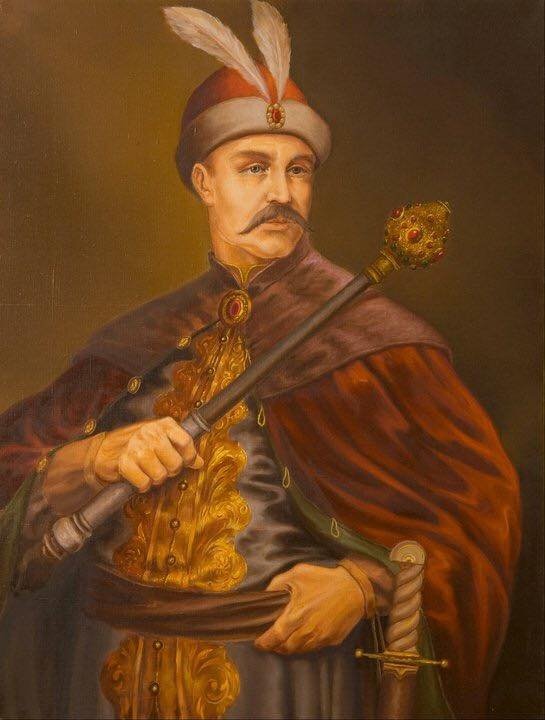
Mykhailo Doroshenko
The vassal dependence of Crimea on Turkey was extremely vaguely defined under Mengli Giray; of course, the Sultan had the right to depose and appoint khans at will, but in their choice he had to limit himself to members of the Giray dynasty; besides, he was bound by a promise not to execute members of this dynasty. Ultimately, the Sultan enjoyed the right to demand military assistance from the khan at his discretion and to occupy some fortresses within the khanate with his garrisons. However, these conditions were never precisely established and rested solely on custom, rather than a written treaty. Due to such vagueness, the most energetic khans tried to weaken their dependence on the Sultan as much as possible, disobeying his instructions regarding military campaigns, etc.
The Sultans, for their part, found a reliable means of constantly threatening the khans: taking advantage of the size of the Giray dynasty, they constantly kept several dozen of its representatives in Istanbul and, at the slightest disobedience from the khan, threatened him with deposition and replacement by one of his relatives. Moreover, the autonomous aspirations of the khans were significantly weakened due to reasons hidden in the internal affairs of the khanate itself. The Nogai hordes were in vassal dependence on the Crimean khan, and they, in turn, were burdened by this dependence.
The strongest and most energetic Nogai leaders, for their part, dreamed of freeing themselves from subordination to the khan and were ready to enter into direct vassal relations with the Porte, i.e., to become independent khans themselves. Thus, they constituted a useful tool for the Sultans inside the khanate itself in the struggle against the autonomist aspirations of the Girays.
All these motives were particularly sharp in the third decade of the 17th century: Khan Janibek Giray, suspected of striving for excessive independence, was removed in 1623 under the pretext of negligent behavior during the Persian campaign. His successor, under the protection of Vizier Huseyn Pasha, was Mehmet Giray III, who was in exile on the island of Rhodes at that time. The new khan proved to be an extremely active and independent person; relying on his brother Sahin Giray, whom he gave the rank of kalga, he did not wish to carry out the instructions of the Porte, did not supply the required military contingents, and did not build the fortresses indicated by the Sultan.
After repeated warnings, the Sultan decided to change the disobedient khan; Janibek Giray was reappointed to his place and sent to Kaffa accompanied by a Turkish fleet with a powerful military detachment. However, that time the change did not take place: Mehmet Giray inflicted a decisive defeat on the Turks and forced them to leave Crimea. For its part, the Porte, occupied at that time with other political affairs, temporarily fell silent about this resistance of its vassal, even renewed relations with him as if nothing had happened, but looked for ways to remove him and for this purpose turned its attention to the position of the Nogai hordes.
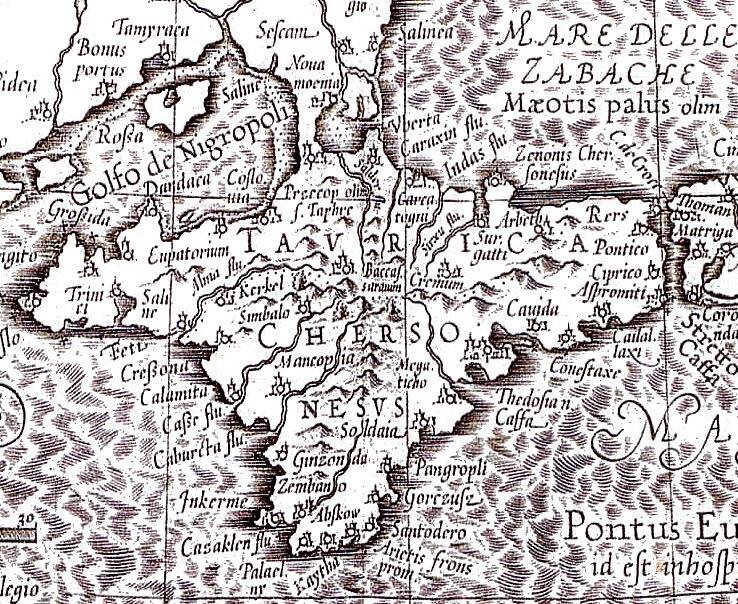
Gerard Mercator's Map of Crimea, 1630
At that time, the strongest of the Nogai mirzas was the head of the Budzhak Horde, Kantemir Mirza, who owned the southern part of Bessarabia from Akkerman to Kiliya, the so-called Budzhak. He had long been burdened by dependence on Crimea, evaded carrying out the khan's orders, resorted to raids on Ukraine without the khan's knowledge, and sought to establish an independent khanate under Turkish protectorate. It was him whom the Turkish government chose in contrast to Mehmet Giray after the conflict with the latter.
Now the government was particularly gracious to Kantemir: he was promised the Sultan's protection, then given the title of Pasha of Silistra, thanks to which he depended directly on the Sultan and was freed from subordination to the Crimean khan. Noticing the danger from Budzhak, Mehmet Giray sent Kantemir a stern order – to resettle the Budzhak Horde to Crimea in order to stop its unauthorized raids on Polish possessions.
This order, of course, was not carried out, and Kalga Sahin Giray was sent with an army to Budzhak to force Kantemir to obey; however, the latter transferred his horde to the right bank of the Danube in advance, to the possessions of the Ottoman Empire outside the territory subject to the khan. Sahin Giray engaged in battle with Kantemir, but was completely defeated and barely escaped by retreating to Crimea; Kantemir followed on his heels, appeared in Crimea, and besieged both Girays in Bakhchisaray, who had shut themselves up there with a small group of supporters.
Meanwhile, in Constantinople, all preparations had already been made in case of Kantemir's victory. Having learned of the desired outcome of the clash, the Divan declared both the khan and his kalga traitors who dared to invade one of the Turkish provinces with weapons in hand. Both of them were deposed, Janibek Giray was reappointed as khan, and his brother Devlet Giray as kalga. A powerful Turkish fleet with a numerous landing force was sent to Kaffa to place the new khan on the throne with Kantemir's help. The besieged Girays, who found themselves in such a critical situation, tried to save themselves by involving a new unexpected ally, and Sahin Giray sent Bolgar Mirza to Zaporozhzhia to ask the Cossacks for help.
At that time, Hetman Mykhailo Doroshenko himself was in Zaporozhzhia, obliged to remain constantly in the Nyz with a thousand registered Cossacks to prevent Cossack sea campaigns. The mirza's negotiations with the hetman led to the conclusion of conditions beneficial to both sides: Sahin Giray undertook to pay the Cossacks one hundred thousand gold coins and hand over to them the Islam-Kermen fortress recently rebuilt near the borders of Zaporozhzhia, if they came to the khan's aid in time. Doroshenko immediately set out for Crimea with 4,000 Cossacks (obviously, free Zaporozhians joined the registered ones).
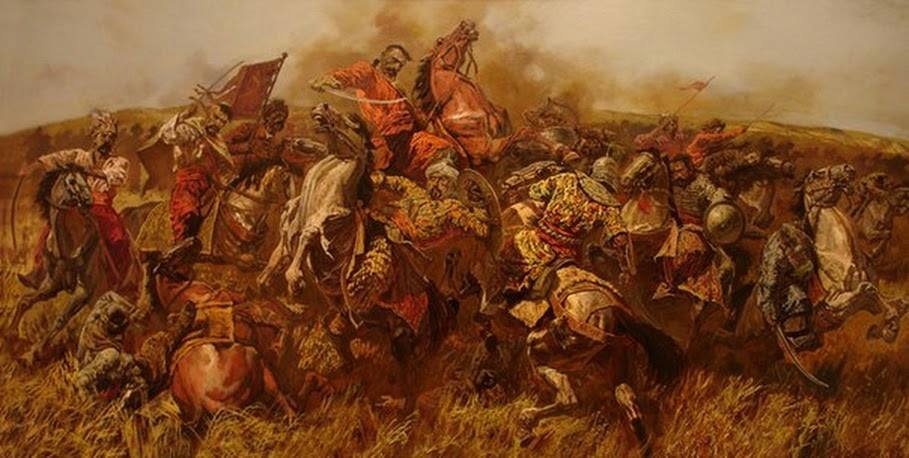
Directly beyond Perekop, the Cossacks were surrounded by Nogai hordes; they immediately formed a camp and bravely advanced to Bakhchisaray, fighting off the Tatars continuously for six days. During this crossing, Hetman Doroshenko died along with a fourth of the entire host. However, the surviving Cossacks broke through to Bakhchisaray, under the walls of which they defeated Kantemir, forced him to flee to Kaffa under the cover of the Turkish garrison, and freed their allies from the siege. At the same time, the Turkish fleet accompanying Janibek Giray arrived in Kaffa.
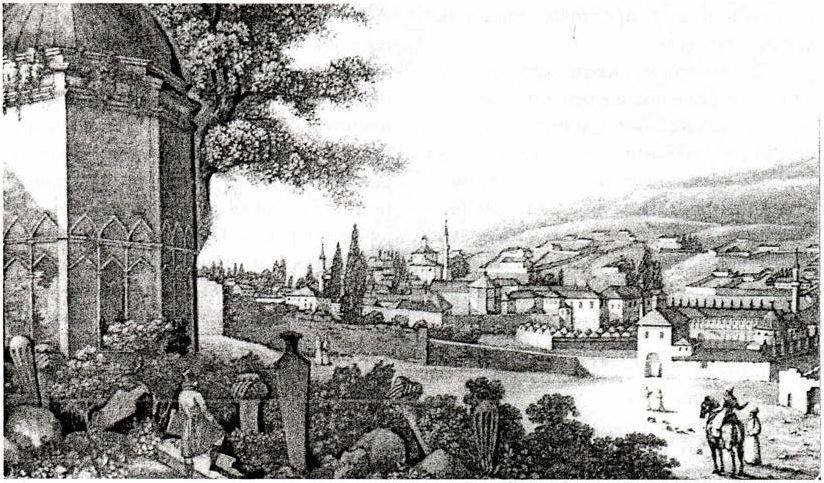
Bakhchisaray - View of the Khan's Palace. Engraving by S. Himly
Meanwhile, Sahin Giray's defeat in Dobrudja, Kantemir's invasion of Crimea, and the appearance of the Turkish fleet near Kaffa completely destroyed Mehmet Giray's authority among his subjects: the leaders of the Crimean Tatars refused to support him, sided with the new khan, and went to him in Kaffa. The abandoned Mehmet and Sahin were forced to flee Crimea, and the Cossacks returned to Zaporozhzhia, where Sahin Giray soon arrived as well.
Under the agreement, he handed over Islam-Kermen to the Cossacks, who demolished the fortifications of this town and transported the artillery that was in the fortress to Zaporozhzhia, after which they temporarily allowed Sahin Giray to nomadize on Zaporozhian lands pending the royal decision. Then both allies jointly sent an embassy to the king. Sahin Giray asked for protection and help for himself, promising, in case of success, to submit the Crimean Khanate to the protectorate of Poland. For their part, the Cossacks apologized for the campaign to Crimea, for which they had not received royal permission, and claimed that they had intervened in the Tatar strife solely for the political benefit of the Polish-Lithuanian Commonwealth, aiming to facilitate the weakening of the khanate.
The Polish government refrained from punishing the Cossacks for the unauthorized campaign and confirmed the new "elder of the Zaporozhian Host". After Doroshenko's death in Crimea, a certain Moyzhenytsia was elected head in the Cossack camp, but he was soon caught hiding part of the military funds and executed. Hryhoriy Savych, known under the name of Hrytsko Chornyi, was elected in his place. Among the Cossacks, he was the last representative of that party of peaceful politicians formed under the influence of Sahaidachnyi.
The following year after his election, the Cossacks took an active part in the campaign against the Tatars who had invaded Red Ruthenia under the leadership of Kalga Devlet Giray (September 1629). This campaign ended in a brilliant victory won by the Cossack-Polish troops under Chmielecki over the Tatars near Burshtyn. The Tatar army was dispersed and almost destroyed. At the same time, captured prisoners and looted booty were recovered. Among the Tatars who were captured was Islam Giray, who later ascended the khan's throne and significantly assisted Khmelnytskyi in his struggle during the uprising.
Presented with abridgements from the publication: K. Melnyk. Information about the campaign to Crimea of Mykhailo Doroshenko (1628) / Kievskaya Starina. – No. 11. – 1896. – P. 274-286.
Translation from Russian, adaptation – Serhiy Konashevych